Some of the shops we link to are partners who may pay us when you buy through them. This doesn't change which pieces we recommend. How this works.
Quick answer: if you want one knife that covers most home cooking without a steep learning curve, get the KAI Seki Magoroku Damascus Santoku — but check Amazon first, since it’s frequently listed there for less than the maker’s own site. Full comparison below, with six real, currently in-stock knives from $38 to $199.
Comparison at a Glance
| Knife | Price | Steel | Best For |
|---|---|---|---|
| Shimomura Verdun 165mm | $38 (JapaneseTaste) | Stainless molybdenum, all-metal | Best budget |
| Fuji Cutlery Kurenai 170mm | $72 (JapaneseTaste) | Molybdenum-vanadium, san-mai clad | Best for beginners |
| KAI Seki Magoroku Damascus 165mm | $119 (JapaneseTaste) | Stainless, Damascus-clad | Best overall |
| Sakai Takayuki TUS Steel 180mm | $89 (Hocho Knife) | TUS high-carbon stainless | Best from a specialist retailer |
| Sori Yanagi 180mm | $89 (JapaneseTaste) | Molybdenum-vanadium, tri-layer clad | Best gift |
| Takamura Hamono VG10 170mm | $199 (JapaneseTaste) | VG10 stainless, hammered finish | Best premium |
Bevel and Steel, Briefly
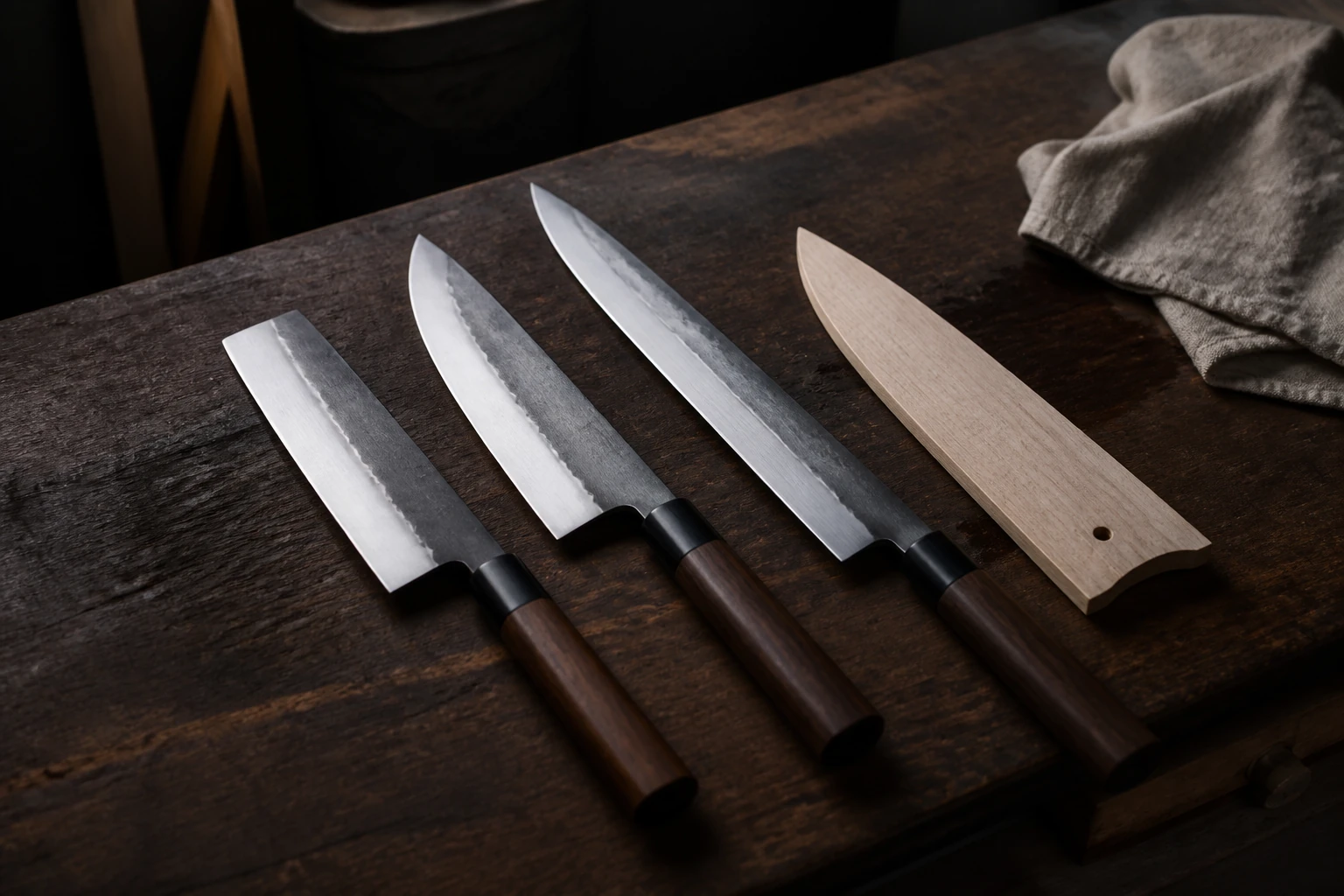
Traditional Japanese knives (yanagiba, deba, usuba) are often ground on one side only — a single bevel, which allows a more acute, precise edge but takes real skill to use and sharpen, and is handed (left or right). All six knives below are double bevel, ground on both sides like a Western knife, which is what makes them workable for home cooks without retraining how you cut. On steel: carbon steel takes a sharper edge and holds it longer, but needs drying and occasional oiling to avoid rust. All six picks here are stainless, which trades a little edge retention for not having to think about rust every time you wash it — the right call for a first Japanese knife.
1. Shimomura Verdun Santoku 165mm — Best Budget
An all-metal, one-piece design — the stainless handle is integrated with the blade rather than a separate wood or resin piece. At $38, it’s the cheapest genuinely Japanese-made knife in this lineup, not a knockoff.
Pros:
- Lowest price here for a knife actually made in Japan
- One-piece stainless construction means no handle material to crack or loosen over time
Cons:
- All-metal handles can feel colder and less grippy than a wood-handled knife when wet
- No cladding or hammered finish — this is a purely functional knife, not one you’re buying for looks
Bottom line: the one to buy if you just want a real Japanese santoku without spending much. See it at Japanese Taste.
2. Fuji Cutlery Kurenai Santoku 170mm — Best for Beginners
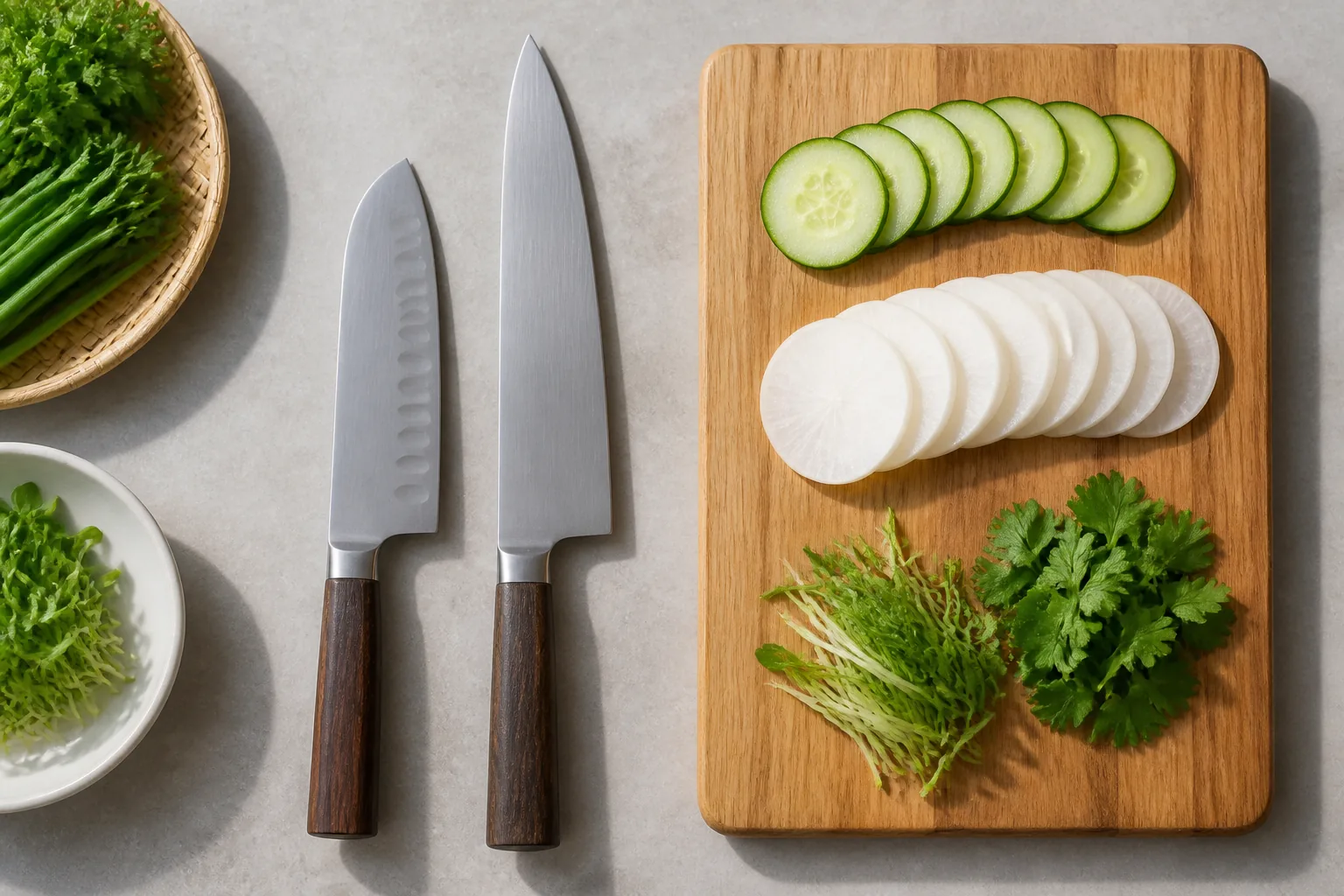
This one uses san-mai construction — a harder molybdenum-vanadium core sandwiched between softer stainless cladding — paired with a traditional wa-style wood handle rather than the all-metal handles on the budget pick. That combination (forgiving handle grip, san-mai blade) is why it’s the one we’d hand to someone who’s never used a Japanese knife before.
Pros:
- Wa-style handle is lighter and easier to control than a heavy Western handle for someone new to Japanese knives
- San-mai construction is a step up in blade quality over a single-steel budget knife
Cons:
- Wood handle needs more care than the all-metal Shimomura (avoid soaking, dry it promptly)
- Not the knife to reach for once you’re comfortable and want something premium
Bottom line: the most sensible first “real” santoku if you’re new to Japanese knives. See it at Japanese Taste.
3. KAI Seki Magoroku Damascus Santoku 165mm — Best Overall
KAI is headquartered in Seki, Gifu — one of Japan’s historic cutlery cities — and this knife’s Damascus-pattern cladding is the visual giveaway of a mid-tier Japanese knife. One honest gap: the listing doesn’t disclose the exact core steel grade, so we won’t guess at it here — what’s confirmed is a Damascus-clad stainless construction.
Pros:
- Recognizable, established maker with a long cutlery history
- Damascus cladding at a price well under many hand-forged options
Cons:
- Core steel grade isn’t disclosed on the product page
- Check Amazon before buying — see below, it’s often cheaper there
Bottom line: the best all-around pick, especially if you catch it at the lower Amazon price. See it at Japanese Taste, or check the current Amazon listing below.

Kai Seki Magoroku Damascus Santoku 6.5"
Made in Japan, often cheaper here than direct-from-maker. 4.4★ (2,069 ratings).
4. Sakai Takayuki TUS Steel Santoku 180mm — Best From a Specialist Retailer
Sakai Takayuki knives are made by Aoki Hamono Co., Ltd. in Sakai City, Osaka — one of Japan’s three historic cutlery-making regions alongside Seki and Tsubame-Sanjo. Every other knife in this roundup is bought from Amazon or Japanese Taste; this one comes from Hocho Knife, a dedicated Japanese knife specialist that isn’t a marketplace storefront. “MADE IN JAPAN” is etched directly onto the blade itself, not just stated in the listing copy.
Pros:
- Manufacturer, production city, and steel type (TUS high-carbon stainless) are all named
- Bought from a specialty knife retailer rather than a third-party Amazon listing
- Comparable price to the KAI Seki Magoroku, with a more traditional wood-composite (plywood) handle
Cons:
- Less brand recognition outside Japan than Shun, Kai, or Tojiro
- Only 3 reviews on the retailer’s site at time of writing — a thinner review base than the Amazon-sold picks here
Bottom line: the pick if you’d rather buy your first “real” santoku directly from a Japanese knife shop than take a chance on an Amazon marketplace listing.

Sakai Takayuki TUS Steel Santoku 180mm
Made by Aoki Hamono in Sakai City, Japan. 5.0★ (3 ratings).
5. Sori Yanagi Kitchen Knife 180mm — Best Gift
Sori Yanagi was a celebrated Japanese industrial designer, and this exact knife design is held in museum design collections — that pedigree is what makes it a genuinely good gift rather than just another all-purpose knife. Worth noting: the maker’s own listing calls this an “all-purpose chef’s knife” rather than specifically a “santoku,” even though the profile is what most home cooks would recognize as one.
Pros:
- Real design credentials, not just marketing — a legitimate gift-with-a-story
- All-metal one-piece construction, same low-maintenance logic as the Shimomura budget pick
Cons:
- Technically marketed as an “all-purpose chef’s knife,” not labeled santoku, so don’t expect that exact word on the box
- Also frequently cheaper on Amazon than on the maker’s own storefront (see below)
Bottom line: the one to buy as a gift for someone who’d appreciate the design story, not just the blade. See it at Japanese Taste, or check the current Amazon listing below.
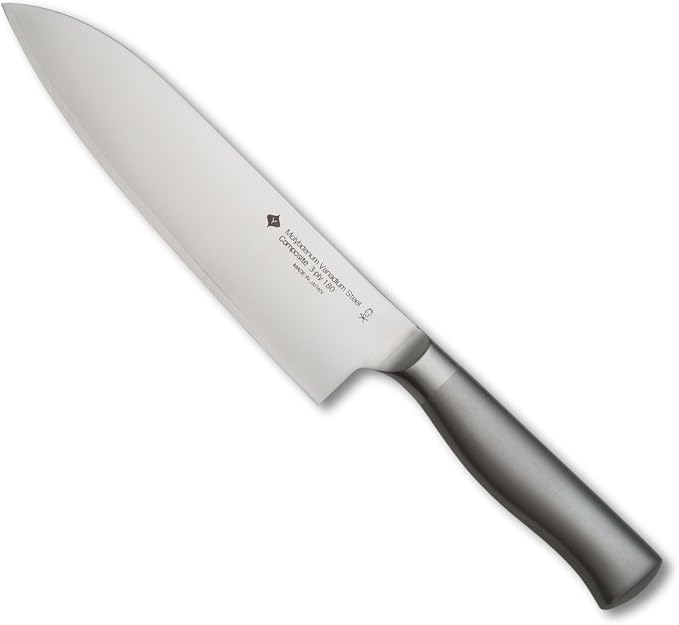
Sori Yanagi Kitchen Knife 18cm
Japan import, iconic industrial-design knife. 4.3★ (123 ratings).
6. Takamura Hamono VG10 Hammered Santoku 170mm — Best Premium
VG10 is a well-regarded stainless steel in Japanese cutlery, and the hammered (tsuchime) finish here is functional as well as decorative — the dimples help food release from the blade face. Takamura Hamono is a genuine artisan workshop, and unlike the other five knives on this list, it isn’t sold on Amazon at all under its own name, so the maker’s own listing is your only option.
Pros:
- VG10 steel with a real hammered finish, not a printed pattern
- Only 18 units in stock at the time of writing — a genuine (not manufactured) scarcity signal, worth grabbing if you’re set on this one
Cons:
- Handle material isn’t specified on the product listing
- Not available on Amazon or any third-party marketplace we could find — you’re buying directly from Japanese Taste, full price
Bottom line: the pick if you want the best steel on this list and don’t mind paying full price for it. See it at Japanese Taste.
Amazon vs. the Maker’s Own Site: Check Before You Buy
Two of the six knives above were actually cheaper on Amazon.com at the time of writing:
- KAI Seki Magoroku Damascus — $119 at Japanese Taste vs. $73.76 on Amazon (sold by a third-party seller, not Amazon itself)
- Sori Yanagi — $89 at Japanese Taste vs. $77.99 on Amazon (also a third-party seller)
Both Amazon listings are sold by third-party marketplace sellers rather than Amazon directly, so prices and stock can shift — worth a quick check before you commit either way. Takamura Hamono, by contrast, isn’t sold on Amazon at all under its own name; searches for it there only surface unrelated knives from other brands.
Which One Should You Buy?
- If you’re new to Japanese knives, get the Fuji Cutlery Kurenai for the beginner-friendly wa-handle.
- If you just want the best all-around knife for the money, get the KAI Seki Magoroku — check Amazon’s price first.
- If you’d rather buy from a dedicated Japanese knife specialist than Amazon, get the Sakai Takayuki.
- If you’re buying for someone else, get the Sori Yanagi for the design story.
- If you want the best steel and don’t mind paying for it, get the Takamura Hamono.
- If you just want a real Japanese knife as cheaply as possible, get the Shimomura Verdun.
FAQ
Do I need a single-bevel knife to get real Japanese knife quality? No. Single-bevel knives (yanagiba, deba, usuba) are a different, more specialized category built for precision cuts and require real skill to sharpen and use — see our yanagiba vs sujihiki guide if you’re curious about that category. All six knives here are double bevel, which is what most home cooks actually want.
Is stainless steel “worse” than carbon steel for a Japanese knife? Not worse, just a different tradeoff. Carbon steel holds an edge longer but needs drying and occasional oiling to avoid rust. Stainless is lower-maintenance and the better choice if you’re not going to babysit the blade.
Why is the same knife sometimes cheaper on Amazon than the retailer’s own site? Third-party marketplace sellers set their own prices independently, and they can undercut the primary retailer — as seen above with both the KAI and Sori Yanagi knives. It’s worth comparing both before buying, since it isn’t consistent across every product.
Final Thoughts
For most home cooks, the KAI Seki Magoroku Damascus Santoku is the best starting point — just compare the Japanese Taste and Amazon prices before you check out, since one of them is usually the better deal.
If you’re shopping outside the six picks above, run any listing through our buyer’s checklist for spotting Japanese-style knockoffs first — named maker, named city, and an explicit steel spec are the fastest tells. Pair whichever knife you land on with a board that won’t dull it; our hinoki cutting board guide covers two genuinely Japan-made options, and if vegetable prep is most of your knife work, see our Best Japanese Nakiri Knives guide as well.