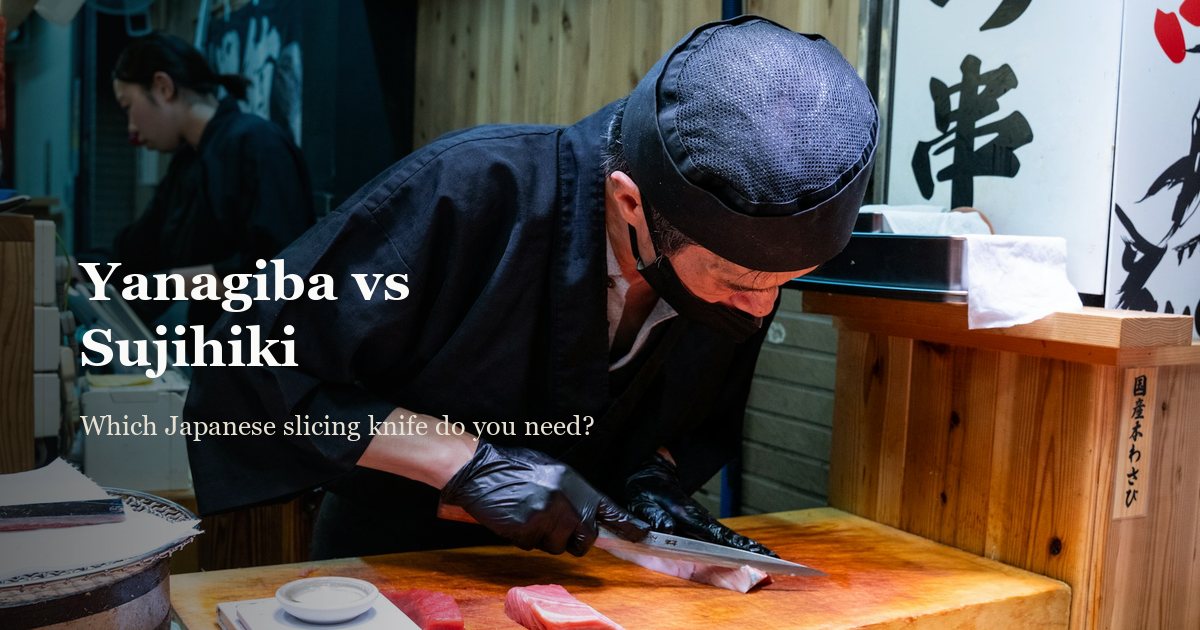
Quick answer: a yanagiba is a traditional single-bevel Japanese knife built almost exclusively for slicing raw fish into sashimi and sushi toppings in one clean pull-stroke; it requires choosing a right- or left-handed model and more sharpening skill. A sujihiki is a double-bevel descendant built as a Japanese take on the Western carving knife, designed to slice both raw fish and cooked proteins, and it’s easier to sharpen and use for either hand. Most home cooks who slice fish only occasionally should get a sujihiki; serious sashimi work is where a yanagiba earns its keep. Details below.
Some of the shops we link to are partners who may pay us when you buy through them. This doesn't change which pieces we recommend. How this works.
Two Knives, One Shared Ancestor
The yanagiba (柳刃, “willow blade”) is one of Japan’s oldest specialist kitchen knives, named for its long, slender, willow-leaf profile. According to Wikipedia’s entry on the yanagiba, the blade is single-beveled — ground on one side only, with the other side left nearly flat — which lets it take a more acute edge angle than a double-bevel knife and slice fish in a single continuous pull-stroke rather than a push-cut, avoiding the ragged edges multiple passes would leave on delicate sashimi. Because the bevel is ground for one hand, yanagiba are sold as separate right-handed and left-handed models; a right-handed blade used in the left hand steers the cut off-line instead of straight through the fish.
The sujihiki (筋引き, roughly “muscle slicer”) came later, developed as Japanese kitchens adapted to slicing beef and other meats after the Meiji era (1868–1912) opened the country to more Western food culture. It’s effectively a double-bevel evolution of the yanagiba shape crossed with a Western carving knife: same long, thin slicing blade, but ground symmetrically on both sides, which makes it usable in either hand and considerably easier to sharpen and maintain. A sujihiki isn’t a downgrade of the yanagiba — it’s a different tool built to slice a wider range of ingredients, raw fish included, without the single-bevel’s handedness requirement.
Comparison at a Glance
| Yanagiba | Sujihiki | |
|---|---|---|
| Bevel | Single (one-sided) | Double (symmetrical) |
| Primary use | Raw fish: sashimi, sushi toppings | Raw fish and cooked meat/poultry |
| Handedness | Right- and left-handed models sold separately | Works in either hand |
| Cutting motion | Single pull-stroke toward the user | Push or pull slicing motion |
| Sharpening | Harder — single-bevel technique, often a whetstone specialist | Easier — same double-bevel technique as most Western knives |
| Typical origin | Traditional Japanese knife, Edo-period roots | Newer, Meiji-era adaptation of Western carving knives |
| Best for | Professional or serious home sashimi prep | General slicing, most home cooks |
Why the Bevel Is the Whole Story
Everything else about these two knives follows from one design choice: how many sides of the edge are ground. A single bevel lets the flat back of the blade glide against the fish with almost no drag, which is exactly what keeps a slice of tuna from tearing at the cut face — restaurants serving sashimi care about that cut face because it’s the entire visual and textural presentation of the dish. But a single bevel also means the blade naturally wants to curve into the food in one direction, which is why handedness isn’t a minor spec on a yanagiba the way it might be on a Western knife — a right-handed yanagiba in a left hand won’t just feel awkward, it will actively cut crooked.
A sujihiki trades that razor-clean single-bevel glide for symmetry. Both sides of the edge are ground the same way, so the blade tracks straight in either hand and behaves much more like the double-bevel knives most cooks already know how to sharpen — the same skill this site covers in its santoku and nakiri guides. That’s a real capability tradeoff, not just a beginner-friendly compromise: a sujihiki genuinely handles a wider range of ingredients (roasts, poultry, ham) that a yanagiba’s fish-only geometry isn’t built for.
Which One Should You Buy?
- Get a yanagiba if you regularly prepare sashimi or sushi at a serious level and are willing to learn single-bevel sharpening, or to have it professionally sharpened. Confirm right- or left-handed before you buy — it isn’t reversible.
- Get a sujihiki if you want one long slicing knife that handles raw fish occasionally and cooked meat and poultry the rest of the time, and you’d rather sharpen it the same way you already sharpen a santoku or gyuto.
- Most home cooks should start with a sujihiki. It’s the more flexible tool, and the double-bevel edge means it fits into the same sharpening routine as the rest of a Japanese knife set instead of requiring a separate skill.
Both shapes are made by Sakai Takayuki (Aoki Hamono, Sakai City), and both of these list Made in Japan and a named steel on the retailer’s spec sheet:
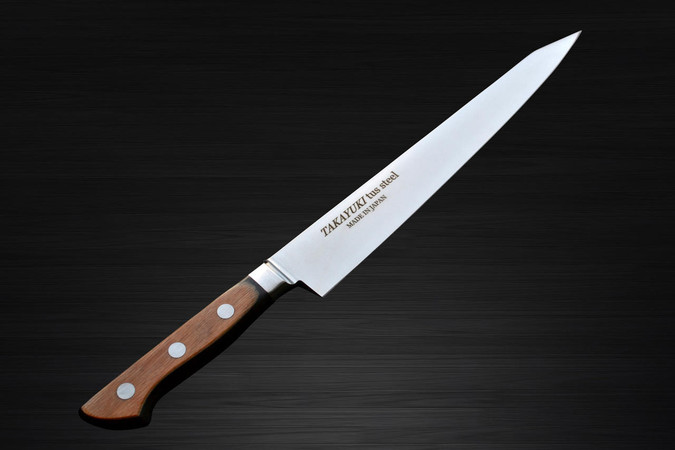
Sakai Takayuki TUS Steel Sujihiki 240mm
TUS high-carbon stainless, double bevel for either hand, 140g. Made in Japan.
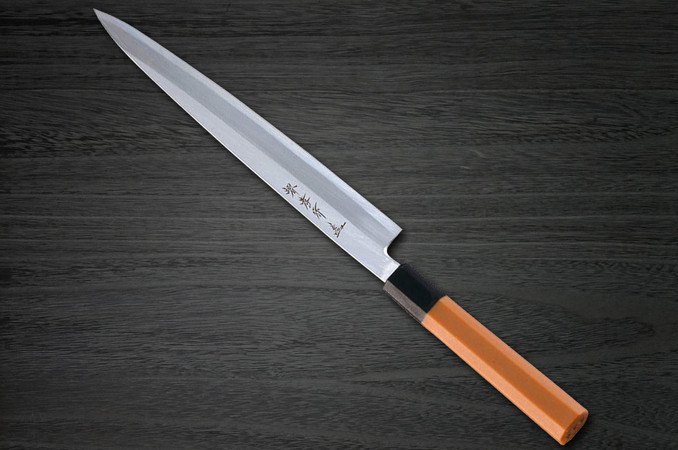
Sakai Takayuki Molybdenum Stainless PH Yanagiba 240mm
Single bevel, rust-resistant molybdenum stainless, Nylon 66 handle. Made in Japan. Confirm handedness on the listing before ordering.
FAQ
Can a sujihiki replace a yanagiba for sashimi? For occasional home use, yes — a sharp sujihiki produces clean slices most people can’t tell apart from a yanagiba’s cut. For professional-level sashimi presentation, the yanagiba’s single-bevel glide still produces a cleaner cut face, which is why sushi chefs keep using it.
Do I need to know if I’m buying a left-handed or right-handed yanagiba? Yes, and this is the single most common mistake buyers make. Because the bevel is ground on one side only, a right-handed yanagiba used in the left hand will steer the blade off a straight line instead of tracking through the fish cleanly. Left-handed models exist but are less common and often cost more.
Is a sujihiki the same thing as a Western carving knife? Related but not identical. A sujihiki is generally longer and thinner than most Western carving knives, with a thinner edge geometry closer to other Japanese slicing knives, even though both are double-bevel and both slice cooked meat.
Which one is harder to sharpen? The yanagiba, by a wide margin. Its single bevel requires a different whetstone technique than double-bevel knives, and getting it wrong can ruin the acute edge angle that makes the knife worth owning in the first place. A sujihiki sharpens the same way as most other Japanese kitchen knives.
Final Thoughts
A yanagiba and a sujihiki solve overlapping problems from two different design philosophies — one a centuries-old fish specialist, the other a more recent, more flexible adaptation — and neither is simply an upgrade over the other. For most home kitchens, a sujihiki’s versatility and easier sharpening routine make it the more practical first purchase; a yanagiba earns its place once sashimi prep becomes a regular, serious part of how you cook.
For the rest of a Japan-made knife set, see this site’s Best Japanese Santoku Knives roundup, the Best Japanese Nakiri Knives guide for vegetable prep, the Deba Knife vs Fillet Knife comparison for breaking down whole fish before slicing, or the fake-knife-brands research for the specific brands to watch for across every knife shape covered here.