Some of the shops we link to are partners who may pay us when you buy through them. This doesn't change which pieces we recommend. How this works.
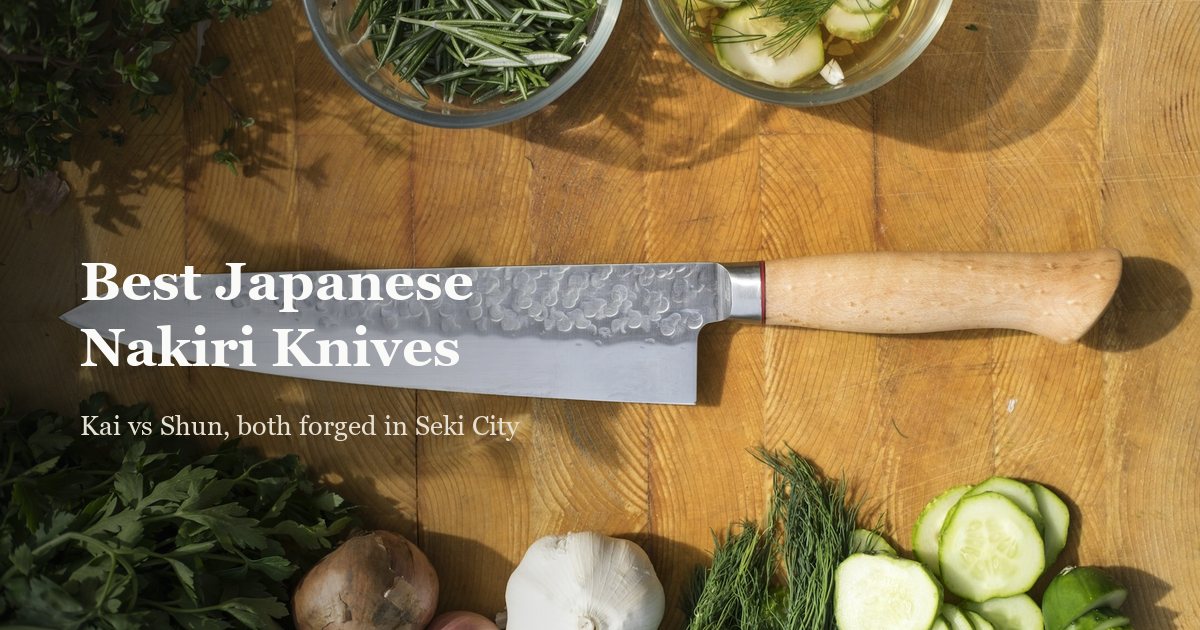
For an everyday vegetable knife on a budget, get the Kai Seki Magoroku Watakake Nakiri 165mm — forged in Seki City, Japan, with the country of origin stated directly in the product description. For a mid-range pick bought directly from a Japanese knife specialist rather than Amazon, the Sakai Takayuki INOX Nakiri 180mm is made in Sakai City by Aoki Hamono Co., Ltd. For a premium pick, the Shun Classic Blonde 6.5" Nakiri is handcrafted in Japan by the same parent company, Kai Corporation. All three are genuinely Japan-made; some of the brands sold right next to them under "Japanese nakiri" search results are not.
The Same Gap, One Knife Shape Later
This site has already documented the country-of-origin gap in santoku knives, kitchen shears, and whetstones: search Amazon for “Japanese nakiri knife” and the results do include Japan-made blades from named manufacturers, mixed in with listings that lean on the word “Japanese” while never stating where the finished knife was actually forged. Nakiri knives turn up the same pattern, including at least two brands already named in this site’s fake-knife-brands research now selling nakiri models alongside their santoku and chef’s knives.
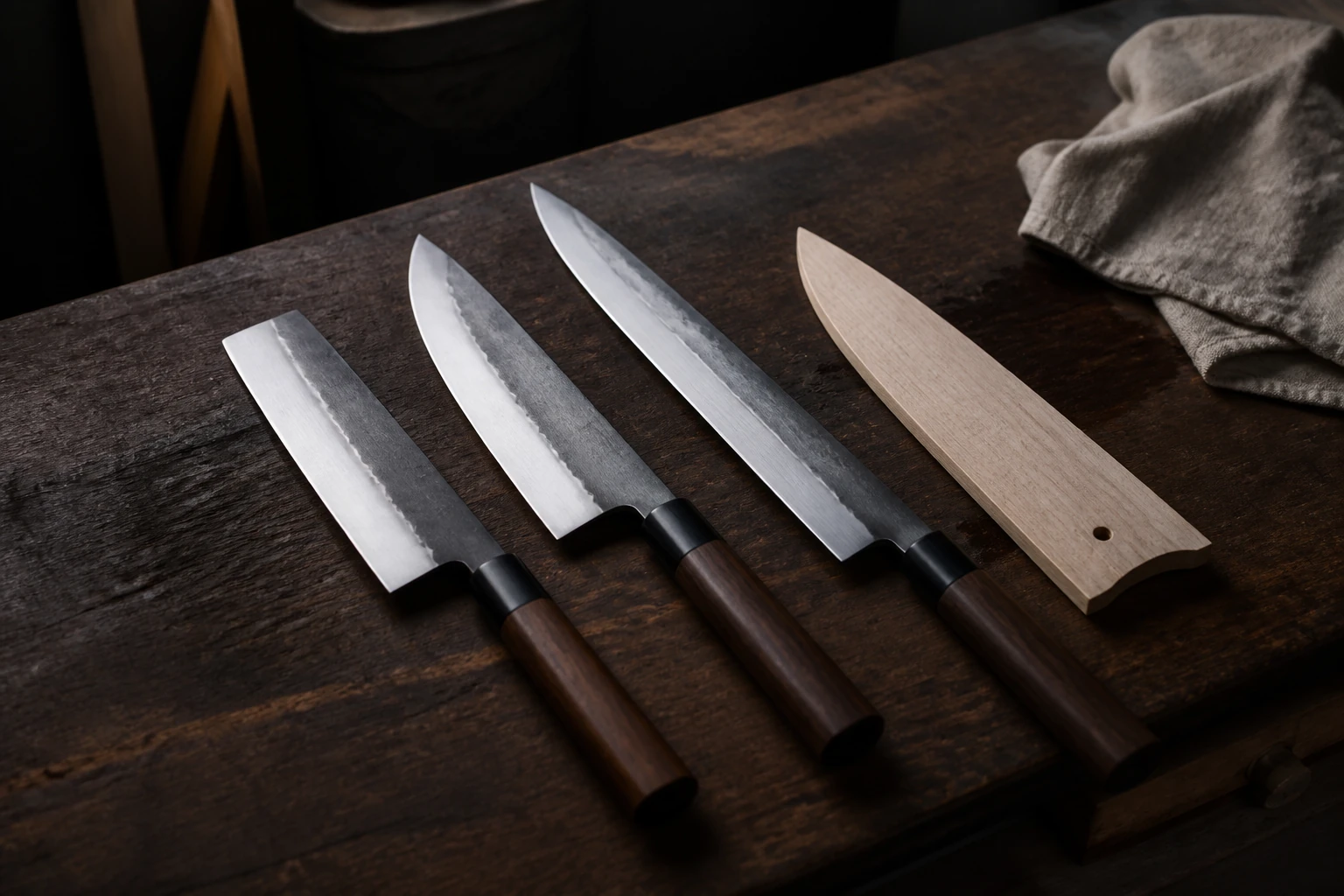
A nakiri (菜切り, “leaf cutter”) is a rectangular, double-beveled vegetable knife with a straight edge and a blunt tip built for a flat push-cut through onions, cabbage, and other produce, unlike the curved, pointed santoku most Western kitchens already own. It’s a useful knife to add to a santoku or gyuto, not a replacement for one.
Comparison at a Glance
Checked against current Amazon.com listings on September 4, 2026. Prices vary by retailer and change often.
Why “Damascus” Isn’t a Made-in-Japan Guarantee
The same check that applies to kitchen shears and pruning saws applies here: does a listing name an actual manufacturer and a production city, or does it lean on a knife-adjacent word that sounds more specific than it is? Damascus, in the case of nakiri and other kitchen knives, describes a layered, patterned surface finish, not a steel grade or a country of manufacture. A blade can carry a Damascus pattern and still not disclose what core steel is underneath it or where it was actually ground — this site’s own knowledge base has already flagged one Kai Seki Magoroku Damascus listing for exactly that gap. The pattern looks premium in a product photo either way, which is precisely why it gets used as a stand-in for information a listing doesn’t actually give you.
Both nakiri picks below avoid that gap: the Kai’s product description states “Country of origin: Japan” directly, and Shun’s own listing describes the knife as “meticulously handcrafted in Japan.”
1. Kai Seki Magoroku Watakake Nakiri 165mm (Best Budget)
Kai Corporation has manufactured cutlery in Seki City, Japan’s centuries-old blade-making district, since 1908, and the Seki Magoroku line is its everyday, non-premium tier — the same tier this site’s santoku and kitchen shears roundups have already verified as actually Japan-made rather than a Seki-adjacent marketing name. The Watakake nakiri’s product description states its country of origin as Japan directly, and buyer reviews on the Amazon listing repeatedly single this out — reviewers specifically note that it’s “actually made in Seki, Japan” rather than “Japanese-style,” which lines up with the country-of-origin gap this site tracks across every category.
At 197 ratings averaging 4.6 stars and an Amazon’s Choice badge, it has a real review base for a knife at this price. The high-carbon stainless steel blade and polypropylene handle are dishwasher-safe, which is a genuine convenience tradeoff against the hand-wash-only premium pick below.
Pros:
- Country of origin stated directly on the listing, not implied by a brand name alone
- Made by Kai Corporation in Seki City, the same maker as this site’s verified santoku and kitchen shears picks
- Dishwasher-safe handle, and a real price under $20
Cons:
- Thinner blade than the premium pick; not built for winter squash or anything dense
- Single-layer steel needs more frequent honing than the Shun’s harder VG-MAX core
- Plastic handle feels less substantial than a wa-handle or Pakkawood grip
Bottom line: the pick for a first nakiri, or for anyone who wants a genuinely Japan-made vegetable knife without spending past $20.

Kai Seki Magoroku Watakake Nakiri 165mm
Dishwasher-safe, country of origin stated directly on the listing, 4.6★ (197 ratings).
2. Sakai Takayuki INOX Nakiri 180mm (Best From a Specialist Retailer)
Sakai Takayuki knives are made by Aoki Hamono Co., Ltd. in Sakai City, Osaka — a cutlery-making region with roughly 600 years of history and one of the three named production centers this site’s knife verification checklist looks for. Unlike the two Kai/Shun picks in this roundup, this one isn’t sold on Amazon at all — it comes directly from Hocho Knife, a dedicated Japanese knife specialist, with “Made in JAPAN” stated directly in the product’s own spec sheet alongside the named INOX (AUS8A) stainless steel.
Pros:
- Manufacturer, production city, and steel type are all named on the listing
- Bought from a specialty knife retailer rather than an Amazon marketplace listing
- Sits at a genuine mid-point in price and blade size between the budget Kai and premium Shun
Cons:
- Thinner review base than the Amazon-sold picks here (2 reviews at time of writing)
- Handle material isn’t specified beyond “wood composite” on the listing
Bottom line: the pick if you’d rather buy a step-up nakiri directly from a Japanese knife shop than gamble on an unfamiliar Amazon marketplace listing.

Sakai Takayuki INOX Nakiri 180mm
Made by Aoki Hamono in Sakai City, Japan. 4.0★ (2 ratings).
3. Shun Classic Blonde 6.5” Nakiri (Best Premium)
Shun is Kai Corporation’s premium export line, also produced in Seki City, and its own product copy describes the knife as “meticulously handcrafted in Japan” rather than only naming a steel spec. The Classic Blonde nakiri pairs a VG-MAX steel core with 68 layers of Damascus cladding — in this case a documented core steel underneath the pattern, which is the distinction the section above is about — and a 16-degree edge that Shun states directly rather than leaving as a vague “razor sharp” claim.
With 1,070 ratings at 4.8 stars and an Amazon’s Choice badge, it has by far the deepest review base of any nakiri in this comparison, at a price that puts it solidly in the gift or long-term-investment category rather than an everyday-beater knife.
Pros:
- Named core steel (VG-MAX) underneath the Damascus pattern, not just the pattern alone
- Deepest, most consistent review base of any nakiri covered here
- Comes with Shun’s stated free sharpening and honing service
Cons:
- Pakkawood handle is hand-wash only, unlike the Kai’s dishwasher-safe grip
- At roughly 10x the Kai’s price, it’s a harder buy for a first nakiri
- Damascus cladding is cosmetic on top of the VG-MAX core; it doesn’t cut better on its own
Bottom line: the pick if you already know you want a nakiri long-term and are willing to pay for Shun’s build quality and review track record.
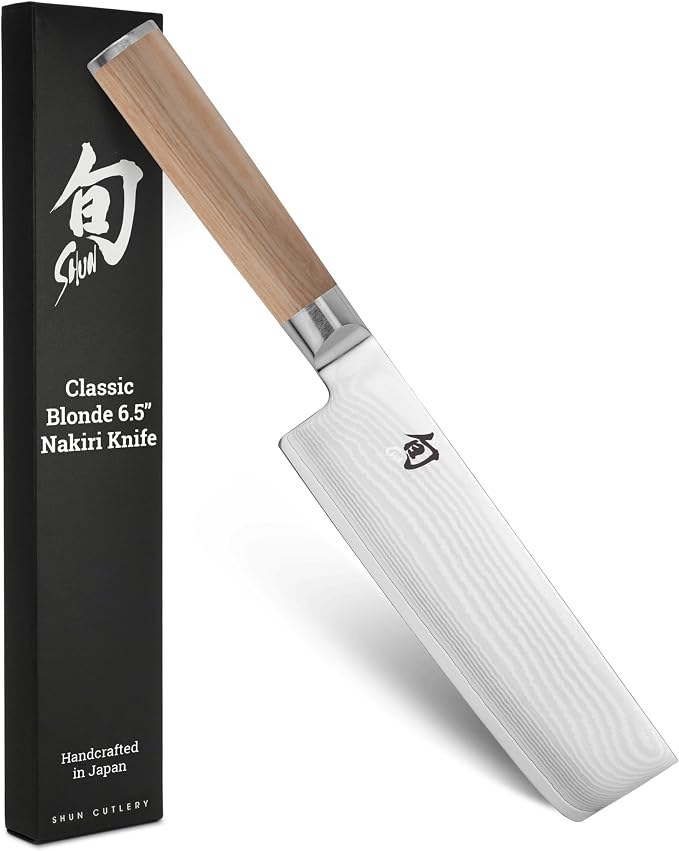
Shun Classic Blonde 6.5" Nakiri
VG-MAX core, 68-layer Damascus cladding, hand-wash only, 4.8★ (1,070 ratings).
Where “Japanese Nakiri” Listings Get Murky
This site’s fake-knife-brands research already documented both brands: Mitsumoto Sakari (base of operations reported as Shenzhen, while marketing claims a Yokohama headquarters) sells a “hand forged” nakiri alongside its santoku and chef’s knives, and HOshanHO (uses imagery of Kyoto’s Yasaka Pagoda; actual operator reported as based in Singapore) lists a “Japanese High Carbon Stainless Steel” nakiri that names no manufacturer and no production city anywhere in the listing.
Neither brand is being called counterfeit here — that’s not a claim this site makes about any brand, for the same reasons laid out in the fake-brands article. The pattern worth noticing is narrower and fully checkable: a listing that repeats “Japanese” next to a steel grade, without ever naming who made the knife or where, hasn’t told you what it implies it has.
Nakiri vs Santoku: Not the Same Knife
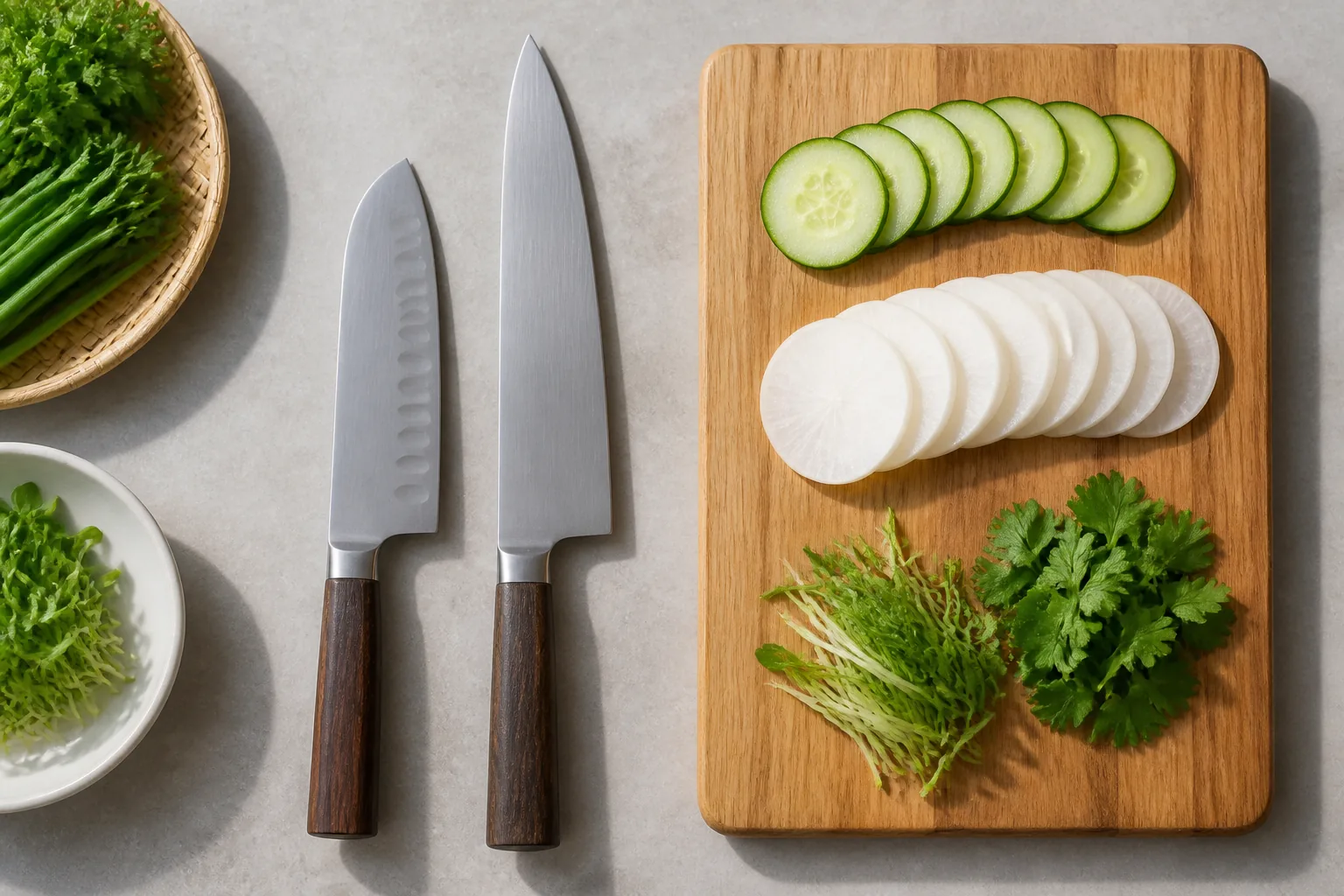
A nakiri and a santoku get confused constantly because both are compact, double-beveled Japanese kitchen knives aimed at home cooks, but they’re shaped for different jobs. A santoku has a slight curve toward a rounded tip, so it can rock through a chop the way a Western chef’s knife does, and it handles meat and fish in addition to vegetables. A nakiri’s edge is dead straight from heel to tip with a squared-off corner, built for a flat up-and-down push cut through vegetables only — it isn’t designed to rock, and using it to break down a chicken thigh will chip the thin edge. If you already own a santoku or gyuto and do a lot of vegetable prep, a nakiri earns its place as a second knife rather than duplicating what a santoku already does.
Which One Should You Buy?
- For a first nakiri, or a dishwasher-safe knife you won’t baby, get the Kai Seki Magoroku Watakake.
- For a step-up nakiri bought directly from a Japanese knife specialist rather than Amazon, get the Sakai Takayuki INOX.
- For a knife you’ll hand-sharpen and keep for decades, get the Shun Classic Blonde.
- If a listing only repeats “Japanese” next to a Damascus pattern or a steel grade without naming a manufacturer or city, treat that as a material claim, not a country-of-origin claim.
FAQ
Is a nakiri knife good for meat? Not really. The straight edge and thin blade are built for a flat push-cut through vegetables. Cutting through bone or connective tissue with a nakiri risks chipping the edge; use a santoku or gyuto for meat instead.
Does “Damascus” mean a nakiri is made in Japan? No. Damascus describes a layered surface pattern, not a country of origin or even a steel grade on its own. Some listings that show a Damascus pattern don’t name the core steel underneath it or where the knife was actually forged.
Is Kai Seki Magoroku the same company as Shun? Yes. Both are made by Kai Corporation in Seki City, Japan. Seki Magoroku is Kai’s everyday, budget-friendly line; Shun is its premium export line.
Can a nakiri go in the dishwasher? It depends on the specific knife, not the knife shape in general. The Kai Seki Magoroku Watakake’s polypropylene handle is stated as dishwasher-safe; the Shun Classic Blonde’s Pakkawood handle is not, and should be hand-washed like most higher-end Japanese knives.
Final Thoughts
All three nakiri picks here name their manufacturer and production city directly, which is a lower bar than it should be and still not one every “Japanese nakiri” listing on Amazon clears. For the underlying six-point method behind picks like these, applied across every category on this site, see the buyer’s checklist for real vs. knockoff Japanese craft.
If you’re building out a full Japanese knife set, see this site’s Best Japanese Santoku Knives roundup for an all-purpose blade, the Santoku vs Gyuto guide for choosing your first knife shape, or the fake-knife-brands research for the specific brands to watch for across every knife category on this site, nakiri included. For paper-thin, uniform vegetable slices that are hard to get consistently with any knife, see our Benriner mandoline review.