Some of the shops we link to are partners who may pay us when you buy through them. This doesn't change which pieces we recommend. How this works.
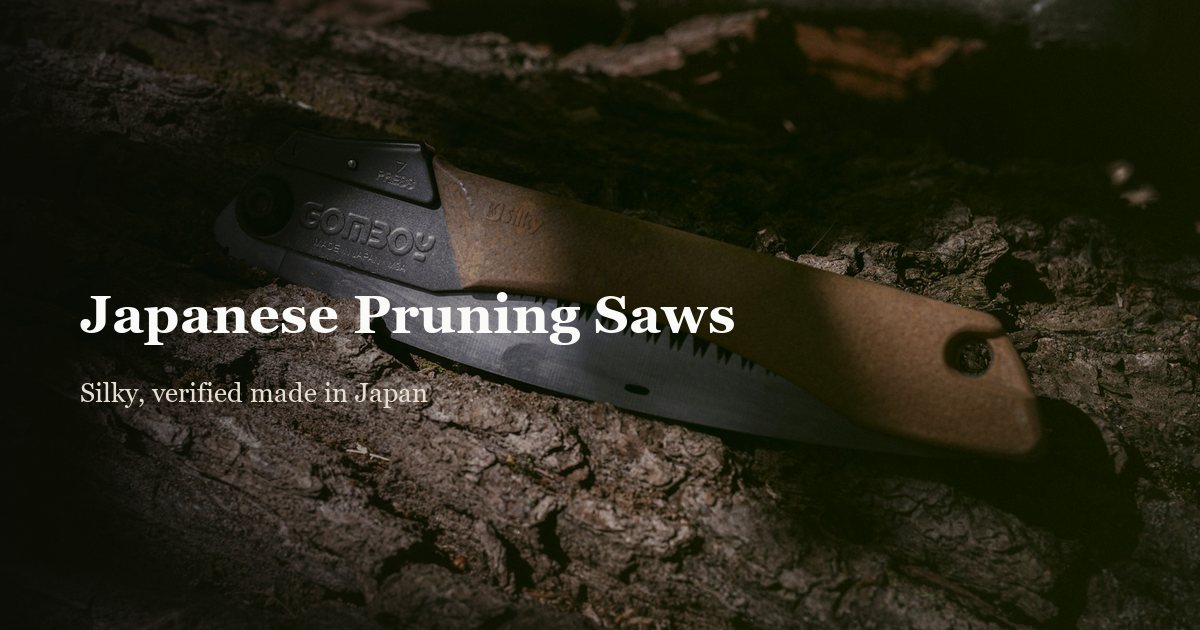
For everyday branches, get the Silky GomBoy Professional 240mm — Silky's own top seller worldwide, made by a company with a documented founding date, founder, and manufacturing city. For thicker limbs, the Silky BigBoy 360mm covers branches up to about 7 inches across. Both come from the same Japanese saw maker. A lot of the "Japanese steel" folding saws sold next to them on Amazon name the steel spec and stop there, without saying who made the saw or where.
The Garden Tools Section Keeps Turning Up the Same Gap
This is the fourth garden tool this site has covered, after pruning shears, hori-hori knives, and the Okatsune vs Felco comparison, and the same pattern has shown up in every single one. Search “Japanese pruning saw” on Amazon and the results genuinely do include Japan-made saws from a named manufacturer with a documented history. They’re also mixed in with saws that lean on the word “Japanese” in the title while never actually saying where the finished tool comes from. It’s the same country-of-origin gap this site has now documented in knives, whetstones, kitchen shears, pruning shears, and hori-hori knives, just showing up again in a new tool category.
Comparison at a Glance
Checked against current Amazon.com listings on September 3, 2026. Prices vary by retailer and change often.
Why a Steel Name Isn’t a Country of Origin
The same check that applies to kitchen shears and pruning shears applies here: does the listing name an actual company and a manufacturing location, or does it just repeat the word “Japanese” next to a steel specification? SK5 — a real steel grade defined under Japan’s JIS (Japanese Industrial Standards) system — shows up constantly on folding-saw listings, including ones with no other connection to Japan. SK5 describes a steel composition, not where a blade was forged. Any factory anywhere can buy steel milled to that spec and stamp “Japanese steel” on the box, because the phrase sounds more specific than it actually is.
Silky’s listings go further than a steel-grade name. The GomBoy Professional’s own product copy calls out “refined Japanese cutting technology” and “a premium Japanese handle” and names Silky as the manufacturer directly, with a documented company history that’s independently verifiable — not just a phrase borrowed for the title.
1. Silky GomBoy Professional 240mm Medium Teeth
Silky Saws was founded in 1919 in Kishi by Katsuji Miyawaki, and the company still manufactures in Ono, a city in Hyogo Prefecture with a long-documented tradition in cutlery steel — Silky’s own company history describes the region as producing “the finest cutlery steel known to man.” The company is still family-run; Silky’s current leadership, Uichi Miyawaki, carries the same family name as the founder. That’s a specific, checkable set of facts, the same kind this site looks for in every category, not a generic “since [year]” claim with nothing behind it.
The GomBoy Professional is, by Silky’s own description, the company’s best-selling saw worldwide, and the review numbers back that up: 4.8 stars across more than 3,300 ratings on Amazon.com, a meaningfully larger and more consistent base than most other folding saws in this category. It has precision-ground, impulse-hardened teeth and comes with a clear plastic hinged case for storage.
Pros:
- Named manufacturer (Silky Saws), named founder, named manufacturing city (Ono, Hyogo)
- By far the largest, most consistent review base of any pruning saw in this comparison
- Compact folding size works for most everyday pruning and trimming without extra bulk
Cons:
- 4.7-inch cut capacity means thicker limbs need the BigBoy or a different tool
- Chrome-plated carbon steel still needs to be wiped dry after wet use to avoid rust
- Silky sells a large lineup (GomBoy, GomBoy Curve, GomBoy-7, Outback Edition) that’s easy to confuse when comparing listings — double-check the exact model code
Bottom line: the pick for most home gardeners, and the one with the deepest independently verifiable track record.

Silky GomBoy Professional Folding Saw 240mm
Medium teeth, made in Japan. 4.8★ (3,365 ratings).
2. Silky BigBoy 360mm Large Teeth
The BigBoy is Silky’s larger folding saw, built for branches the GomBoy Professional isn’t sized for. Its 14.2-inch blade nearly doubles the GomBoy’s cut capacity, up to about 7.1 inches, and the two-handed rubberized handle is designed to stay grippy on thicker cuts and green wood that resists a smaller blade. It comes from the same Ono, Hyogo Prefecture manufacturing base as the GomBoy, with a hard chrome-plated blade that resists rust and pitch buildup.
Pros:
- Same named manufacturer and documented manufacturing city as the GomBoy Professional
- Nearly double the cut capacity of the 240mm GomBoy, useful for thicker limbs and small felling jobs
- Very strong review base for a larger-format saw: 4.9 stars across more than 600 ratings
Cons:
- Folded length (about 16 inches) is noticeably bulkier to carry than the GomBoy
- Large teeth configuration is built for speed on thick wood, not fine or delicate cuts
- Costs more than the GomBoy Professional, and pricing swings with retailer promotions
Bottom line: the pick if you’re regularly cutting branches too thick for a standard folding saw.

Silky Professional BIGBOY Folding Saw 360mm
Large teeth for thicker branches, made in Japan. 4.9★ (643 ratings).
Where “Japanese Pruning Saw” Listings Get Murky
Oregon, the brand behind the “13-inch Curved Premium Japanese High-Carbon Steel Hand Saw,” is itself an American company — Oregon Products, part of a Portland, Oregon-based tool manufacturer, which makes the “Japanese” claim in the title an odd fit before you even look closer. The listing’s own bullet copy is specific about the blade material — premium Japanese high-carbon steel, chrome-plated — but nowhere does it name where the finished saw is actually assembled. That’s not the same claim as Silky’s, which names a manufacturer and a city directly. It’s a steel-sourcing claim wearing the shape of a country-of-manufacture claim.
Other listings skip the word “Japanese” in the title but lean on the same steel spec anyway. Generic-brand folding saws advertising SK5 steel — a real JIS designation, and genuinely associated with Japanese steel standards — are common on Amazon, priced well below Silky, with no company history, no named production city, and no country-of-origin claim anywhere in the listing or a search for the brand itself. That doesn’t mean the saw is poorly made. It means, unlike Silky, there’s nothing in the listing to check if the reason you’re paying more for “Japanese” is specifically about where the tool was forged.
None of this makes a saw with an unnamed origin a bad tool. A well-set blade cuts wood regardless of which factory ground it. It means that if country of manufacture is specifically what you’re paying for, the listing needs to say so directly, the same country-of-origin check this site applies to knives, whetstones, kitchen shears, and pruning shears.
Which One Should You Buy?
- For everyday pruning and the deepest review history in this category, get the Silky GomBoy Professional 240mm.
- For thicker branches or a larger cut capacity, get the Silky BigBoy 360mm.
- If a listing only names a steel spec like SK5, or uses “Japanese” to describe the steel rather than the manufacturer, treat it as a material claim, not a country-of-origin claim.
FAQ
Is SK5 steel proof a saw is made in Japan? No. SK5 is a JIS (Japanese Industrial Standards) steel specification, not a country of manufacture. Steel milled to that spec can be forged into a blade anywhere, so a listing naming SK5 alone hasn’t told you where the finished saw was actually made.
Is Oregon a Japanese company? No. Oregon Products, the brand behind the “Premium Japanese High-Carbon Steel Hand Saw,” is an American tool manufacturer based in Portland, Oregon. The listing describes the blade steel as Japanese-sourced; it doesn’t state a manufacturing location for the finished saw.
Do Silky saws need special maintenance? Yes, in the sense that any carbon-steel blade does. Silky’s blades are chrome-plated to resist rust, but wiping the blade dry after cutting green or wet wood and avoiding long damp storage still extends the life of the plating and the edge underneath it.
What’s the real difference between the GomBoy and the BigBoy? Size and cut capacity. The GomBoy Professional’s 240mm blade handles branches up to about 4.7 inches; the BigBoy’s 360mm blade nearly doubles that to about 7.1 inches, at the cost of a bulkier folded size.
Final Thoughts
Silky names a founder, a founding year, and a manufacturing city directly in its own company history, and its listings back that up rather than just repeating “Japanese” as a marketing word. A lot of the folding saws sharing shelf space with Silky on Amazon name a steel spec and stop there. For the underlying six-point method behind picks like these, applied across every category on this site, see our buyer’s checklist for real vs. knockoff Japanese craft.
If you’re building out a full Japan-made garden kit, see our Best Japanese Pruning Shears roundup for the finer cutting side of the toolbox, or our Japanese hori-hori garden knives guide for digging and dividing. And if precision trimming on smaller plants is more your speed than branches, see our companion guide to Japanese bonsai tools.