Some of the shops we link to are partners who may pay us when you buy through them. This doesn't change which pieces we recommend. How this works.
For the most-reviewed option, get the Wazakura Satsuki Bonsai Scissors — an Amazon's Choice pick, hand-forged in Sanjo, Niigata Prefecture, with the origin stated directly in the listing. For a stainless option that skips carbon-steel maintenance, the KAKURI Satsuki Bonsai Scissors come from the same Niigata cutlery district, made from Hitachi steel. Both name a manufacturing city directly. A lot of the "Japanese bonsai scissors" sold next to them on Amazon use the word in the title and never say where the tool is actually made.
A New Category, the Same Gap as Garden Tools
Bonsai tools are a step outside this site’s usual clusters — closer to a hobby craft than tableware or a kitchen knife — but the underlying question is identical to the one we’ve asked about pruning saws, pruning shears, and hori-hori knives: does “Japanese” in the title describe where the tool was made, or just the style it’s imitating? Search “Japanese bonsai scissors” on Amazon and you’ll find genuinely Japan-made tools from named manufacturers sitting next to scissors that use the word “Japanese” as a style descriptor and never name a company, a city, or a country of manufacture anywhere in the listing.
One wrinkle specific to this category: several famous bonsai-tool brand names, including Masakuni — the company credited with making the first purpose-built bonsai shears in Japan roughly 70 years ago — and Kaneshin, a Seki-based maker founded in 1919, turned out to have their specific Amazon listings out of stock or carrying only a handful of reviews when we checked. A famous name isn’t the same thing as an actual, buyable listing, the same lesson this site has learned the hard way in other categories — so the two picks below are both currently in stock with real review histories, not just recognizable names.
Comparison at a Glance
Checked against current Amazon.com listings on September 3, 2026. Prices vary by retailer and change often.
Sanjo, Not a Marketing Word
Both picks below come from the same district: Sanjo City, in Niigata Prefecture, part of the wider Tsubame-Sanjo metalworking region this site has already verified as the manufacturing base behind Nisaku’s hori-hori knives. Wazakura’s own product listing states its scissors are “hand-forged [by] local artisans in the city of Sanjo… known since 17th century for the metalwork skills of their artisans and blacksmiths.” KAKURI Corporation, the other pick here, was founded in the same district in 1946. That two independent bonsai-tool brands both trace back to the same historically documented cutlery city — the same one behind an unrelated product category on this site — is the kind of specific, cross-checkable fact that a generic “Japanese steel” claim never gives you.
1. Wazakura Satsuki Bonsai Scissors
Wazakura’s listing states its origin plainly: “Made in Japan (Niigata prefecture)”, hand-forged by local artisans in Sanjo, from S58C black carbon steel — a specific JIS steel grade, not a generic “Japanese steel” claim. The Satsuki style is built for fine, delicate work: thinning buds, deadheading, and trimming branches up to about 1/8 inch, using a slim blade and long handle designed to reach into tight spots in the canopy without disturbing surrounding growth. It’s also the most-reviewed bonsai scissors we found in this category by a wide margin, with an Amazon’s Choice badge and 4.8 stars across 368 ratings.
Pros:
- Origin stated directly in the listing: “Made in Japan (Niigata prefecture)”
- Named steel grade (S58C) and a specific production city (Sanjo), not just “Japanese steel”
- By far the largest, most consistent review base of any bonsai scissors in this comparison
Cons:
- Black carbon steel needs the same rust-prevention routine as any high-carbon blade — dry it and oil it after use
- Sized for fine trimming, not thick branches; a separate concave cutter or knob cutter handles structural work
- Wazakura’s own history only goes back to 2019, a much shorter track record than the district it’s forged in
Bottom line: the pick for most home bonsai growers, and the one with the deepest independently verifiable track record.
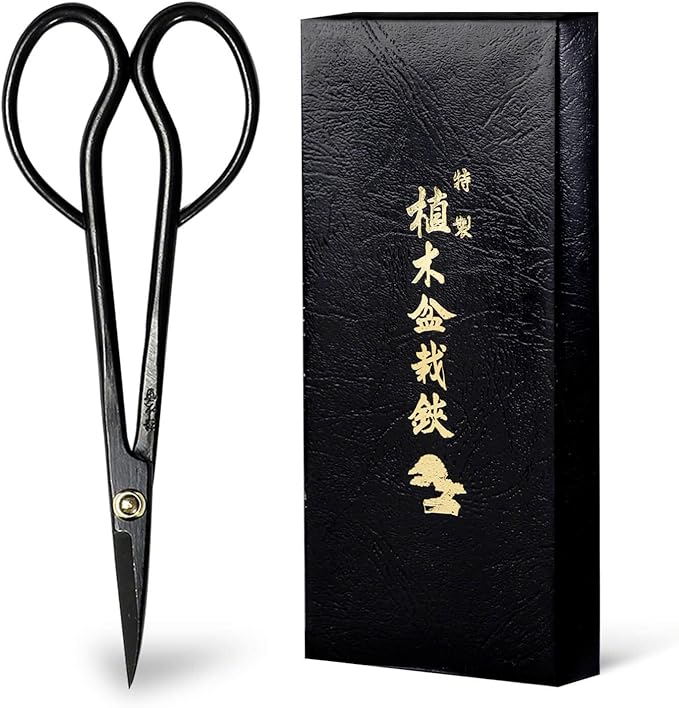
Wazakura Satsuki Bonsai Scissors, 7"
Made in Japan, Satsuki-style hasami pruning shears. 4.8★ (368 ratings).
2. KAKURI Satsuki Bonsai Scissors
KAKURI Corporation, founded in 1946 in Sanjo City, is the same manufacturer behind the hori-hori knife this site has already verified — a company with a documented founding date operating in the same Niigata cutlery district as Wazakura. This stainless version of KAKURI’s Satsuki scissors is forged from Hitachi SLD steel, a named high-carbon stainless alloy from Hitachi, a real, independently verifiable Japanese steel producer, rather than an unnamed “premium steel” claim. The listing describes the scissors as hand-forged and sharpened by Japanese artisans, and states the country of manufacture directly.
Pros:
- Origin stated directly: “Made in Japan,” from a company (KAKURI) this site has already cross-verified in a different product category
- Named steel producer (Hitachi) and alloy (SLD), a more specific claim than most competing listings make
- Stainless blade needs less rust maintenance than Wazakura’s carbon-steel pick
Cons:
- Far fewer reviews than the Wazakura pick (12 ratings vs. 368) at the time we checked
- Stainless steel generally holds an edge less long than high-carbon steel between sharpenings
- Same fine-trimming size class as the Wazakura pick — not built for structural branch cuts
Bottom line: the pick if you’d rather deal with less rust risk than squeeze out the last bit of edge retention.

KAKURI Satsuki Bonsai Scissors, 7"
Made in Japan, stainless steel blade for fine pruning. 4.5★ (12 ratings).
Where “Japanese Bonsai Scissors” Listings Get Murky
VISEMAN, a brand selling one of the best-reviewed bonsai scissors on Amazon in this category — 4.3 stars across 813 ratings — puts “Japanese” directly in the product title and lists “Japanese” again under the listing’s style field. The product description talks about “premium carbon steel blades” and nothing else: no company history, no named production city, no country-of-origin statement anywhere in the listing. It ships from a US warehouse. That’s not proof the scissors are poorly made or dishonestly sold — carbon steel is carbon steel regardless of where it’s forged — but it’s a real example of a large, popular listing where “Japanese” describes a style, not a place, and there’s nothing in the listing itself to check if the country of manufacture is what you’re actually paying for.
A wider pattern shows up if you search “Japanese bonsai tool kit” directly: several of the best-selling results — generic multi-piece sets from brands like VOUIU, with hundreds of ratings each — don’t mention Japan anywhere in the title or listing at all, despite ranking for that exact search term. They’re not pretending to be something they’re not; they simply don’t make the claim, which means a buyer specifically searching for Japan-made tools has to actively filter past a lot of results that were never claiming that in the first place.
None of this means an unlabeled or U.S.-sold pair of bonsai scissors is a bad tool for casual use. It means that if a Japan-made pair of scissors specifically is what you’re paying for, the listing needs to name a company, a city, or a country directly, the same country-of-origin check this site applies to knives, whetstones, and every garden tool covered so far.
Which One Should You Buy?
- For the deepest review history and a stated Niigata origin, get the Wazakura Satsuki Bonsai Scissors.
- For a stainless-steel alternative from a manufacturer already verified on this site, get the KAKURI Satsuki Bonsai Scissors.
- If a listing only says “Japanese” in the title or style field and never names a company, a city, or a country of manufacture in the actual description, treat it as a style claim, not a manufacturing one.
FAQ
Are Masakuni bonsai tools worth seeking out? Masakuni has a genuinely documented history as one of the original bonsai-shears makers in Japan, founded by Shichinosuke Kawasumi roughly 70 years ago in collaboration with bonsai master Kyuzo Murata of Omiya Bonsai Village. The brand’s reputation is real. Its specific Amazon.com listings were out of stock with no reviews when we checked, which is why it isn’t one of the two picks above — check current availability directly if you’re set on the brand.
What does “Satsuki” mean on a pair of bonsai scissors? It refers to the scissors’ style and use, not a place. Satsuki scissors are built for fine detail work — trimming buds, thin branches, and satsuki azaleas specifically — with a slim blade and long handle, as opposed to heavier scissors built for thicker cuts.
Is stainless or carbon steel better for bonsai scissors? Neither is strictly better. Carbon steel, like the Wazakura pick’s S58C blade, holds a sharper edge longer but needs to be dried and oiled after use to avoid rust. Stainless steel, like the KAKURI pick’s Hitachi SLD blade, resists rust with less maintenance but generally needs sharpening more often.
Why do so many bonsai tool listings avoid saying where they’re made? The same reason it happens with knives, whetstones, and other Japanese-marketed tools on this site: a vague or absent origin claim isn’t necessarily dishonest, but it also isn’t verifiable. A listing that names a real company and city gives a buyer something to check; one that only says “Japanese” in the title doesn’t.
Final Thoughts
Wazakura and KAKURI both name the same historically documented metalworking district — Sanjo, Niigata — directly in their listings, and KAKURI is a manufacturer this site has already independently verified in a different tool category. A lot of the bonsai scissors sharing shelf space with them on Amazon use “Japanese” as a style word and stop there. For the underlying six-point method behind picks like these, applied across every category on this site, see our buyer’s checklist for real vs. knockoff Japanese craft.
For the rest of a Japan-made garden kit, see our Best Japanese Pruning Saws and Best Japanese Pruning Shears roundups for the branch-cutting side of the toolbox, or our Japanese hori-hori knives guide for digging and dividing. Wazakura also makes ikebana scissors in the same Niigata district — see our Best Japanese Ikebana Scissors guide if flower arranging, not bonsai, is the actual project.