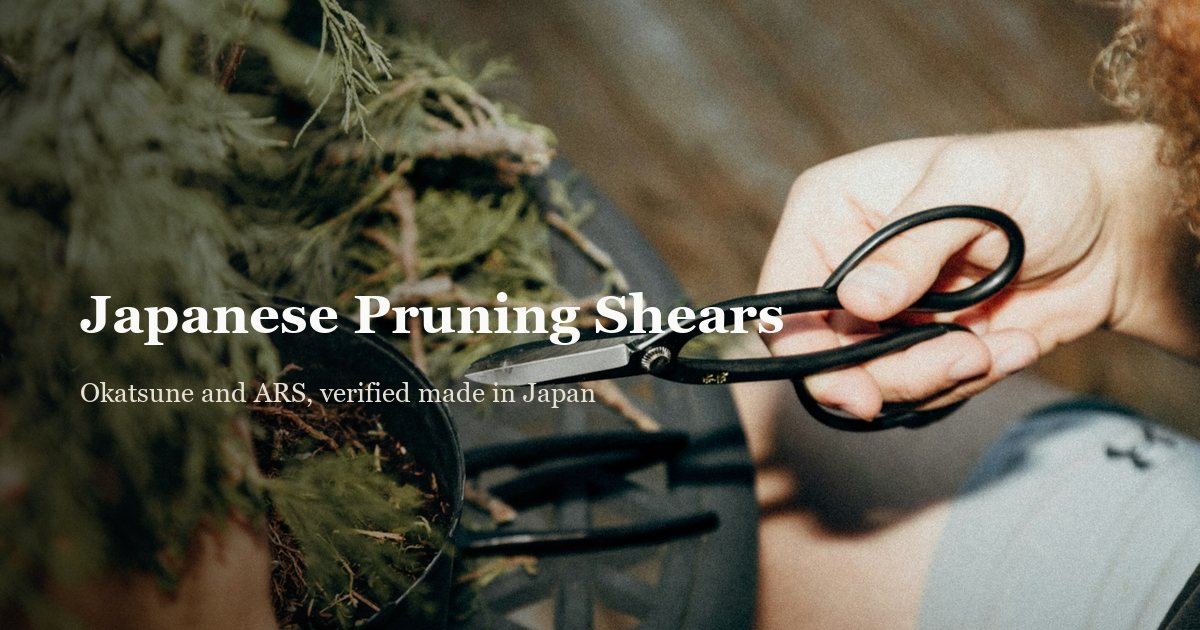
Some of the shops we link to are partners who may pay us when you buy through them. This doesn't change which pieces we recommend. How this works.
For an everyday pair, get the Okatsune 103 Bypass Pruner — Made in Japan stated directly in the listing, forged from Izumo Yasugi steel by a company with a named founder and a documented history back to the 1920s. For a heavier-duty pair, the ARS HP-VS8Z Signature Pruner comes from a Sakai company that's been forging blades since 1876. Both are genuinely Japan-made. A lot of the "Japanese steel" pruning shears sold next to them are made elsewhere and just borrow the language.
This Is a New Category for This Site, and the Same Pattern Showed Up Immediately
Everything else on this site has been kitchenware, tableware, or knives. Pruning shears are the first garden tool we’ve covered, and we went into the research expecting the “real vs. Japanese-style” pattern we’ve documented in knives, whetstones, and kitchen shears might not apply outside the kitchen. It applies. Search “Japanese pruning shears” on Amazon and the results mix genuinely Japan-made tools from named manufacturers with listings that lean hard on the word “Japanese” while never actually saying where the shears are made.
Comparison at a Glance
| Okatsune 103 | ARS HP-VS8Z | |
|---|---|---|
| Maker | Okatsune, founded by Tsuneichi Okano | ARS Corporation |
| Made in | Japan (stated in listing) | Japan (stated in listing) |
| Steel | Izumo Yasugi steel | High-carbon Japanese steel, hard-chrome plated |
| Roughly | $30 | $40-45 |
| Rating | 4.7★ (3,493 ratings) | 4.6★ (1,500+ ratings) |
| Best for | Everyday pruning, general purpose | Heavier branches, professional use |
Checked against current Amazon.com listings on September 2, 2026. Prices vary by retailer and change often.
Why Steel Names Are the Easiest Thing to Fake Here
The single most useful check for pruning shears, the same one that applies to kitchen shears, is whether a listing names an actual steel grade and a company, or just repeats the word “Japanese.” SK5 is a real steel designation, part of Japan’s JIS (Japanese Industrial Standards) numbering system, and it shows up constantly in this category. The catch: SK5 is a steel specification, not a country of manufacture. Any factory anywhere in the world can buy steel milled to the SK5 spec and forge it into a blade, and plenty of listings do exactly that while putting “Japanese” in the product title, because a steel-grade name that sounds technical reads as more credible than it actually is.
Okatsune and ARS both go a step further than a steel-grade name. Okatsune names Izumo Yasugi steel specifically, a high-carbon steel from the Izumo region of Shimane Prefecture that’s also used in katana blades, not a generic “Japanese steel” claim. ARS states its blades are hard-chrome plated high-carbon steel and names the company directly. Both fill in a country-of-origin field that says Japan, not just a steel spec that sounds like it.
1. Okatsune 103 Bypass Pruner
Okatsune was founded by Tsuneichi Okano, who began his blacksmithing apprenticeship in 1925 and later started the company that carries a version of his own name (Oka + Tsune), based in Hiroshima. The company chose red-and-white handles deliberately, a color combination that reads as good luck in Japan, and it’s still the brand’s signature look. The 103 is Okatsune’s best-selling general-purpose model, forged from Izumo Yasugi steel, the same steel tradition used for katana, and the listing states “Made in Japan” directly rather than only in the title.
This is also, by a wide margin, the best-reviewed product on this list: 4.7 stars across roughly 3,500 ratings, with over 400 bought in the past month at the time we checked, which is a meaningfully larger and more consistent review base than any of the other pruning shears we looked at in this category.
Pros:
- Made in Japan stated directly in the listing
- Named founder, named company history, named steel (Izumo Yasugi), not just “Japanese steel”
- By far the largest, most consistent review base of any product in this comparison
Cons:
- General-purpose sizing; not built for thick, heavy branches the way the ARS pick below is
- Vinyl-coated handle rather than a wrapped or forged-metal grip
- No rotating handle option at this specific model tier
Bottom line: the pick for most home gardeners, and the one with the most independently verifiable track record.

Okatsune 103 Bypass Pruners, Medium
General-purpose bypass pruners, made in Japan. 4.7★ (3,501 ratings).
2. ARS HP-VS8Z Signature Heavy Duty Pruner
ARS Corporation was founded in 1876 in Sakai, one of Japan’s three historic cutlery-forging cities alongside Seki and Tsubame-Sanjo, with a blade-forging history that predates the company itself by centuries in that city. ARS began manufacturing its tools, including pruning shears, in Japan in 1929, using a brazing method (joining the blade and handle as separate forged pieces rather than one piece of steel) that the company is credited with pioneering for garden shears, aimed at keeping the tool light without sacrificing blade strength. The HP-VS8Z is a heavier-duty pruner than the Okatsune 103, built with hard-chrome-plated high-carbon steel blades and a cast-aluminum handle.
Pros:
- Made in Japan stated directly in the listing
- Named company with a documented, independently verifiable founding date and city (1876, Sakai)
- Built for thicker branches than the Okatsune 103, with a locking latch for one-handed use
Cons:
- More expensive than the Okatsune 103
- Cast-aluminum handle is less traditional-feeling than a forged-steel or wood handle
- ARS sells a large model lineup (VS7Z, VS8Z, VS9Z, VS8XZ, and more) that’s easy to confuse when comparing listings; double-check the exact model code before buying
Bottom line: the pick if you’re cutting thicker branches regularly and want a heavier-duty tool than a general-purpose pruner.

ARS HP-VS8Z Signature Heavy Duty Pruner
For thicker branches, made in Japan. 4.6★ (1,593 ratings).
Where “Japanese Pruning Shears” Listings Get Murky
Search the same term and you’ll find shears from brands like Gardeness, which is upfront about it: the product title itself says “Made in Taiwan,” even while the bullet copy describes the blade as “Crafted from Japanese SK5 steel.” That’s an honest listing, just not a Japan-made one, and it’s a useful example of the distinction this site keeps coming back to: a steel spec and a country of manufacture are two different claims, and a listing can be honest about one while using the other for marketing flavor.
Other listings are less clear. Kynup, a brand with pruning shears carrying tens of thousands of combined ratings across its product lineup, sells shears described with an “SK5 Steel Blade” but no company history, no named production city, and no country-of-origin claim anywhere we could find in the listing or a search for the company itself. That’s not proof the shears are bad, or even that they’re not made in Japan. It just means, unlike Okatsune and ARS, there’s nothing in the listing or the company’s own public presence that backs up a Japan-made claim if that’s what a buyer is paying for.
None of this means a Taiwan-made or unlabeled pair of shears is a bad tool. A well-ground blade cuts well regardless of where it was forged. It means that if the reason you’re paying for “Japanese pruning shears” specifically is the country of manufacture, the listing needs to actually say so, the same country-of-origin check that applies to knives, whetstones, and kitchen shears on this site.
Which One Should You Buy?
- For everyday pruning with the strongest review track record in this category, get the Okatsune 103.
- For thicker branches or heavier professional use, get the ARS HP-VS8Z.
- If a listing only names a steel spec like SK5 and never names a company, a founding history, or a country of origin, treat “Japanese” in the title as a style claim, not a manufacturing one.
FAQ
Is SK5 steel always Japanese-made? No. SK5 is a Japanese Industrial Standards steel specification, not a country of origin. Steel milled to the SK5 spec can be forged into a blade anywhere in the world, so a listing naming SK5 hasn’t told you where the finished tool was actually made.
What does the “brazing” method ARS uses actually mean? It means the blade and handle are forged separately, then joined, rather than pressed or forged from one continuous piece of steel. ARS is credited with pioneering this approach for garden shears specifically to keep the tool light and well-balanced without weakening the blade.
Are Taiwan-made “Japanese steel” shears bad? Not on functional grounds. A listing like Gardeness’s is upfront about Taiwan manufacture in its own title, even while describing the blade steel as Japanese-spec. The issue is only relevant if the country of manufacture, not just the steel grade, is specifically what you’re paying for.
Do Okatsune or ARS shears need special maintenance? Both are high-carbon steel, which holds a sharp edge well but is more prone to rust than stainless steel if left wet. Wipe the blades dry after use and apply a light coating of camellia oil (a traditional Japanese tool oil, also used on carbon-steel kitchen knives) periodically to prevent corrosion.
Final Thoughts
This is the first garden tool category on this site, and the same real-vs-”Japanese-style” gap we’ve documented in the kitchen shows up here too. Okatsune has the deepest, most consistent review history of anything in this comparison; ARS has the longer company history and the heavier-duty build. Both name a company, a steel, and a country of origin directly. For the underlying six-point method behind picks like these, applied across every category on this site, see our buyer’s checklist for real vs. knockoff Japanese craft.
If you’re building out a full Japan-made garden kit, see our companion guide to Japanese hori-hori garden knives for the digging-and-weeding side of the toolbox, or Best Japanese Pruning Saws for branches too thick for a hand pruner. And if you’re weighing the Okatsune 103 against a Western pruner you already know, our Okatsune vs Felco comparison walks through the two different philosophies — sharpen-forever vs. rebuild-forever — behind Japanese and Swiss pruning shears.