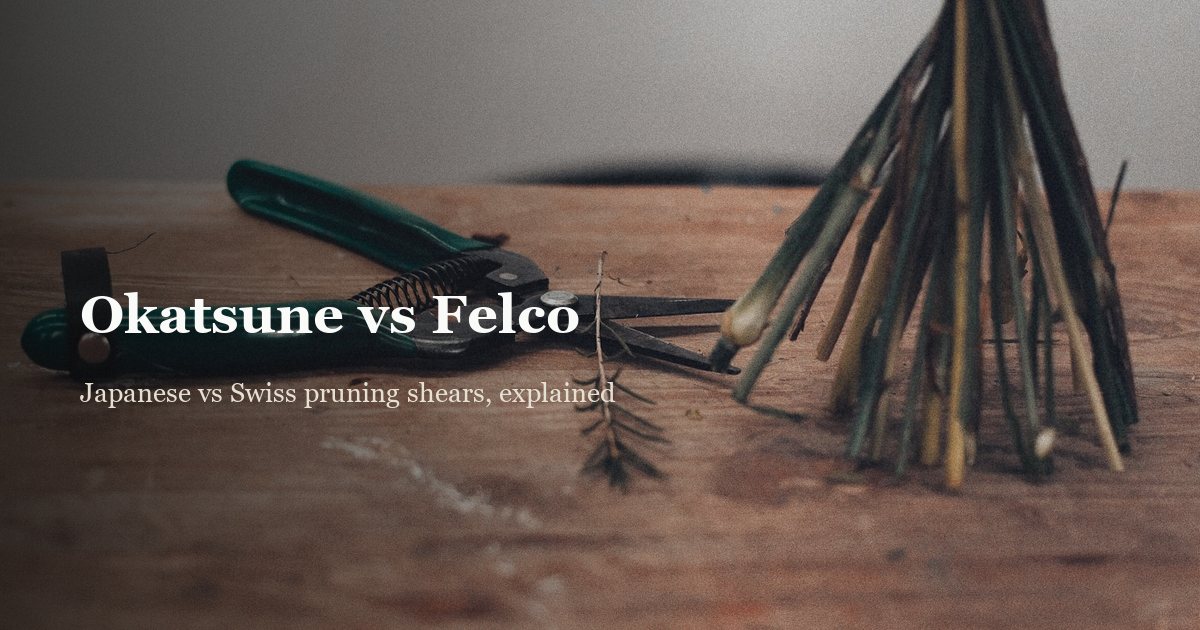
Quick answer: Okatsune’s 103 is a one-piece forged Japanese blade you resharpen as it dulls — lighter, cheaper, and built around the assumption you’ll maintain the edge yourself. Felco’s 2 is a Swiss pruner engineered so every part, blade included, is individually replaceable — heavier, pricier, and built around the assumption you’ll rebuild rather than resharpen or replace the whole tool. Both are genuinely excellent; the right one depends on whether you’d rather sharpen a blade or swap a part. Details below.
Some of the shops we link to are partners who may pay us when you buy through them. This doesn't change which pieces we recommend. How this works.
Two Companies, Two Different Answers to “How Should a Pruner Age?”
Okatsune was founded by Tsuneichi Okano, who began his blacksmithing apprenticeship in 1925 and later built the company (Oka + Tsune) in Hiroshima. Its shears, including the 103 model this site has reviewed in detail, are forged from Izumo Yasugi steel — the same steel tradition used in katana — as a single blade unit, sharpened by hand over its working life the way a kitchen knife is.
Felco was founded in 1945 by engineer Félix Flisch, who bought an old watch-dial factory in Les Geneveys-sur-Coffrane, in Switzerland’s watchmaking region, and turned it toward pruning shears instead. The Felco 2, launched in 1948, has sold more than 19 million units worldwide and remains the company’s signature model. Sources: FELCO’s own company history, independently corroborated by cutlery retailer Country Knives and vineyard-tool specialist VineWorks.
Neither company is copying the other. They’re answering a different question about what happens to a good pruner over ten years of use.
Comparison at a Glance
| Okatsune 103 | Felco 2 | |
|---|---|---|
| Origin | Hiroshima, Japan | Les Geneveys-sur-Coffrane, Switzerland |
| Founded | 1925 (blacksmithing apprenticeship); company later formalized under Okano’s name | 1945 |
| Blade construction | Forged as a single steel unit | Forged blade, individually replaceable |
| Steel | Izumo Yasugi high-carbon steel | Hardened steel blade, forged aluminum handle |
| How you maintain it | Hand-sharpen the existing blade | Swap the blade (and any other worn part) for a new one |
| Roughly | $30 | $45-60 |
| Warranty | Standard manufacturer warranty | Lifetime warranty on forged aluminum handles; 24-month guarantee on the tool |
Sources: Okatsune 103 review (this site), FELCO company history, FELCO North America product page.
Why the Blade Philosophy Is the Real Difference
Okatsune’s approach is the same one this site has documented in Japanese kitchen knives and whetstones: a single, high-carbon steel blade that takes and holds a very sharp edge, maintained by sharpening rather than replacing parts. Reviewers who’ve used an Okatsune 103 for a full growing season without resharpening aren’t unusual — Izumo Yasugi steel holds an edge well — but eventually every blade needs either a sharpening session or, once it’s sharpened down past a useful point, a new tool.
Felco’s approach is closer to a piece of serviceable machinery than a knife. Every blade, spring, bolt, and handle on a Felco pruner is sold individually as a spare part, and the company’s own materials describe the tool as built to be repaired, not replaced. When the blade eventually dulls past what a home sharpening can fix, or a spring wears out, the fix is a $10-20 replacement part rather than a new $45-60 tool. That’s a meaningfully different cost curve over a 10- or 15-year ownership period, even though the upfront price is higher.
Neither is more “correct.” A one-piece forged blade is simpler, lighter, and cheaper to buy new; a fully modular tool costs more upfront but can theoretically outlive several one-piece blades bought over the same span, provided you’re willing to order replacement parts instead of a whole new pruner.
Weight, Grip, and Hand Fit
The Okatsune 103 is noticeably lighter than the Felco 2 — its all-steel, mostly one-piece build with a vinyl-coated grip keeps it compact, and gardeners with smaller hands frequently report it’s easier to use for long weeding-and-pruning sessions than the bulkier Felco. The Felco 2’s forged aluminum handle and rotating-bolt locking mechanism add weight and bulk, but the tradeoff is a tool explicitly engineered around decades of disassembly and reassembly — a heavier, more mechanical object by design, not by accident.
Long-time Felco users who try an Okatsune sometimes describe the cutting action as more jarring on the wrist, since the Okatsune’s simpler action doesn’t have the same ergonomic hand geometry Felco has refined over decades. The reverse complaint shows up too: gardeners used to the Okatsune’s light weight find the Felco clunky for quick, repetitive cuts. This is a genuine preference split, not a case where one design is objectively better.
Which One Should You Buy?
- Get the Okatsune 103 if you want a lighter, cheaper pruner and don’t mind sharpening a blade yourself as it dulls — the same mindset this site recommends for Japanese kitchen knives over disposable ones.
- Get the Felco 2 if you’d rather order a $10-20 replacement part than resharpen, and you’re fine paying more upfront for a tool explicitly built to be rebuilt rather than replaced.

Okatsune 103 Bypass Pruners, Medium
One-piece forged Izumo Yasugi steel, made in Japan. 4.7★ (3,501 ratings).

Felco F2 Pruning Shears
Swiss-made, aluminum body, individually replaceable parts. 4.8★ (14,424 ratings).
FAQ
Is Felco actually Swiss-made, or just Swiss-designed? Manufacturing is based in Les Geneveys-sur-Coffrane, Switzerland, where the company was founded in 1945 and remains family-owned according to its own company history. This is a different situation from a lot of “Japanese steel” garden tools on Amazon that name no manufacturer or production location at all.
Can you resharpen a Felco blade the way you would an Okatsune? Yes, and Felco sells sharpening tools for exactly that purpose — but the design also allows swapping the blade for a new one entirely once resharpening no longer restores a usable edge, which isn’t an option with the Okatsune’s one-piece forged construction.
Is one of these actually better for professional use? Both see professional use — Okatsune shears are common among Japanese gardeners and landscapers, while Felco is a standard in European vineyards and arboriculture. The choice tends to come down to whether a user already owns other Felco tools (and wants shared spare parts) or prefers a lighter Japanese blade.
Does the price difference reflect a quality difference? Not directly. It mostly reflects Felco’s modular, serviceable engineering versus Okatsune’s simpler one-piece forging. Higher upfront cost buys a tool designed for part-by-part repair over many years, not necessarily a sharper or more durable blade at the moment of purchase.
Final Thoughts
Okatsune and Felco solve the same problem — a bypass pruner that holds an edge and lasts — from two different manufacturing philosophies, and both have the documented company histories to back up the claim that they’re genuinely what they say they are. If you want the specific model this site verified as Made in Japan with current pricing and review data, see the full Okatsune 103 review. For the country-of-origin checks that apply across every tool category on this site, see the buyer’s checklist for real vs. knockoff Japanese craft.
For the rest of a Japan-made garden kit, see our guide to Japanese hori-hori garden knives — the same real-vs-”Japanese-style” gap covered here shows up in digging knives too — or our roundups of Best Japanese Pruning Saws and Best Japanese Bonsai Tools for the rest of the toolbox.