Some of the shops we link to are partners who may pay us when you buy through them. This doesn't change which pieces we recommend. How this works.
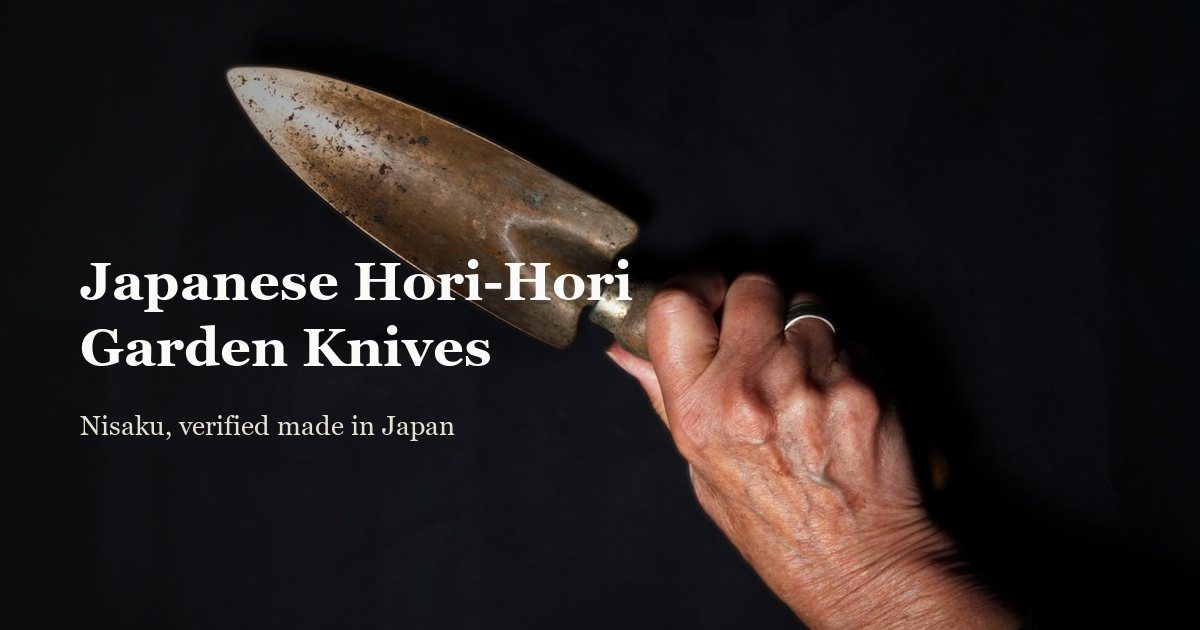
For the classic, most-reviewed option, get the Nisaku NJP650 "The Original" Hori-Hori — made by Tomita Cutlery in Tsubame-Sanjo, Niigata Prefecture, and stated as Japanese stainless steel directly in the listing. For a harder, more premium blade, the Nisaku NJP801 Yamagatana S uses vanadium-infused 440C steel hardened to HRC58. Both come from the same Japanese manufacturer. A lot of the "hori-hori" knives sold alongside them on Amazon lean on the word "Japanese" in the title without saying where the blade is actually forged.
What a Hori-Hori Actually Is, Before It Was a Marketing Word
In Japan, this tool isn’t usually called a “hori-hori” at all. Independent sources including Wikipedia and multiple gardening retailers describe it domestically as a sansai-bori (山菜ナイフ, “mountain vegetable knife”) or leisure knife (レジャーナイフ), a tool originally used to dig up sansai — wild mountain vegetables and fiddleheads — without damaging the roots. “Hori” comes from the Japanese verb horu (掘る), “to dig,” and the doubled “hori-hori” is an onomatopoeia for the digging motion itself, not a brand or a place name.
That distinction matters for this site’s usual question. The tool’s Japanese origin isn’t in doubt — the design, the double-edged blade with one serrated side, and the concave cross-section for scooping soil are all genuinely Japanese. What’s not guaranteed is that any specific knife with “hori-hori” in the title, sold on Amazon today, was actually forged there. The same “real vs. Japanese-style” gap this site has documented in pruning shears, kitchen shears, and whetstones shows up again here — a Japanese word describing a Japanese tool design, attached to a supply chain that isn’t always Japanese at all.
Comparison at a Glance
Checked against current Amazon.com listings on September 3, 2026. Prices vary by retailer and change often.
Why the Region Behind Nisaku Matters
Nisaku’s hori-hori knives are made by Tomita Cutlery, based in Tsubame City, in the Tsubame-Sanjo district of Niigata Prefecture. This isn’t an incidental detail — Tsubame-Sanjo is one of Japan’s oldest and most documented metalworking regions, the same district behind Tojiro’s kitchen knives and other cutlery brands this site has verified in earlier articles. Blacksmithing there traces back to the early Edo period, when local craftsmen were taught to forge nails and gradually expanded into knives, saws, and garden tools as the trade grew. A listing that names the actual manufacturer and region, not just the country, is the same kind of verifiable claim this site looks for across every category — a specific, checkable fact rather than a word that sounds authentic.
1. Nisaku NJP650 “The Original” Hori-Hori
The NJP650, sometimes listed under the older name Namibagata, is Nisaku’s best-selling model and the one most gardening retailers default to when they say “hori-hori.” It’s forged from Japanese stainless steel with a 7.25-inch blade — one edge straight and beveled for slicing through roots and clean soil lines, the other serrated for sawing through fibrous roots and compacted ground. Inch markings etched into the blade double as a depth gauge for bulb and seedling planting. It’s also, by a wide margin, the most reviewed hori-hori on Amazon in this category, with a rating in the high 4-star range across thousands of ratings and reported sales in the thousands of units per month at various points.
Pros:
- Made by a named manufacturer (Tomita Cutlery) in a documented cutlery region (Tsubame-Sanjo, Niigata)
- By far the largest, most consistent review base of any hori-hori on Amazon
- Dual edge (straight + serrated) covers most digging, dividing, and weeding tasks without switching tools
Cons:
- Wood handle needs occasional oiling and isn’t as grippy wet as a textured plastic handle
- Standard stainless is less hard than the NJP801’s vanadium-infused steel, so it dulls faster in rocky or sandy soil
- No sheath rigidity to speak of beyond the basic model included — some buyers upgrade to a dedicated leather sheath separately
Bottom line: the pick for most gardeners, and the one with the deepest independently verifiable track record.

NISAKU NJP650 Hori Hori Weeding Knife
7.25" stainless steel blade, made in Japan. 4.8★ (9,435 ratings).
2. Nisaku NJP801 Yamagatana S
The NJP801 is Nisaku’s harder-edged, more premium hori-hori, built from 440C stainless steel infused with vanadium and hardened to HRC58 — noticeably harder than the standard NJP650 blade. The tradeoff for that extra hardness is a bit more brittleness on twisting motions, but for straightforward digging and cutting it holds an edge longer, which matters most in rocky or clay-heavy soil where the standard blade dulls faster. It comes with an ergonomic plastic handle and a hilt guard rather than the NJP650’s plain wood grip, and carries the same dual straight/serrated edge and depth markings.
Pros:
- Harder steel (HRC58, vanadium-infused 440C) holds an edge longer in demanding soil than the standard NJP650
- Same named manufacturer and documented production region as the NJP650
- Hilt guard adds a measure of hand protection the NJP650’s plain handle doesn’t have
Cons:
- Costs more than the NJP650, and pricing swings between roughly $25 and $45 depending on retailer and promotion
- Harder steel is somewhat more prone to chipping than flexing under lateral stress, compared to a softer blade
- Fewer independent reviews than the NJP650, since it’s a smaller share of Nisaku’s total sales
Bottom line: the pick if you’re regularly working rocky, root-heavy, or clay soil and want a harder edge than the standard model.

Nisaku NJP801 Yamagatana S Hori Knife
HRC58 hardened Japanese stainless steel. 4.5★ (104 ratings).
Where “Hori-Hori” Listings Get Murky
Not every hori-hori on Amazon is dishonest about where it’s made — some are straightforward about a mixed supply chain. KAKURI, a cutlery company founded in 1946 and based in Sanjo City — the same Tsubame-Sanjo district behind Nisaku — sells a carbon-steel hori-hori whose listing states the blade itself is made in China, with quality control from the Japanese manufacturer. That’s an honest, specific claim: a real Japanese company, transparent about a Chinese-made blade, which is a genuinely different thing from a “Made in Japan” claim even though the brand’s roots are real. It’s a useful example of the same distinction this site keeps drawing — a company’s history and a specific product’s country of manufacture are two different facts, and a listing can be honest about one while staying quiet on the other.
Other listings are less specific. A hori-hori marketed as the Black Iron Hori Hori Garden Knife puts “Japanese Stainless Steel” directly in the title, but nowhere in the listing does it name a manufacturer, a production region, or a country of origin for where the knife itself is assembled. That doesn’t prove it isn’t made in Japan — it means, unlike Nisaku, there’s nothing in the listing itself a buyer can check if the country of manufacture is what they’re actually paying for.
None of this means a Chinese-made or unlabeled hori-hori is a bad digging tool. A well-hardened blade cuts soil and roots regardless of where it was forged. It means that if “Japanese hori-hori” is doing real work in your buying decision — not just the tool’s design lineage, which genuinely is Japanese, but where this specific knife was made — the listing needs to actually say so, the same country-of-origin check that applies to knives, whetstones, and pruning shears on this site.
Which One Should You Buy?
- For general garden work with the deepest review history in this category, get the Nisaku NJP650.
- For rocky, root-heavy, or clay soil where edge retention matters more than a lower price, get the Nisaku NJP801.
- If a listing only says “Japanese stainless steel” and never names a company, a production region, or a country of origin, treat “Japanese” as a description of the tool’s design, not proof of where it was made.
FAQ
Is “hori-hori” a brand name? No. It’s a Japanese onomatopoeia for a digging motion, describing the tool’s original use for foraging mountain vegetables. In Japan the same tool is more often called a sansai-bori or leisure knife. “Hori-hori” became the common English-language name for the category, which is why it now shows up in dozens of brands’ product titles regardless of where any specific one is made.
What’s the real difference between the NJP650 and the NJP801? Steel hardness. The NJP801’s 440C vanadium-infused steel is hardened to HRC58, harder than the NJP650’s standard stainless, so it holds an edge longer in demanding soil but is marginally more prone to chipping under twisting stress than flexing with it.
Do carbon-steel hori-hori knives need different care than stainless ones? Yes. Carbon steel, like the blade on KAKURI’s model, holds an edge well but rusts faster than stainless if left wet or dirty. Wipe the blade dry after use and apply a light coat of oil periodically, the same maintenance routine this site has covered for carbon-steel pruning shears.
Can a hori-hori replace a trowel and a weeding knife? For most home gardening, yes. The combination of a pointed digging tip, a serrated edge for roots, and depth markings for planting covers what a trowel and a separate weeding tool would otherwise do as two pieces.
Final Thoughts
The hori-hori’s Japanese origin isn’t a marketing story — it’s a real tool with a documented use, name, and manufacturing region. What varies is whether any specific knife sold under that name today was actually made there. Nisaku’s two models both name a manufacturer, a production district, and a country of origin directly in the listing; a lot of the competition sharing shelf space with them on Amazon names none of the three. For the underlying six-point method behind picks like these, applied across every category on this site, see our buyer’s checklist for real vs. knockoff Japanese craft.
For the rest of a Japan-made garden kit, see our Best Japanese Pruning Shears and Best Japanese Pruning Saws roundups for the cutting side of the toolbox, or our Okatsune vs Felco comparison if you’re weighing a Japanese pruner against a Western one you already own.