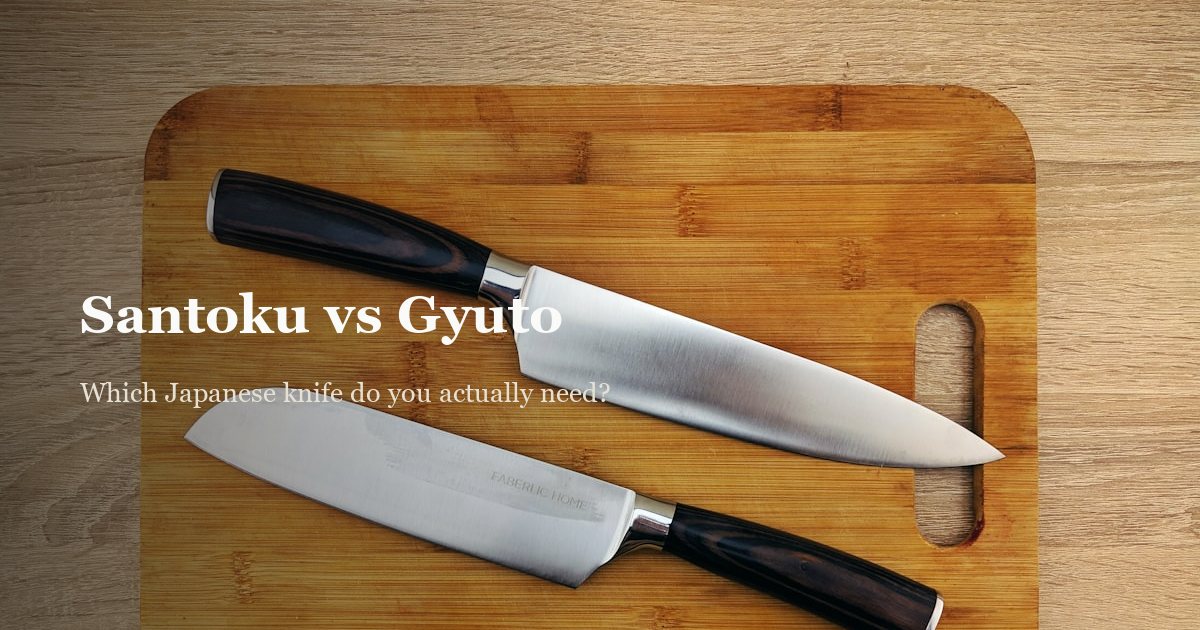
Quick answer: choose a santoku if you mostly chop vegetables and want a compact, easy-to-control first Japanese knife. Choose a gyuto if you also want a pointed tip for meat, fish, and precise trimming. Both are Japanese knife shapes; this is not the usual Japanese-vs-Western comparison.
Some of the shops we link to are partners who may pay us when you buy through them. This doesn't change which pieces we recommend. How this works.
Decide in 20 Seconds
Mostly vegetables, a smaller board, or a first Japanese knife? Start with a santoku.
Regularly trim meat, prep fish, or want one longer all-rounder? Start with a gyuto.
The shape tells most of the story. The santoku keeps a long, fairly flat cutting edge close to the board. The gyuto trades some of that compactness for reach, a curved belly, and a usable point.
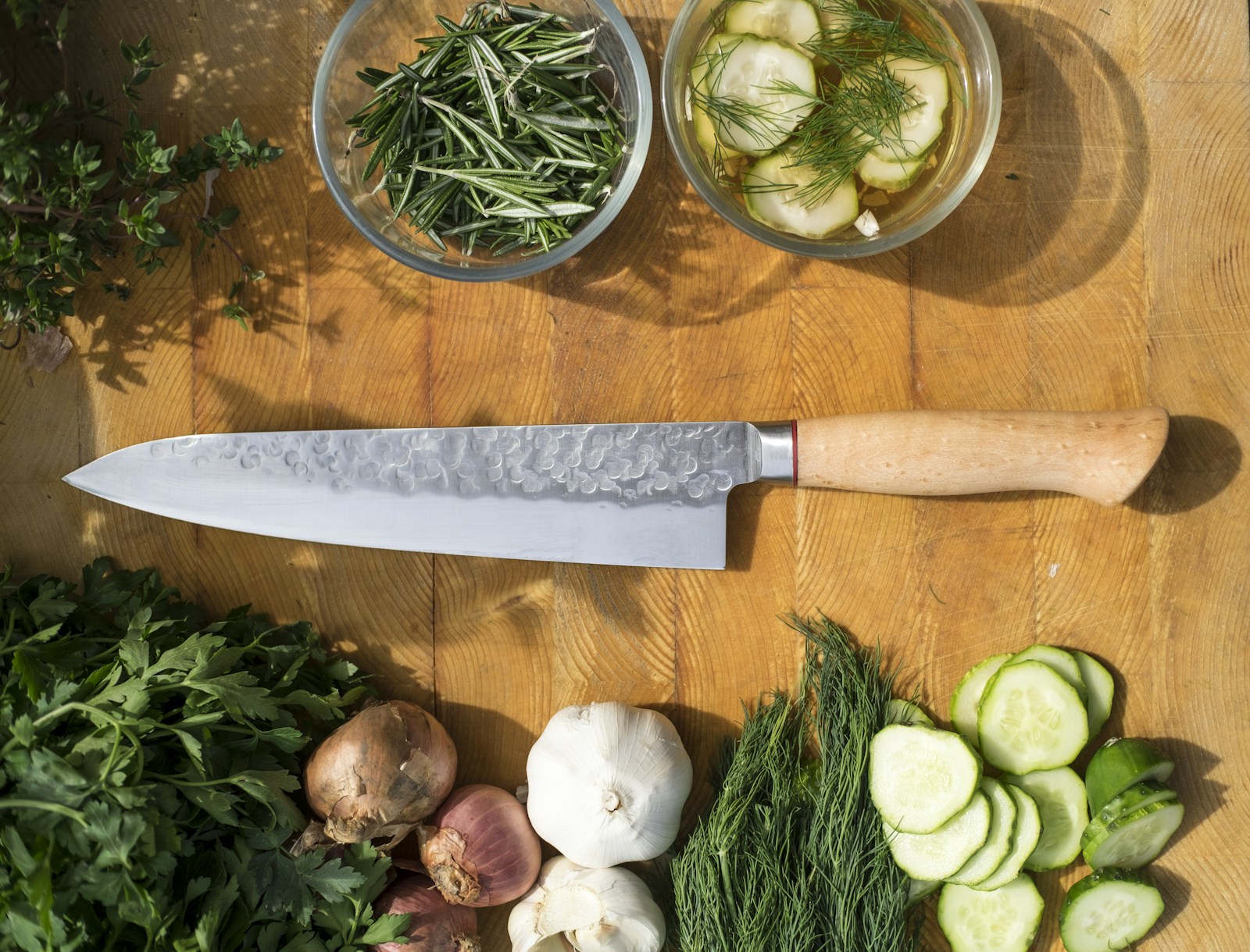
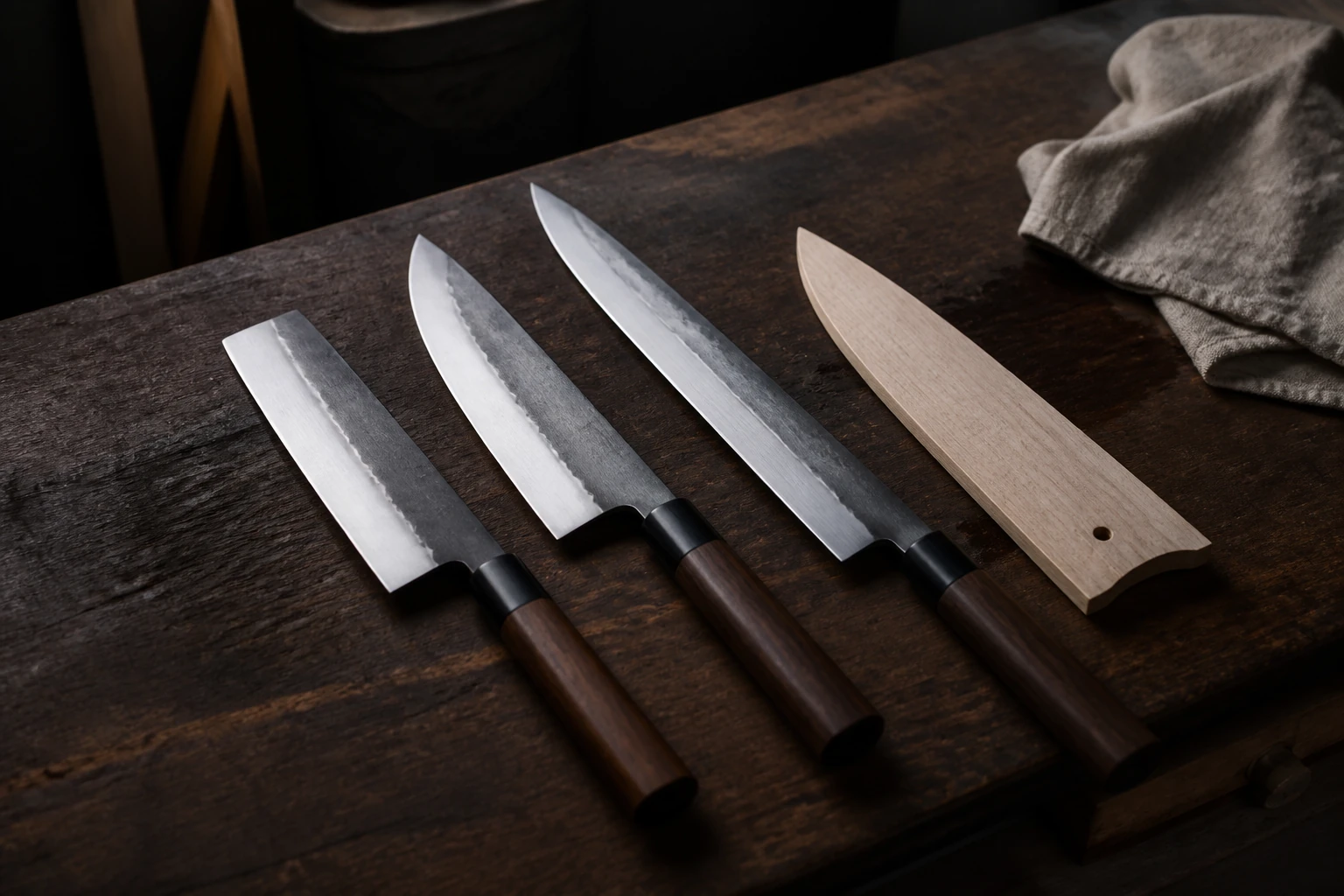
The Core Differences at a Glance
| Santoku | Gyuto | |
|---|---|---|
| Typical blade length | 165–180mm (6.5–7 in) | 210–270mm (8.2–10.6 in), up to 300mm |
| Tip shape | Sheep’s-foot (flat, no point) | Pointed |
| Blade profile | Minimal curve, mostly flat | Curved belly from base to tip |
| Best cutting motion | Straight up-and-down push cut | Rocking motion and pull/push slicing |
| Name meaning | “Three virtues” (santoku, 三徳): meat, fish, vegetables | “Beef sword” (gyuto, 牛刀) |
| Origin | Domestic Japanese kitchen knife | Adapted from Western chef’s knives during the Meiji era |
Sources: Zahocho Knives Tokyo, Sakai Ichimonji Mitsuhide. Both are Japan-based knife specialists, and their blade-length ranges and tip descriptions agree.
One useful caveat: these are typical profiles, not fixed rules. A 180mm gyuto can feel nimble, while a tall santoku can handle more than vegetables. Use the shape as your starting point, then check the exact blade length and weight on the listing.
These Are Two Japanese Knives, Not a Japan-vs-West Comparison
It’s worth being explicit about what this comparison actually is, because it’s easy to conflate with a different question. A santoku is a domestic Japanese kitchen knife design. A gyuto is also genuinely Japanese-made and Japanese-designed, even though its name and shape were adapted from Western chef’s knives after Japan’s Meiji-era shift toward eating beef: “gyuto” literally means “beef sword.” Neither knife is a stand-in for “the Western knife” the way a chef’s knife is in our santoku vs Western chef’s knife comparison. Both santoku and gyuto are built, sharpened, and sold by the same Japanese knife makers, often as two sizes in the same product line.
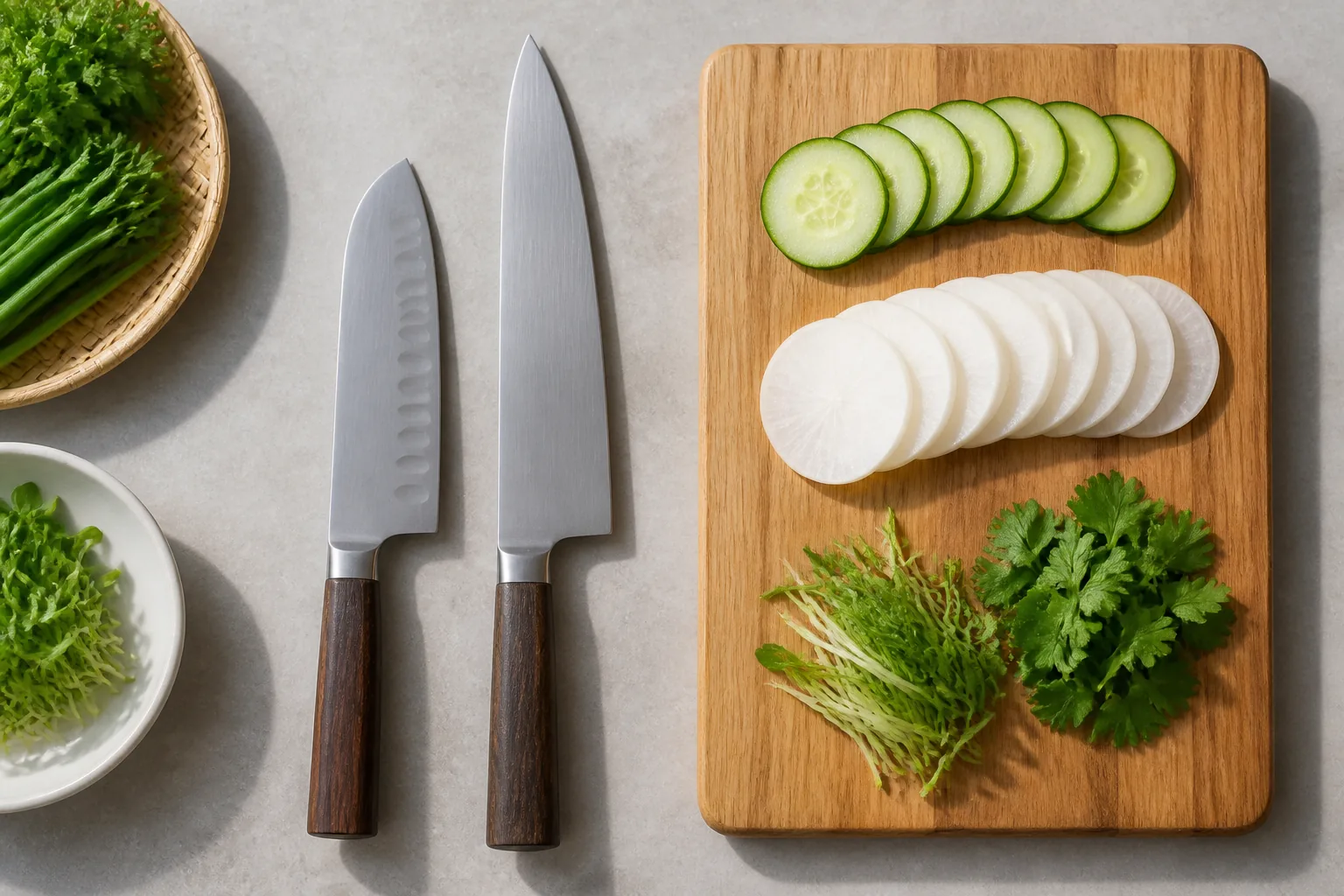
Why the Tip Shape Is the Real Decision Point
The single biggest practical difference is the tip. A santoku’s sheep’s-foot tip is flat and rounded, which makes the whole blade shorter and lighter but removes the pointed tip a gyuto has. That matters for any task that needs a point: trimming silverskin off a piece of meat, deveining shrimp, scoring the skin on a fillet, or cutting around a bone. A gyuto’s pointed tip handles all of that; a santoku can’t, by design.
The tradeoff runs the other way for straight chopping. A santoku’s flatter profile keeps more of the edge in contact with the cutting board through a straight up-and-down cut, which is what most home vegetable prep actually is. A gyuto’s curved belly is built to rock through that same motion, or to pull-slice in one long stroke: better for portioning meat or making long, clean cuts through something like a whole cucumber, but not necessarily faster for small, repetitive chopping.
Why the Length Difference Matters More Than It Sounds
A santoku’s 165–180mm blade and a gyuto’s 210–270mm blade aren’t just a size preference: the extra length on a gyuto is what makes a single pull-slice possible across a wider cut of meat or a larger vegetable, where a santoku would need multiple strokes. The shorter santoku is correspondingly easier to control in a smaller kitchen or with less counter space, and it’s generally the easier knife to learn on first, since a shorter, flatter blade is more forgiving of an inconsistent cutting motion than a longer, curved one.
Which One Should You Buy First?
- Get a santoku first if most of your cooking is vegetable-heavy home prep and you want a lighter, shorter knife that’s easy to control. This is the same recommendation as our santoku vs Western chef’s knife guide: a santoku covers most home cooking on its own.
- Get a gyuto first if you regularly break down meat, fillet fish, or want a single knife that also does tip work like trimming and deveining, tasks a santoku’s flat tip can’t do.
- You’ll likely want both eventually. They’re not redundant with each other the way two santoku would be; a gyuto fills in exactly the tip-work gap a santoku leaves open. See our santoku knife comparison for six verified Made-in-Japan picks if you’re starting with a santoku, and confirm you’re buying the genuine article either way: see our buyer’s guide to spotting Japanese-style knockoffs.
If you want to compare the two shapes without also comparing two different makers, Sakai Takayuki (Aoki Hamono, Sakai City) makes both in the same TUS steel line, so blade shape is the only real variable between these two:

Sakai Takayuki TUS Steel Santoku 180mm
TUS high-carbon stainless, double bevel, made in Sakai City, Japan. 5.0★ (3 ratings).
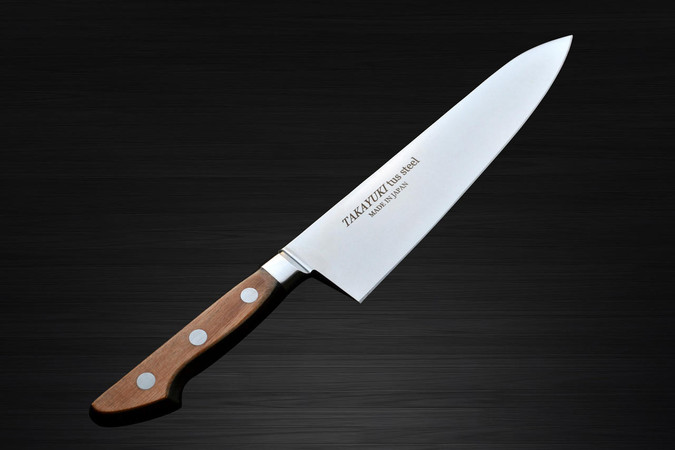
Sakai Takayuki TUS Steel Gyuto 210mm
Same TUS steel and maker, pointed tip, double bevel, 180g. Made in Japan.
Still Unsure? Replay Last Week’s Dinners
Choose the knife that suits the work you already do, not the one that sounds more versatile on paper.
| If this sounds like your kitchen | Start with | Why |
|---|---|---|
| You make stir-fries, soups, salads, and weeknight vegetable prep | Santoku | Its shorter, flatter edge is comfortable for repeated board work. |
| You often portion chicken, trim connective tissue, or prep fish | Gyuto | The pointed tip gives you control where a santoku deliberately has none. |
| Your board and counter space are limited | Santoku | A 165–180mm blade is easier to manoeuvre without sacrificing everyday utility. |
| You cook for a crowd or slice larger ingredients in long strokes | Gyuto | The longer blade gives you more reach and a cleaner pull-slice. |
If two rows apply equally, don’t overthink it: start with the one whose length feels less intimidating. Good technique and a well-maintained edge matter more than forcing yourself into a profile you will not enjoy using.
FAQ
Is a gyuto just a Japanese chef’s knife? Functionally, yes. A gyuto fills the same role a Western chef’s knife does, and its shape (pointed tip, curved belly) is closer to a chef’s knife than a santoku’s is. The difference from an actual Western chef’s knife is usually thinner grind geometry and lighter weight, the same distinction covered in our santoku vs Western chef’s knife guide.
Can a gyuto do everything a santoku does? Mostly, yes, with practice. A gyuto’s longer, curved blade can chop vegetables, just with a rocking motion instead of the santoku’s straight push cut. What a gyuto can’t easily replicate is the santoku’s compactness and ease of control in a small space, which is why many home cooks find a santoku faster to get comfortable with.
What about bunka or kiritsuke knives? Both are hybrids that borrow from santoku and gyuto: a bunka has a santoku-like flat profile with an angular, reverse-tanto tip instead of a rounded one, and a kiritsuke has a longer, gyuto-like blade with a similar angular tip. Neither is necessary as a first knife; they’re generally a second or third purchase once you already know whether you prefer a santoku’s compactness or a gyuto’s reach.
Final Thoughts
If you’re choosing your first Japanese knife, the honest answer is that a santoku covers more of what a typical home cook does day to day, which is why it’s the more common recommendation for beginners. A gyuto earns its place once you’re regularly doing the tip work (trimming, filleting, deboning) that a santoku’s flat profile was never designed for. Neither is the “wrong” knife; they solve different problems, and most serious home cooks eventually own both.
Whichever one you buy, make sure it’s genuinely Japanese-made before you check out: our buyer’s guide to spotting Japanese-style knockoffs covers the same six checks across knives, ceramics, and lacquerware.
Keep Reading
- Want a santoku recommendation? See six verified Made-in-Japan santoku knives for home cooks.
- Going with a gyuto? Read What Size Gyuto Should You Get? for 180, 210, 240, and 270mm compared.
- Comparing a santoku with the knife you already own? Read santoku vs Western chef’s knife.
- Need a dedicated vegetable knife instead of an all-purpose one? See Best Japanese Nakiri Knives.
- Slicing raw fish or cooked meat instead of chopping? Read Yanagiba vs Sujihiki.
- Adding a small knife next to your main one? Read Petty Knife vs Paring Knife.
- Before buying from a marketplace listing, use our six-check guide to spotting Japanese craft knockoffs.