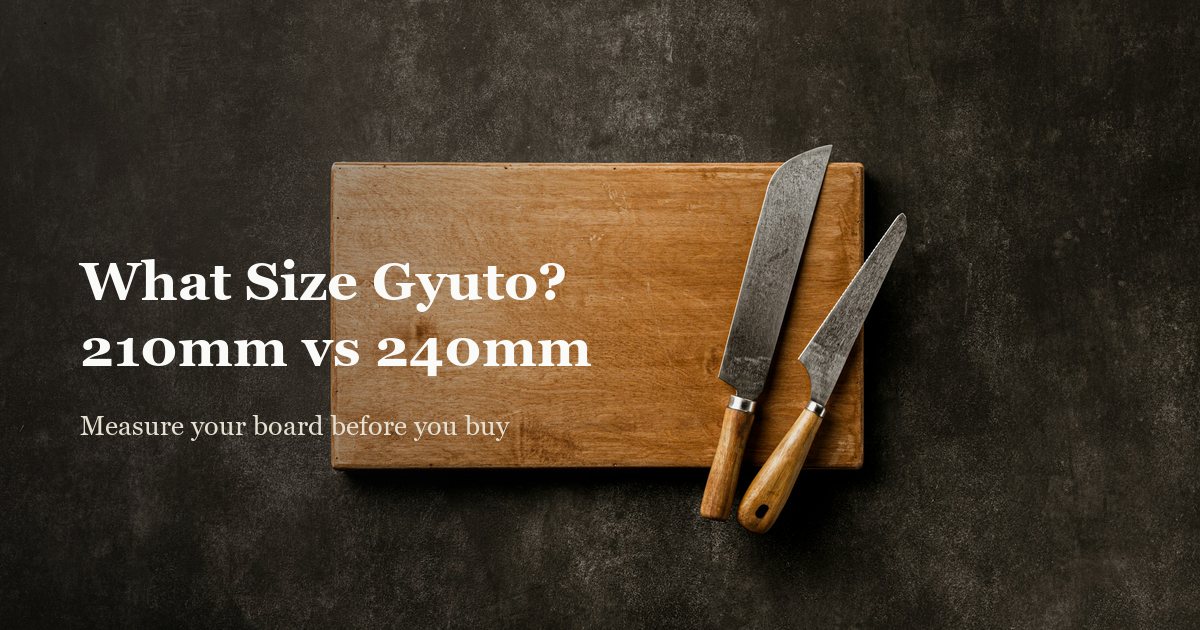
For most home cooks, get a 210mm gyuto. In the Sakai Takayuki TUS line used below, the 210mm is $86.99, weighs 180g, and measures 12.8 in (325mm) from tip to handle end. Step up to 240mm ($131.99, 220g, 14.6 in overall) only if your cutting board is longer than the knife and you regularly cut large produce or big batches. The 180mm and 270mm are edge cases, covered below.
Some of the shops we link to are partners who may pay us when you buy through them. This doesn't change which pieces we recommend. How this works.
Search this question and the answers come mostly from knife forums, where threads like this 210 vs 240 discussion on KitchenKnifeForums keep circling the same two factors: how much board space you have, and how big the things you cut are. Those factors are real, but the discussions rarely put numbers on them. To do that, it helps to hold everything else constant: the same maker, the same steel, and the same handle, in four lengths.
Same Knife, Four Sizes: What Actually Changes
Every knife below is the Sakai Takayuki TUS Steel Gyuto, made by Aoki Hamono in Sakai, Osaka, in TUS high-carbon stainless steel with a double-bevel edge and a plywood handle. Only the length changes. Measurements are from Hocho Knife’s spec sheet, prices from the same retailer, both checked on September 24, 2026.
| Blade length | Total length | Weight | Price | Jump from the size below |
|---|---|---|---|---|
| 180mm (7.1 in) | 295mm (11.6 in) | 160g | $80.99 | n/a |
| 210mm (8.3 in) | 325mm (12.8 in) | 180g | $86.99 | +$6, +20g |
| 240mm (9.4 in) | 370mm (14.6 in) | 220g | $131.99 | +$45, +40g |
| 270mm (10.6 in) | 395mm (15.6 in) | 260g | $152.99 | +$21, +40g |
Two things stand out. First, the step from 180mm to 210mm costs almost nothing: $6 and 20g. Second, the step from 210mm to 240mm is where both price and weight jump: $45 more (about 52%) and 40g heavier. That’s the decision most buyers are actually making, and it’s the one worth being deliberate about.
The Measurement That Decides It: Your Cutting Board
Before choosing a length, measure the long side of the board you use most. The knife needs room for the whole blade plus a comfortable margin for your guiding hand and the ingredient you’re cutting.
The 210mm’s overall length is 12.8 in; the 240mm’s is 14.6 in. If your board’s long side is shorter than the knife’s overall length, you’ll be cutting with the tip hanging off one end or angling the knife across the corner, and the extra 30mm of blade does very little for you. A 240mm makes sense on a board that’s comfortably longer than 14.6 in. Our hinoki cutting board guide lists the dimensions of each pick if you’re sizing a board alongside the knife.
The second question is what you cut. A longer blade lets you slice through something wide, like a whole cabbage, a large squash, or a roast, in one pull instead of sawing back and forth. If most of your prep is onions, carrots, garlic, and chicken breasts, a 210mm reaches through all of it with room to spare.
210mm: The Default for Home Cooks
The 210mm is the length most home kitchens fit, and at $86.99 it’s also where this line’s value peaks: only $6 more than the 180mm for noticeably more reach. At 180g it’s light enough for quick tip work on herbs and garlic, and its 12.8 in overall length fits the boards most people already own.
Pros:
- Nearly the same price as the 180mm, with 30mm more usable blade
- Light and easy to control for everyday vegetable prep
- Fits standard home cutting boards without the tip hanging off
Cons:
- Takes two or three strokes on very wide items that a 240mm would slice in one
- If you already own a 180mm santoku, the lengths overlap more than a 240mm would
Bottom line: the right first gyuto for most home cooks, and the one to buy if you aren’t sure.
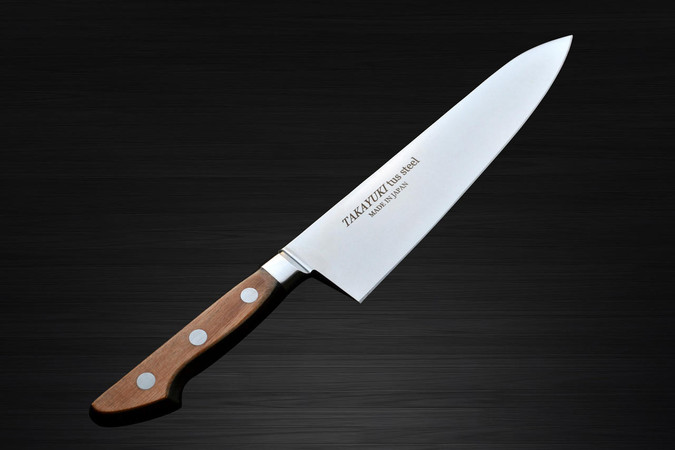
Sakai Takayuki TUS Steel Gyuto 210mm
325mm overall, 180g. Made by Aoki Hamono in Sakai, Japan.
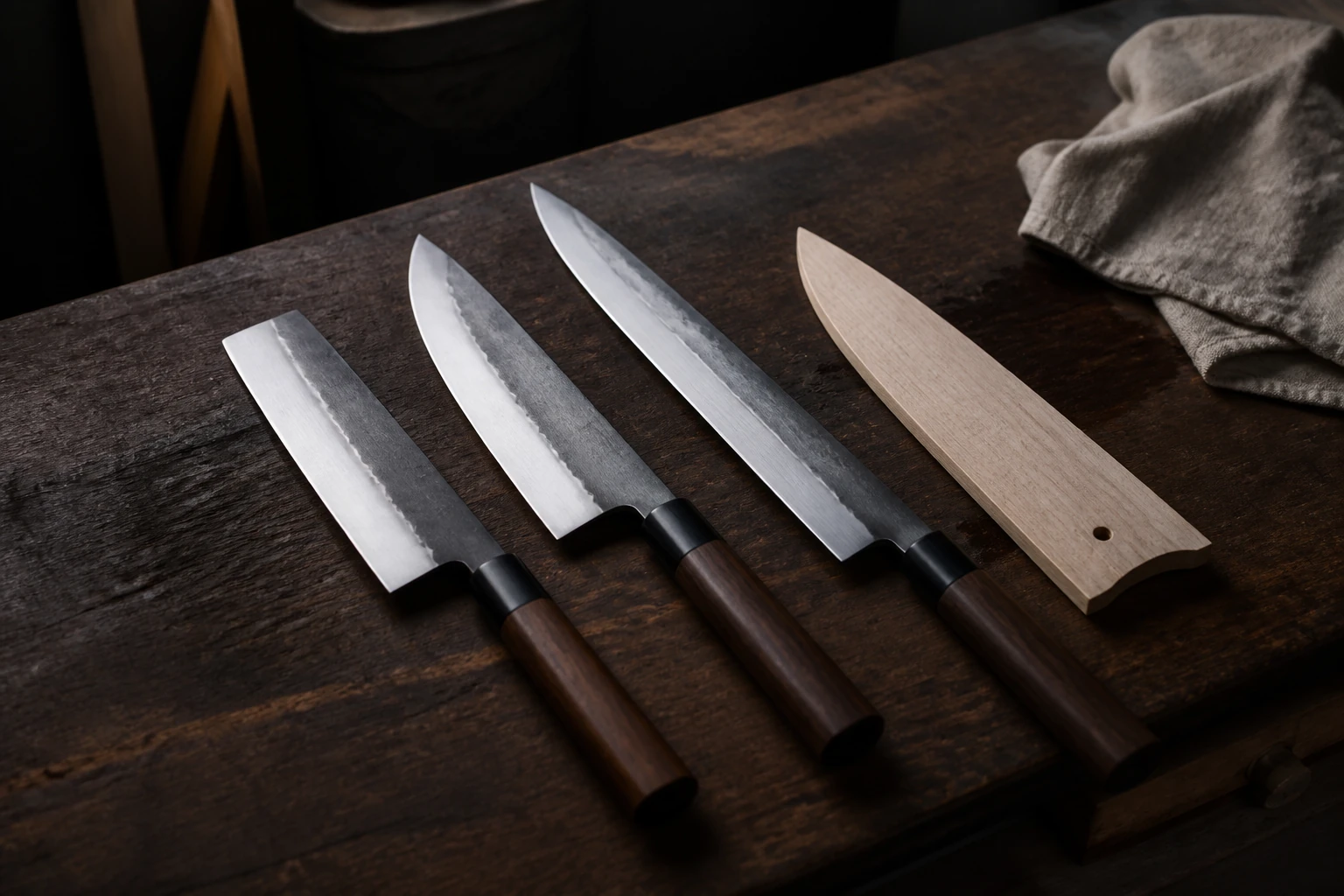
240mm: Worth the Extra $45 in the Right Kitchen
The 240mm earns its price if you cook for a crowd, batch-prep vegetables, or regularly break down large produce and roasts. The extra length means longer, smoother slicing strokes and more of the edge in contact with the board on each cut. It also costs $45 more than the 210mm and weighs 220g, and at 14.6 in overall it needs a board that’s longer than that to work well.
Pros:
- Slices wide items in a single stroke
- Longer edge speeds up high-volume prep
- A clearer step up from a santoku if you already own one
Cons:
- $45 more than the 210mm in the same line
- Feels cramped on smaller cutting boards and counters
- 40g heavier, which you notice over a long prep session
Bottom line: buy it if your board and your cooking are both big enough to use the extra length. Otherwise the 210mm does the same job for less.
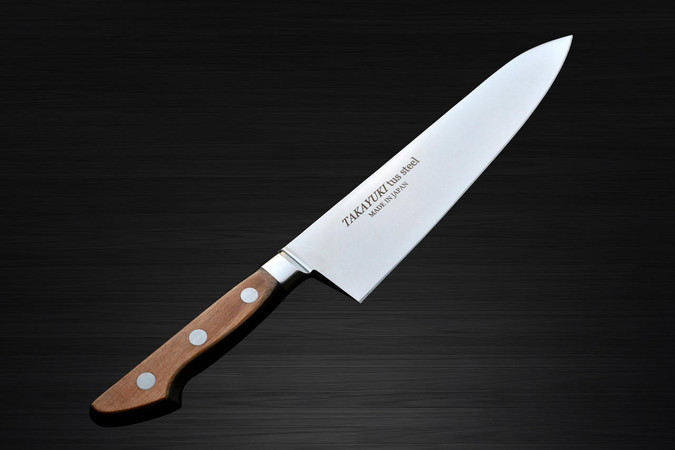
Sakai Takayuki TUS Steel Gyuto 240mm
370mm overall, 220g. Same maker, steel, and handle as the 210mm.
180mm and 270mm: The Edge Cases
The 180mm ($80.99, 160g) suits a very small kitchen or board, or a cook who wants a gyuto’s pointed tip in roughly the size of a santoku. Since the 210mm costs only $6 more, the 180mm mainly makes sense when space, not price, is the constraint.
The 270mm ($152.99, 260g, 15.6 in overall) is a professional-kitchen length. It needs a large board and a lot of counter space, and it’s the heaviest of the four. For almost any home kitchen, the 240mm already covers what the extra reach would add.
Checking That It’s Actually Japanese-Made
All four sizes above pass the checks from our guide to telling if a Japanese knife is real: a named manufacturer (Aoki Hamono), a named city (Sakai), a named steel (TUS), and “Made in JAPAN” on the spec sheet, sold by a dedicated Japanese knife retailer. A listing that gives a blade length but no maker, city, or steel fails those checks no matter which size you pick. Our list of brands reported to mislabel their origin covers the most common examples.
Which Size Should You Buy?
- Not sure, or cooking for one to four people on a standard board: 210mm.
- Cooking for a crowd, batch-prepping, and working on a board longer than 15 in: 240mm.
- Very small kitchen or board: 180mm, which costs only $6 less than the 210mm, so choose it for space, not savings.
- Professional-scale prep at home, with the board and counter to match: 270mm.
- Still deciding between a gyuto and a santoku? Start with our santoku vs gyuto comparison before picking a length.
FAQ
Is a 240mm gyuto too big for a home kitchen? Not inherently, but it needs space. In the line above, the 240mm measures 14.6 in overall, so it works best on a cutting board that’s comfortably longer than that. On a smaller board, the 210mm is easier to use.
Is a 270mm gyuto too big? For most home cooks, yes. At 15.6 in overall and 260g it’s a professional-kitchen length, and a 240mm already handles large produce and roasts.
Is 180mm too short for a gyuto? It’s short but usable, roughly santoku territory with a pointed tip. Because the 210mm costs only $6 more in this line, most buyers get more from the 210mm unless space is tight.
Does a longer gyuto cost much more? It depends on the step. Here, 180mm to 210mm adds $6, while 210mm to 240mm adds $45. That middle jump is the one to think about.
I already own a santoku. What size gyuto should I add? A 240mm gives the two knives more distinct jobs: the santoku for everyday chopping and the gyuto for long slicing strokes and large items. A 210mm overlaps more with a 180mm santoku.
Final Thoughts
Most of the gyuto size debate comes down to two measurements you can take at home: the long side of your cutting board and the width of what you cut most often. If you can’t decide, the 210mm is the safe choice, and in this line it costs almost the same as the 180mm. Whichever size you pick, our whetstone guide covers keeping the edge sharp.