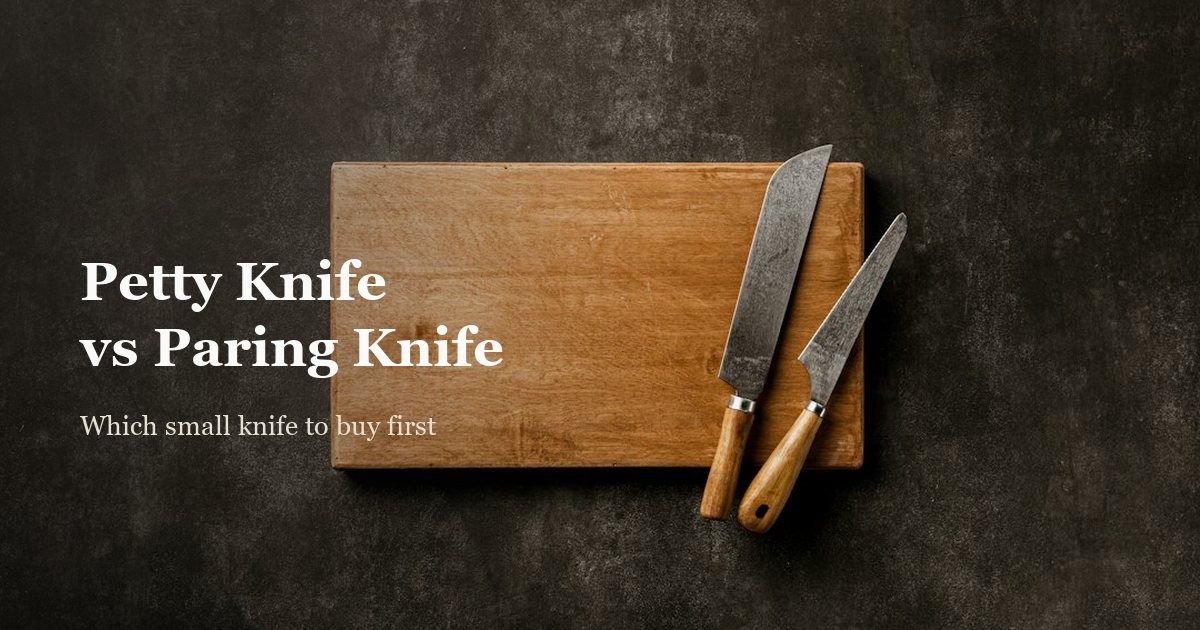
If you already own a gyuto or santoku, buy a 120mm petty knife first. It handles the small board work a big knife is clumsy at (shallots, garlic, herbs, trimming meat) and can still peel an apple. A paring knife is shorter (usually 80 to 100mm) and built for work done in your hand, like peeling, coring, and hulling strawberries. Buy one only if you do a lot of that, and it doesn't need to be expensive. Japan-made examples: the Sakai Takayuki TUS petty 120mm at $66.99 and the Tamahagane Bamboo paring knife 90mm at $56.99.
Some of the shops we link to are partners who may pay us when you buy through them. This doesn't change which pieces we recommend. How this works.
Most “petty vs paring” pages online are written by knife shops, and most of them end by recommending you buy both. That’s rarely necessary. The two knives overlap a lot, and the real question is where you do your small cutting: on the board, or in your hand.
Petty vs Paring: Comparison at a Glance
Prices are from Hocho Knife and were checked on September 26, 2026. The 120mm petty listed below is $66.99 and the 150mm is $71.99; the paring knife is $56.99.
The Real Difference: Board Work vs In-Hand Work
A petty knife is basically a small gyuto. It has enough length to slice on a board, with a pointed tip for detail work, and it fills the gap between a big chef’s knife and your hands. When you’re mincing one shallot or taking the silver skin off a pork tenderloin, a 210mm gyuto is more knife than the job needs, and that’s where the petty comes in.
A paring knife is shorter because it’s meant to be held close to the tip and moved against your thumb: turning an apple while the peel comes off, coring a tomato, cutting the eyes out of a potato. On a board, its short blade runs out of length quickly.
A petty can do most paring jobs, just a little less comfortably, because the longer blade sits further from your hand. A paring knife can’t do most petty jobs at all. That’s why the petty is usually the more useful first purchase.
Sakai Takayuki TUS Petty Knife: The One to Buy First
The Sakai Takayuki TUS line comes from Aoki Hamono, a knife maker in Sakai City, Osaka (the Sakai tourism bureau’s page on Aoki Hamono covers the company). It’s the same TUS steel line we use in our santoku vs gyuto comparison and gyuto size guide. According to Hocho Knife’s spec sheet, the petty knives are TUS high-carbon stainless steel with a double-bevel edge that works for left- and right-handed users, a plywood handle, and “Made in JAPAN.”
| Blade length | Total length | Weight | Price |
|---|---|---|---|
| 120mm (4.7 in) | 225mm (8.9 in) | 70g | $66.99 |
| 150mm (5.9 in) | 260mm (10.2 in) | 80g | $71.99 |
The 30mm and $5 between them matter less than what else you own. If your main knife is a 210mm gyuto, the 120mm is the better partner: it’s different enough in size to feel like a separate tool. If your main knife is a santoku of about 165 to 180mm, a 150mm petty is too close in length to add much, so the 120mm is the better choice there too. The 150mm makes more sense for people who want one small knife to do some slicing as well, like cutting sandwiches or portioning a small fillet.
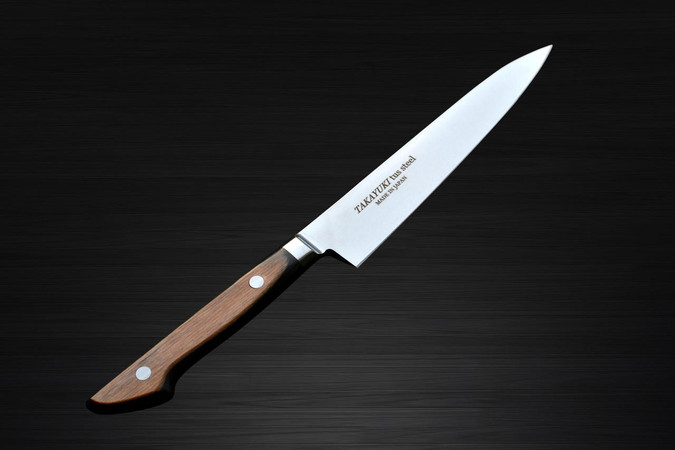
Sakai Takayuki TUS Steel Petty 120mm
TUS high-carbon stainless, double bevel, 70g, made in Sakai City, Japan.
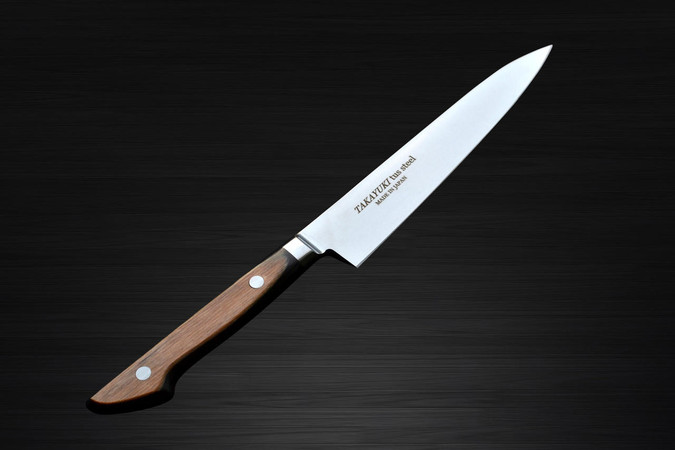
Sakai Takayuki TUS Steel Petty 150mm
Same steel and maker, 30mm longer, 80g. Made in Japan.
Pros:
- Covers the small board jobs a gyuto or santoku handles clumsily
- Light (70 to 80g), stainless, and double-beveled, so it’s easy to live with
- Priced close to a decent Western paring knife
Cons:
- Less comfortable than a real paring knife for peeling small, round fruit in your hand
- The plywood handle is practical rather than decorative
Tamahagane Bamboo Paring Knife: If You Peel by Hand a Lot
If most of your small-knife work is done in your hand (peeling apples and pears, coring tomatoes, hulling strawberries), a paring knife is the more comfortable tool. The Tamahagane Bamboo 3-Layer paring knife is 90mm long. Hocho Knife’s spec sheet lists the manufacturer as Kataoka (Japan), with a VG-5 steel core clad in 13-chrome stainless, an 18-8 stainless steel handle, a double-bevel edge, and “Made in JAPAN.” It’s $56.99.
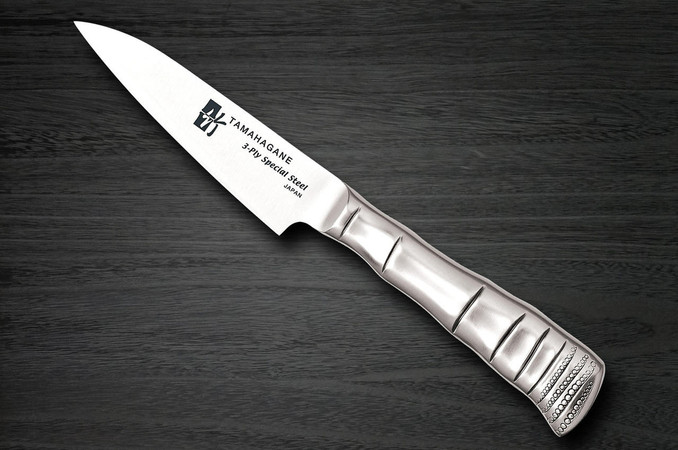
Tamahagane Bamboo 3-Layer Paring Knife 90mm
VG-5 core with stainless cladding, all-stainless handle, double bevel. Made in Japan.
Pros:
- The right shape for peeling and coring in the hand
- All-stainless construction, including the handle
Cons:
- Too short for most cutting-board work
- A metal handle can feel slippery with wet hands
Who shouldn’t spend on a Japanese paring knife: anyone who peels only occasionally. Peeling and coring don’t need premium steel, and an inexpensive Western paring knife from a brand like Victorinox does the job. We don’t earn anything from that suggestion. The case for a Japanese paring knife is that you want the same steel and sharpness as your other knives, not that the job requires it.
Petty or Paring: Which Should You Buy?
- You have a gyuto or santoku and want one more knife: a 120mm petty.
- Your main knife is a 165 to 180mm santoku: still the 120mm petty, not the 150mm.
- You peel and core fruit by hand most days: a paring knife, alongside or instead of a petty.
- You want one small knife that can also slice sandwiches or small fillets: a 150mm petty.
- You’re buying your first Japanese knife: neither. Start with a gyuto or santoku; our santoku buying guide is a good place to begin.
Whatever you buy, check that the maker and origin are listed, not just “Japanese-style.” Our guide to telling if a Japanese knife is real covers what to look for on a listing.
FAQ
Can a petty knife replace a paring knife? For most home cooks, yes. A 120mm petty can peel, trim, and core, just less comfortably than a shorter paring knife for in-hand work. It can’t go the other way: a paring knife is too short for most board work.
What size petty knife should I get? 120mm for most people, especially if you already own a 210mm gyuto or a santoku. In the Sakai Takayuki TUS line, the 120mm is 225mm overall and 70g; the 150mm is 260mm overall and 80g.
Is a petty knife the same as a utility knife? Roughly. Japanese retailers often list petty knives as “utility” knives, and Hocho Knife labels these “Petty Knife (Utility).” Western utility knives cover a similar length range but are sometimes serrated, which Japanese petty knives usually are not.
Do I need a Japanese paring knife? Not necessarily. In-hand peeling and coring don’t need premium steel. Buy a Japanese paring knife if you want it to match the rest of your knives, not because the job demands it.
How do I sharpen a petty or paring knife? The same way as a larger double-bevel knife, on a whetstone. Short blades are actually easier to sharpen evenly. Our whetstone grit guide covers which stones to start with.
Final Thoughts
A petty knife and a paring knife overlap more than knife shops usually admit. If you own a gyuto or santoku, the 120mm petty is the one small knife that adds the most, and it can peel in a pinch. Add a paring knife only if you really do a lot of peeling and coring in your hand, and remember that job doesn’t need an expensive blade.