Some of the shops we link to are partners who may pay us when you buy through them. This doesn't change which pieces we recommend. How this works.
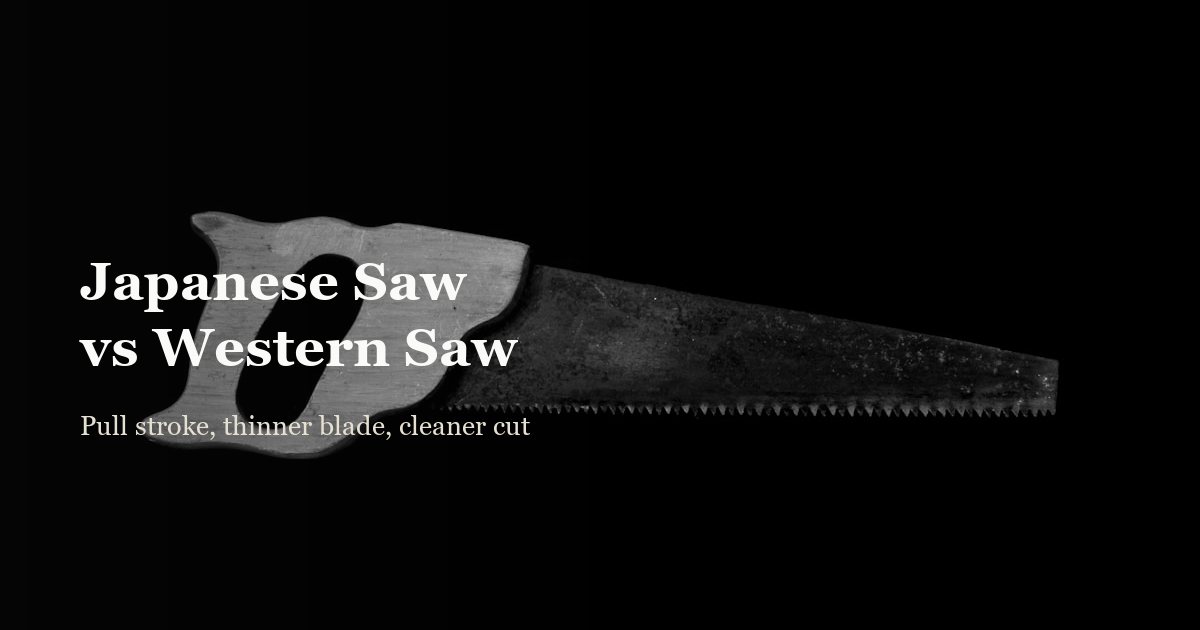
Quick answer: a Japanese saw (nokogiri) cuts on the pull stroke, which lets the blade be thinner and the kerf narrower, so it takes less effort and leaves a cleaner cut. A Western saw cuts on the push stroke, which needs a thicker, set-toothed blade to keep it from buckling. Neither is strictly “better” — the pull saw is easier to start and control for most people, the push saw is more forgiving of rough handling and doesn’t need to be pulled toward your body. Two verified Made-in-Japan picks below.
The Core Differences
| Japanese Saw (Nokogiri) | Western Saw | |
|---|---|---|
| Cutting stroke | Pull (toward the body) | Push (away from the body) |
| Blade under | Tension | Compression |
| Typical blade thickness | 0.010–0.020 in | 0.020–0.035 in |
| Kerf (cut width) | Narrower, roughly half | Wider |
| Tooth set | Minimal or none | Teeth bent outward to prevent binding |
| Common styles | Ryoba (rip + crosscut edges), Dozuki (reinforced spine, fine joinery) | Backsaw, tenon saw, panel saw |
Sources: WoodWorkers Guild of America, Hamana Tool — figures broadly consistent across both.
Why the Pull Stroke Actually Matters
A blade under tension (being pulled straight) resists buckling in a way a blade under compression (being pushed) doesn’t, so a Japanese saw can use a noticeably thinner blade without it flexing or wandering mid-cut. That thinner blade means a narrower kerf, which translates directly into less material removed and less resistance on every stroke. It’s the same reason cutting with a Japanese saw feels lighter than it looks: you’re not fighting a wide, set-toothed blade forcing its way through wood, you’re drawing a thin blade back through a cut it barely has to force open.
The tradeoff shows up in technique, not tool quality. A pull saw is easier to start accurately, since drawing the blade toward you gives more control at the initial cut. It’s harder to correct once a cut has wandered off-line, because you’re steering by pulling rather than by leaning weight into the stroke the way you can with a push saw. Most people find the learning curve shorter with a pull saw; a few who’ve spent years with Western saws find the reversed motion awkward at first.
Ryoba vs. Dozuki: The Two Styles Worth Knowing
Nearly every Japanese pull saw sold for general use is one of these two styles, and picking the wrong one for the job is the most common beginner mistake:
- Ryoba has teeth on both edges of the blade: one side filed for ripping (cutting with the wood grain), the other for crosscutting (cutting across it). It’s the general-purpose pick if you only want one saw.
- Dozuki has a single row of very fine crosscut teeth and a reinforced metal spine along the back, which keeps the blade rigid for precise, shallow cuts — dovetails, tenon shoulders, and any joint where accuracy matters more than cutting speed.
SUIZAN Ryoba Double Edge Saw, 9.5”
SUIZAN names its own manufacturing background directly: blades made by craftsmen in a Japanese town with a saw-making history of more than a century, per the brand’s own product description. This is the general-purpose ryoba, with rip teeth on one edge and crosscut teeth on the other, and a replaceable blade rather than a fixed one.
Pros:
- Rip and crosscut edges on one blade, so it covers most general cutting without a second saw
- Replaceable blade, so a dulled or damaged edge doesn’t mean replacing the whole tool
- By far the largest review base of any pick here, which makes the rating easy to trust
Cons:
- A dedicated dozuki will still out-perform it on fine joinery like dovetails
- Folding or fixed-handle versions vary by listing; check which you’re ordering
- Thin blade needs a straight, even pull; forcing it sideways can kink it
Bottom line: the one saw to own if you’re only buying one.

SUIZAN Ryoba Double Edge Saw, 9.5"
Rip and crosscut edges, replaceable blade. 4.8★ (9,804 ratings).
Gyokucho Folding Japanese Dozuki Razor Saw
Gyokucho is a long-established Japanese saw manufacturer, and this dozuki’s reinforced spine and fine, uniform crosscut teeth are built specifically for joinery cuts, not general demolition or rough lumber work. The folding handle is a genuine practical difference from the SUIZAN pick above: it closes for storage and safer transport, at the cost of a very slightly less rigid grip than a fixed handle.
Pros:
- Reinforced spine keeps the thin blade rigid for accurate, shallow joinery cuts
- Folding handle is safer to store and transport than an exposed fixed blade
- Fine, uniform teeth leave a clean cut with minimal tear-out on hardwood
Cons:
- Not built for ripping or fast material removal; that’s what a ryoba is for
- Smaller review sample than the SUIZAN pick, though the rating itself is solid
- Limited stock at the time of writing; availability can be tight
Bottom line: the pick once you’re doing dovetails, tenon shoulders, or any cut where the line has to be exact.

Gyokucho Folding Dozuki Razor Saw
Reinforced spine, fine crosscut teeth, folding handle. 4.6★ (50 ratings).

Which One Should You Buy?
- You want one saw that handles most general cutting: the SUIZAN Ryoba.
- You’re doing dovetails, tenon shoulders, or other precision joinery: the Gyokucho Dozuki.
- You do both regularly: most woodworkers who own a Japanese saw eventually own one of each, since they’re built for genuinely different cuts rather than competing at the same job.
FAQ
Is a Japanese pull saw better than a Western push saw? Neither is strictly better. A pull saw’s thinner blade and narrower kerf make it easier to start and control for most people, and it takes less force per stroke. A Western push saw is generally more forgiving of rough or off-axis handling and doesn’t require pulling the blade toward your body, which some people find more natural after years of practice.
What’s the difference between a ryoba and a dozuki? A ryoba has teeth on both edges of the blade, one side for ripping and one for crosscutting, and is the general-purpose choice. A dozuki has a single row of fine crosscut teeth and a reinforced spine for rigidity, built for precise, shallow joinery cuts like dovetails rather than fast material removal.
Do Japanese saw blades need to be replaceable? Not necessarily, but it’s a real practical advantage. The steel is hardened to hold an edge longer than a typical Western blade, and when it does eventually dull past the point of resharpening, a replaceable-blade design means buying a new blade rather than a new saw.
Can a beginner use a Japanese pull saw? Yes, and many woodworking guides recommend it as the easier saw to learn on, since the pull stroke gives more control when starting a cut. The main adjustment is technique: you’re drawing the blade toward you rather than pushing it away, and pulling sideways instead of straight back is what most commonly kinks the thin blade.
Final Thoughts
The pull-versus-push distinction isn’t a gimmick or a style preference: a thinner, tension-loaded blade genuinely cuts with less effort and a narrower kerf than a thicker, compression-loaded one, which is the entire reason Japanese saws feel different in hand from the first cut. Pick a ryoba if you want one general-purpose saw, or a dozuki if fine joinery is the actual job. If you’re building out a full set of Japanese hand tools, see our Japanese chisels vs Western chisels and Japanese hand plane vs Western hand plane comparisons next, and our buyer’s checklist for real vs. knockoff Japanese craft for how to spot an import with no stated maker or origin, whatever tool you’re shopping for.