Some of the shops we link to are partners who may pay us when you buy through them. This doesn't change which pieces we recommend. How this works.
For a genuinely made-in-Japan panel with the deepest review history, get the NARUMI Great Wave Hokusai noren (~$18, polyester, "Made in Japan" stated directly in the listing, 4.7★ across 601 ratings). If you want cotton instead, the Narumi Japan Sevens Owl (~$16, 100% cotton, Made in Japan) is the better pick. Noren itself isn't a protected craft name, so the checklist is the same one this site uses everywhere: check the structured Country of Origin field, not just the title. One listing below shows exactly why that matters, from a seller using the same brand name as our top picks.
The 3 Picks
| Noren | Price | Material | Why It Works |
|---|---|---|---|
| NARUMI Great Wave Hokusai | ~$18 | 100% polyester | Most reviewed pick here, Made in Japan stated in listing |
| NARUMI Black Cats | ~$25 | Polyester, blackout | Amazon’s Choice, largest size (59in) |
| Narumi Japan Sevens Owl | ~$16 | 100% cotton | Best cotton pick, highest rating (4.8★) |
Checked against current Amazon.com listings on September 9, 2026.
Noren Is a Function, Not a Protected Name
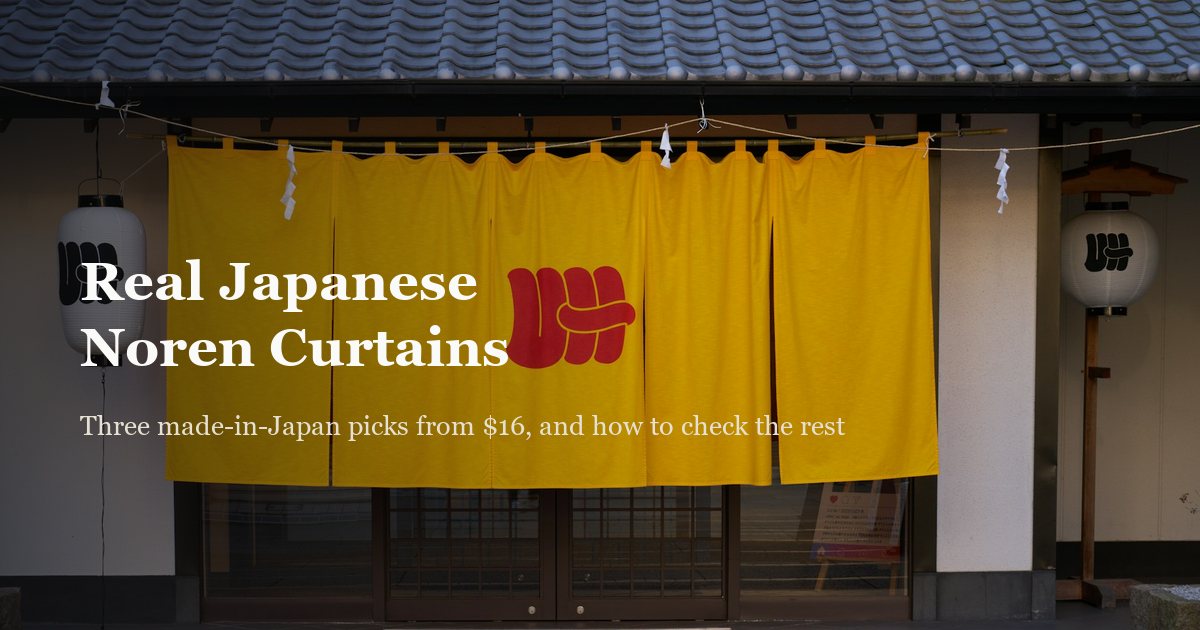
A noren (暖簾) is a split fabric panel hung across a doorway, window, or storefront entrance. The idea is old: cloth hung over openings for warmth and to keep dust out traces back to the Heian period (794-1185), and the version most people picture today, dyed with a shop’s name or crest in white against an indigo background, is an Edo-period (1603-1868) development. Shops used them as a form of signage: a hanging noren meant open for business, and taking it down at closing time was a literal, physical “closed” sign. One detail that survives in noren history write-ups: at some Edo-period restaurants, customers wiped their hands on the noren on the way out, so a well-worn, stained noren was read as a sign the place was actually busy.
None of that history is trademarked. “Noren” describes a shape and a function, a split panel hung in a doorway, not a regionally protected craft the way Kutani ware or Wakasa-nuri lacquerware are. That means a print-on-demand curtain factory anywhere in the world can call its product a noren, the same way anyone can print a wave pattern and call a cloth square a furoshiki. So the useful question for a buyer isn’t “is this a real noren.” Plenty of decorative tapestry-style panels are honestly exactly what they claim to be, a curtain in the noren shape with a Japanese-inspired print. The useful question is narrower: does this specific listing name a real country of origin, or does it just borrow the word and the look?
NARUMI Great Wave Hokusai
The NARUMI 鸣海 Great Wave Hokusai noren is a 33.5in x 33.5in (85cm x 150cm) polyester panel depicting Katsushika Hokusai’s woodblock print Under the Wave off Kanagawa. Its Amazon listing states “Made in Japan” directly in the product bullets, not only in the title, and it’s the most-reviewed pick on this page by a wide margin: 4.7 stars across 601 ratings, and an Amazon’s Choice badge.

NARUMI Great Wave Hokusai Noren
33.5"L x 33.5"W, 100% polyester, "Made in Japan" stated in listing. 4.7★ (601 ratings).
Pros:
- Highest review count of any pick on this page, which makes the rating easier to trust
- Made in Japan stated in the structured product bullets, not just the title
- Recognizable, well-documented public-domain artwork, so there’s no design-licensing ambiguity
Cons:
- Square-ish proportions (33.5in x 33.5in) rather than a longer drop; check the size fits your doorway before buying
- Polyester, not a natural fiber, if that matters to you
- Amazon’s product-detail page lists the brand two different ways (“NARUMI 鸣海” in the title, “Japonmania” in the brand field), a minor inconsistency worth knowing about, though the origin claim itself is consistent
Bottom line: the easiest, cheapest, best-reviewed pick if you just want one genuinely made-in-Japan noren without overthinking the design.
NARUMI Black Cats
The NARUMI 鸣海 Black Cats noren is a larger 59.06in x 33.46in polyester panel with a blackout lining, printed with a Japanese-cat ukiyo-e-style design. Its product description states it was “made by master craftsman ‘TAKUMI’ of Japan,” and “Made in Japan” appears in the structured bullets as well. It carries a 4.7-star rating across 330 reviews and an Amazon’s Choice badge.

NARUMI Black Cats Noren
59.06"L x 33.46"W, polyester, blackout lining, "Made in Japan" stated in listing. 4.7★ (330 ratings).
Pros:
- Largest panel on this page (59in drop), a better fit for a standard interior doorway than the shorter, more square-shaped picks
- Blackout-rated fabric, useful if you actually want it to block light, not just decorate a wall
- Made in Japan stated in the structured listing details
Cons:
- Priced higher than the other two picks here
- Single design; you’re committing to the black-cat motif
- Polyester rather than a natural fiber
Bottom line: the pick if you want a noren sized to actually work as a doorway curtain, not just a wall hanging.
Narumi Japan Sevens Owl
The Narumi Japan Sevens Owl noren is a smaller 33.46in x 33.46in, 100% cotton panel, listed with “Made in Japan” stated directly and a material field that says “Cotton” rather than leaving it vague. It has the highest rating of any pick on this page: 4.8 stars across 65 reviews, with an Amazon’s Choice badge.

Narumi Japan Sevens Owl Noren
33.46"L x 33.46"W, 100% cotton, "Made in Japan" stated in listing. 4.8★ (65 ratings).
Pros:
- The only cotton pick on this page with Made in Japan stated in the listing, useful if natural fiber matters to you
- Highest star rating here, though on a smaller review sample than the Great Wave pick
- Cheapest of the three picks at the time of checking
Cons:
- Smallest, most square-shaped panel of the three, better suited to a narrow doorway or as a wall hanging than a wide entrance
- Lower review count than the polyester picks (65 vs. 601 and 330)
- Cotton needs more care than polyester if it gets dirty; it isn’t a wipe-clean fabric
Bottom line: the pick if you specifically want a natural-fiber noren rather than a synthetic one, and don’t need a large panel.
Same Brand Name, Different Country of Origin: Why the Title Isn’t Enough
Here’s the case for actually reading the spec sheet instead of trusting the brand name: a cotton noren sold under the same “NARUMI 鸣海” branding as two of the picks above (a vertical-stripe design, not one of our picks) lists its structured product details as “Material: Cotton, Country of origin: India.” Nothing else about the listing discloses that up front; the title just says “Japanese Noren Long Type Curtain Tapestry.”
To be clear about what this does and doesn’t show: it isn’t proof the brand’s other listings are also made elsewhere. The two “NARUMI” picks above each state “Made in Japan” in their own structured details, and there’s no reason to assume that’s false just because a different product from the same storefront name says something else. What it does show is that a Japanese-sounding brand name printed on an Amazon listing tells you nothing reliable about where a specific item was actually made. The listing that matters is the one for the exact product you’re about to buy, and the field that matters is Country of Origin, not the brand name in the title. This is the same six-point checklist this site uses for knives, teapots, and lacquerware, applied here to a category where even the brand name can point two different ways across two products.
What a Generic “Japanese Style” Noren Looks Like
A large share of noren listings on Amazon don’t claim a country of origin at all, and don’t try to. Brands like LIGICKY and Ofat Home sell dozens of polyester noren-style panels (Hokusai wave prints, cats, cranes, cherry blossoms) priced around $19 to $24, with no “Made in Japan” bullet, no maker named beyond the storefront brand, and titles that use “Japanese Style” or “Japanese” as a design descriptor rather than a claim about manufacturing. Some of these have excellent review counts (Ofat Home’s cat design has over 400 reviews at 4.7 stars) and are a perfectly reasonable way to decorate a wall or doorway on a budget. The distinction isn’t quality: it’s that they’re not claiming to be Japan-made, so there’s nothing to fact-check. That’s a different, more honest position than a listing that implies Japanese manufacturing through kanji in the brand name while the spec sheet says otherwise.
Sizing: Doorway Curtain vs. Wall Hanging
Most Amazon noren fall into two rough size classes, and knowing which one you’re buying avoids a common complaint in reviews (“too small to actually use as a curtain”):
- Square-ish, roughly 33in x 33in: the size of two of our picks (Great Wave Hokusai and Sevens Owl). Fine as a decorative wall hanging or a narrow doorway divider, but won’t fully cover a standard-width interior doorway.
- Long, roughly 59in and up: the size of the Black Cats pick. Sized to actually function as a doorway curtain, hung from a tension rod, the way a traditional shop noren works.
If you’re buying one specifically to hang in a doorway and have it actually block a sightline, check the length field before buying, not just the pattern.
Which One Should You Buy?
- You want the best-reviewed, cheapest genuinely Japan-made option: the NARUMI Great Wave Hokusai.
- You need something sized to actually work as a doorway curtain: the NARUMI Black Cats.
- You want cotton instead of polyester: the Narumi Japan Sevens Owl.
For more real-vs-decorative textile picks in the same price range, see our Japanese furoshiki wrapping cloths guide and tenugui vs furoshiki comparison. And for the full six-point checklist this article is built on, see how to tell real Japanese craft from knockoffs.
FAQ
Is noren a protected or regionally designated Japanese craft, like Kutani ware? No. Noren describes a shape (a split fabric panel) and a function (hung across a doorway or entrance), not a place-name craft tradition. That’s why the country-of-origin field on the specific listing matters more here than a craft-region name would.
Does polyester mean a noren isn’t authentic? No. Polyester is a normal, common material for noren sold both in Japan and abroad, and several genuinely made-in-Japan listings, including two of our picks, use it. The material isn’t the tell; whether the listing honestly states its material and country of origin is.
Why do two products from the same “NARUMI” brand name show different countries of origin? Brand names on Amazon marketplace listings aren’t a reliable guarantee of a single, consistent manufacturing location across every product a storefront sells. Treat each listing’s own structured Country of Origin field as the source of truth, not the brand name printed on other products from the same seller.
Can I use a noren as a normal curtain, not just decor? Yes, and the longer (roughly 59in and up) panels are sized for exactly that. The shorter, more square panels sold as “curtain tapestry” are better suited to wall decor or a narrow gap than a full doorway.
Final Thoughts
Noren is one more category on this site where the underlying craft name is old and real, but the modern product name isn’t protected, so it can’t do the authenticity work for you. The three picks above each state Made in Japan directly in their structured product details, not just their titles, and the vertical-stripe listing above shows exactly why that distinction matters: the same brand name, applied to a different product, states a different country of origin outright. Read the spec sheet, not the kanji in the brand name.