Some of the shops we link to are partners who may pay us when you buy through them. This doesn't change which pieces we recommend. How this works.
For a straightforward round kenzan that works in almost any bowl or vase, get the Wazakura Round Kenzan, 3.25in Brass. For a two-piece design that splits into a pair of half-moons for narrow or oddly shaped containers, get the Wazakura Sun and Moon Kenzan. Both list "Origin: Sanjo, Niigata prefecture (Japan)" directly in their specifications, sold on Amazon by Wazakura Japan Inc. itself. Most of the generic "flower frog" and "ikebana pin holder" listings sharing the same search results never state a country of manufacture at all.
The Sister Category to This Site’s Ikebana Scissors Guide
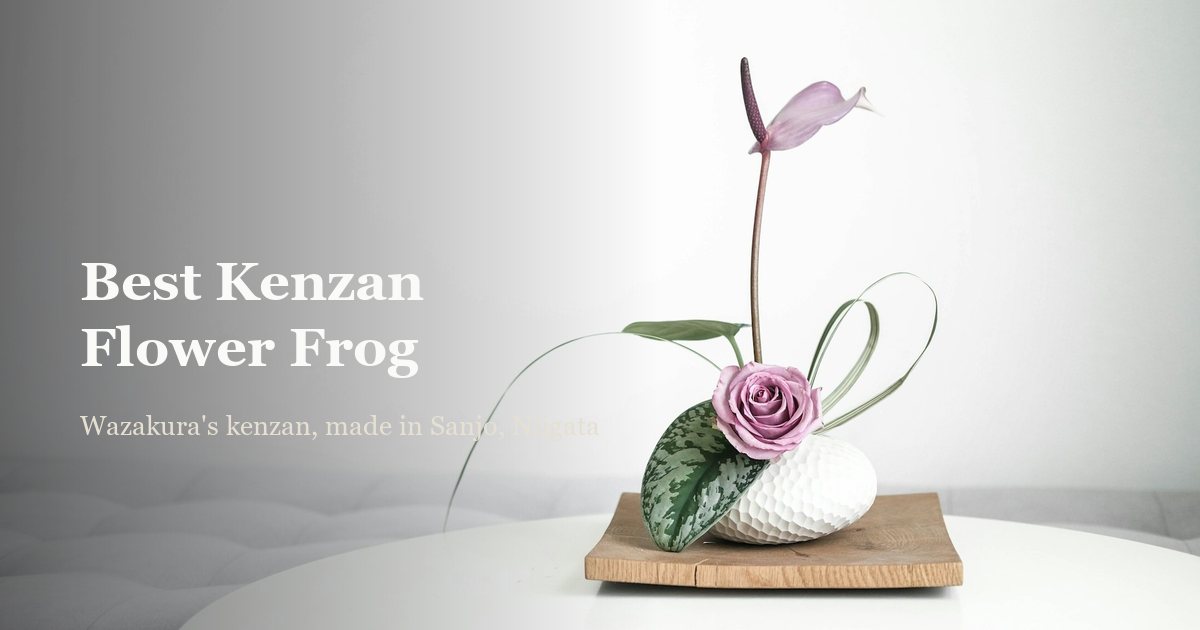
A kenzan (剣山, literally “sword mountain”) is the heavy, needle-studded disc that holds stems upright in ikebana, more commonly called a flower frog or pin frog in English. According to Wikipedia’s entry on the kenzan, the tool was adopted by the Moribana school of ikebana around 1910, though flower frogs of various designs go back to the 16th century, and the format predates floral foam by roughly sixty years. It’s the direct companion tool to the ikebana scissors this site covered days earlier, and it raises the same question this site keeps asking about garden and kitchen tools: does “Japanese” in a listing title describe where a kenzan was actually forged, or just the flower-arranging style it’s built for?
Search “kenzan flower frog” on Amazon and the field is large (over 500 results) and mostly anonymous: stainless-steel multipacks from brand names like WUWEOT, Sliner, and Eggone, sold in sets of three or more, with no country of manufacture named anywhere in the listing. Wazakura is the one brand that turns up repeatedly with a specific, checkable origin claim attached to every size and shape it sells.
Comparison at a Glance
Checked against current Amazon.com listings on September 19, 2026. Prices vary by retailer and change often.
Sanjo, Niigata Again: The Fifth Category From the Same District
Both kenzan below are made by Wazakura, the same company this site verified manufacturing bonsai scissors in Sanjo City, Niigata Prefecture, and the same brand behind the Ikenobo-style ikebana scissors covered in this site’s previous article. Both kenzan listings repeat the identical origin format Wazakura uses across its catalog: a named material breakdown (brass needles, stainless steel base, natural rubber gasket) and “Origin: Sanjo, Niigata prefecture (Japan)” stated as a specification field, not just a marketing line in the title.
That makes kenzan the fifth product category (after pruning shears, bonsai scissors, hori-hori knives, and ikebana scissors) this site has now traced back to the Tsubame-Sanjo metalworking district, and the second one specifically from Wazakura. A single company repeating the same claim across its catalog isn’t independent verification on its own, but Wazakura selling both products directly on Amazon (rather than through an anonymous reseller) at least means the origin claim is attached to a company with a real storefront and a return policy behind it, not just a listing title.
1. Wazakura Round Kenzan, 3.25in Brass
This is the simpler of the two designs: a single 3.25-inch brass disc with 331 needles set into a stainless steel base and a removable natural rubber gasket that protects the inside of a vase or bowl. It’s rated for general ikebana and moribana-style arranging, and Amazon’s own listing marks it as an Amazon’s Choice pick with more than 50 units sold in the past month at the time we checked, the widest adoption of any single kenzan design we found with a stated Japan origin.
Pros:
- Origin stated as a specification field: “Sanjo, Niigata prefecture (Japan)”
- Sold directly by Wazakura Japan Inc. on Amazon, not through an unrelated reseller
- Simple round shape works in the widest range of vases and bowls without modification
- Removable rubber gasket protects ceramic and glass containers from scratches
Cons:
- Brass needles will develop a patina over time; this isn’t a defect, but buyers expecting a permanently bright finish should know it going in
- A fixed round shape doesn’t adapt to narrow-necked or irregular vases the way a splittable design does
- At 331 needles it holds slightly fewer stems than the Sun and Moon design
Bottom line: the simpler, more broadly compatible shape, and the one to buy first if you don’t already know you need something narrower.

Wazakura Ikebana Kenzan Flower Holder, 3.25in Brass
Made in Japan (Sanjo, Niigata), 331 brass needles, removable rubber gasket. 4.8★ (94 ratings), Amazon's Choice.
2. Wazakura Sun and Moon Kenzan, 3.75in x 2.25in Brass
The Sun and Moon design splits into two separate pieces, a larger circular “sun” half and a crescent “moon” half, each of which can be used on its own or fitted together into a single 3.75 x 2.25-inch unit. That splits the difference between one large kenzan and two small ones: use both halves together in a wide bowl for a full moribana arrangement, or separate them to anchor stems in two different containers, or into a single narrow-necked vase where a full-size round kenzan wouldn’t fit. At 370 needles across the combined pieces, it holds slightly more than the single round design, and it’s the more heavily reviewed of Wazakura’s kenzan listings at the time we checked.
Pros:
- Same stated Sanjo, Niigata origin and material breakdown as the round design
- Two-piece format adapts to narrow vases and irregular containers a single round kenzan can’t fit
- Highest review count and rating of any Wazakura kenzan we found (4.9★, 133 ratings)
- Can double as two smaller kenzan for splitting one arrangement across two containers
Cons:
- The two-piece format is a specific-use design; if you only ever use standard round bowls, the simpler round kenzan does the same job for the same price
- Slightly heavier and larger footprint than the single round disc when used as one unit
- Same brass-patina maintenance consideration as the round design
Bottom line: the pick if you arrange in narrow vases, split arrangements across containers, or simply want the more flexible of the two shapes.
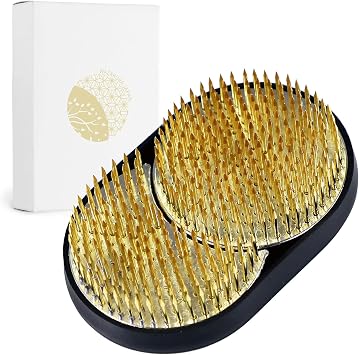
Wazakura Sun and Moon Ikebana Kenzan, 3.75in x 2.25in Brass
Made in Japan (Sanjo, Niigata), 370 brass needles, splits into two pieces. 4.9★ (133 ratings), Amazon's Choice.
Where Generic “Flower Frog” Listings Get Murky
Search “flower frog” or “ikebana pin holder” without the brand name attached, and the results fill up fast with multipacks: three, four, or sixteen kenzan-style pins bundled together for $10-20, sold under names like WUWEOT, Sliner, or generic ASIN-only listings, with reviews numbering in the hundreds. None of this makes them poorly made; a stainless-steel pin frog is a simple enough object that a well-made anonymous version can hold stems just as well as a named one. But none of those listings state a country of manufacture anywhere in the title or specification fields, which matters specifically if a Japan-made kenzan, not just a kenzan-shaped tool, is what you’re paying extra for. That’s the same country-of-origin check this site applies to every category: a listing that names a company and a city gives you something to verify; one that only says “Japanese” or “ikebana” in the title doesn’t.
Which One Should You Buy?
- For a simple, all-purpose kenzan that fits most bowls and vases, get the Wazakura Round Kenzan, 3.25in.
- For narrow vases, irregular containers, or the flexibility to split one kenzan into two, get the Wazakura Sun and Moon Kenzan.
- If a “flower frog” or “kenzan” listing never names a company, a city, or a country of manufacture beyond the word “Japanese” in the title, treat that as a style description, not a manufacturing claim.
FAQ
What does “kenzan” mean, and why is it also called a flower frog? Kenzan (剣山) translates literally to “sword mountain,” describing the rows of upright needles. “Flower frog” is the common English name for the same tool, though the exact reason for that nickname isn’t well documented; the most common explanation is that, like a frog, it lives submerged in water at the bottom of a vase.
Is a kenzan older than floral foam? Yes, by a wide margin. According to Wikipedia, the kenzan format was adopted by the Moribana school of ikebana around 1910, roughly six decades before floral foam became widely available, and pin-and-needle flower-holding designs go back as far as the 16th century.
Do I need a Japan-made kenzan, or is any pin frog good enough? For basic stem-holding, a well-made pin frog from any manufacturer works. A Japan-made kenzan matters specifically if you’re studying ikebana in a school tradition that specifies particular tools, or if a documented Sanjo, Niigata origin is part of what you’re paying for, the same distinction this site draws with ikebana scissors and garden tools from the same district.
Will the brass needles rust or discolor? Brass will develop a natural patina over time rather than rust the way carbon steel does. It’s a cosmetic change, not a functional one, and can be polished back to a brighter finish with a standard metal-care solution if preferred.
Can I use a kenzan in a glass vase without scratching it? Wazakura’s kenzan ship with a removable natural rubber gasket that sits between the metal base and the container, which is specifically meant to prevent scratching on glass or ceramic vases.
Final Thoughts
Wazakura states the same Sanjo, Niigata origin on both of these kenzan that it names on its ikebana scissors and bonsai tools, sold directly on Amazon rather than through an unrelated reseller. That’s a more specific claim than the anonymous multipacks that dominate a plain “flower frog” search, which don’t make a country claim either way. For the underlying method behind picks like these, see our buyer’s checklist for real vs. knockoff Japanese craft.
For the rest of this site’s coverage of the same ikebana category, see our Best Japanese Ikebana Scissors guide, and for the same Niigata cutlery district applied to other tools, see Best Japanese Bonsai Tools.