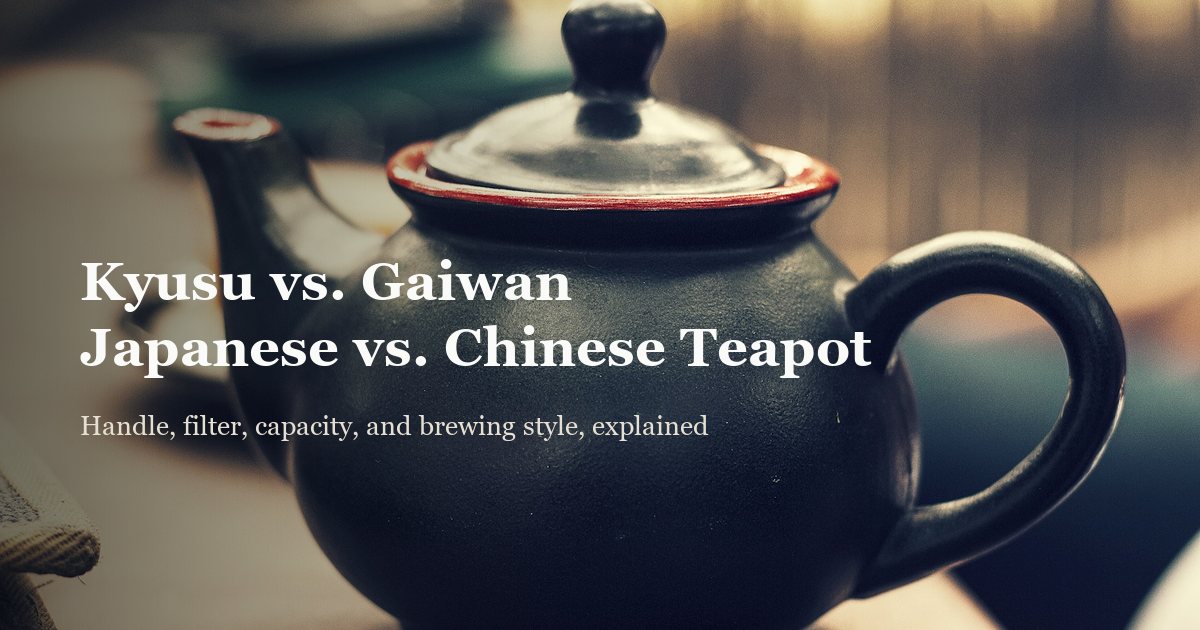
Quick answer: a kyusu is a Japanese side-handled teapot built to steep a fuller pot of green tea (sencha, for example) in one go and pour it out across several small cups. A gaiwan is a Chinese lidded bowl with no handle and no built-in strainer. You hold the bowl and lid together to brew small, concentrated infusions one after another, gongfu-cha style, and drink straight from it or pour into a separate cup. They’re built for different brewing habits, not competing versions of the same object. Details, and two verified kyusu picks, below.
Some of the shops we link to are partners who may pay us when you buy through them. This doesn't change which pieces we recommend. How this works.
Comparison at a Glance
| Kyusu (急須) | Gaiwan (蓋碗) | |
|---|---|---|
| Origin | Japan | China (popularized during the Ming dynasty) |
| Structure | Pot with lid, spout, and side or rear handle | Three-piece lidded bowl (bowl, lid, saucer), no handle |
| Filter | Built-in ceramic mesh (yakishime) or attached stainless mesh | None; the lid itself is angled to hold back leaves while pouring |
| Typical capacity | Roughly 300 to 500 ml, made for a fuller pot | Roughly 100 to 150 ml, made for small, repeated infusions |
| Material | Unglazed clay (Tokoname, Banko) or glazed porcelain (Mino, Hasami, Kutani) | Usually glazed porcelain; sometimes paired with a separate unglazed Yixing pot for oolong or pu-erh |
| Brewing style | One longer steep, poured out across several cups | Many short infusions, tasted and adjusted as you go |
| Best suited to | Japanese green teas: sencha, gyokuro, hojicha | Chinese teas: oolong, pu-erh, white tea |
Sources: Wikipedia (Kyūsu), Wikipedia (Gaiwan). Both are useful for the structural basics; treat brewing-ratio numbers below as general guidance from English-language tea guides rather than a fixed standard, since practice varies by tea and by drinker.
Why the Handle (or Lack of One) Isn’t Cosmetic
A kyusu’s side handle (yokode) exists so you can pour a fuller pot one-handed while your other hand steadies the lid. It’s built around the idea of brewing once and serving several cups from that single pot. Some kyusu use a rear handle instead (dobin-style), which functions similarly.
A gaiwan has no handle at all. You hold the bowl by its rim and the lid by its knob, tilt the lid just enough to let liquid out while it holds the leaves back, and pour directly from the bowl, into a cup or straight into your mouth if you’re drinking alone. The bare bowl is meant to be picked up, used for one quick infusion, and set back down, over and over, which suits gongfu-style brewing.
Why the Filter Works So Differently
A kyusu’s strainer is built into the pot itself: either a ceramic mesh fired into the body (yakishime, the higher-end option, with no metallic taste) or a stainless mesh fitted at the spout. Either way, the tea leaves stay in the pot and you pour clean liquid out through the spout.
A gaiwan has no mesh anywhere. The lid is shaped and angled to create a narrow gap when tilted, wide enough for tea to pass and narrow enough to hold back the leaves. It takes more practice to pour without spilling leaves or scalding your fingers on the rim, which is part of why a kyusu is often recommended as the easier starting point for someone new to loose-leaf tea, while a gaiwan is closer to a deliberate skill some Chinese-tea drinkers work up to.
Why the Two Traditions Brew Differently
The capacity difference reflects two different ideas about what a “cup of tea” is. A kyusu holds enough for one steep to fill two or three small cups, and Japanese green teas are typically steeped once or twice at most. A gaiwan’s much smaller capacity is built for gongfu cha, where the same leaves go through many short, concentrated infusions in a row, sometimes eight or ten, with the flavor shifting steep to steep. Green tea’s flavor compounds extract quickly and can turn bitter if oversteeped, which suits the kyusu’s one-and-done approach. Oolong and pu-erh tend to unfold gradually across repeat infusions, which is what the gaiwan’s format is built for.
You’ll also see Yixing teapots mentioned alongside gaiwan. They’re a separate Chinese vessel, made from a porous purple clay (zisha) mined in Jiangsu Province, typically used for the same gongfu-style brewing of oolong or pu-erh. Unlike a gaiwan, a Yixing pot does have a handle, usually a top-mounted arched one. The clay is prized because it’s porous enough to absorb oils from the tea over years of use, so collectors often dedicate one pot to a single tea, similar to how an unglazed Tokoname kyusu is recommended for one type of tea rather than switched between several.
Which One Should You Get?
- Get a kyusu if you mainly drink (or want to start drinking) Japanese green teas, and you want a pot that makes a full round of tea in one steep without much technique to learn.
- Get a gaiwan if you’re drinking oolong, pu-erh, or white tea and want to taste how the flavor changes across several short infusions. It’s also the more compact, travel-friendly option of the two.
- You don’t need to choose only one. Plenty of tea drinkers keep both and reach for whichever matches what’s in the cupboard that day. See our kyusu authenticity checklist if you’re shopping for the Japanese side of that pairing.
Two Verified Kyusu Examples
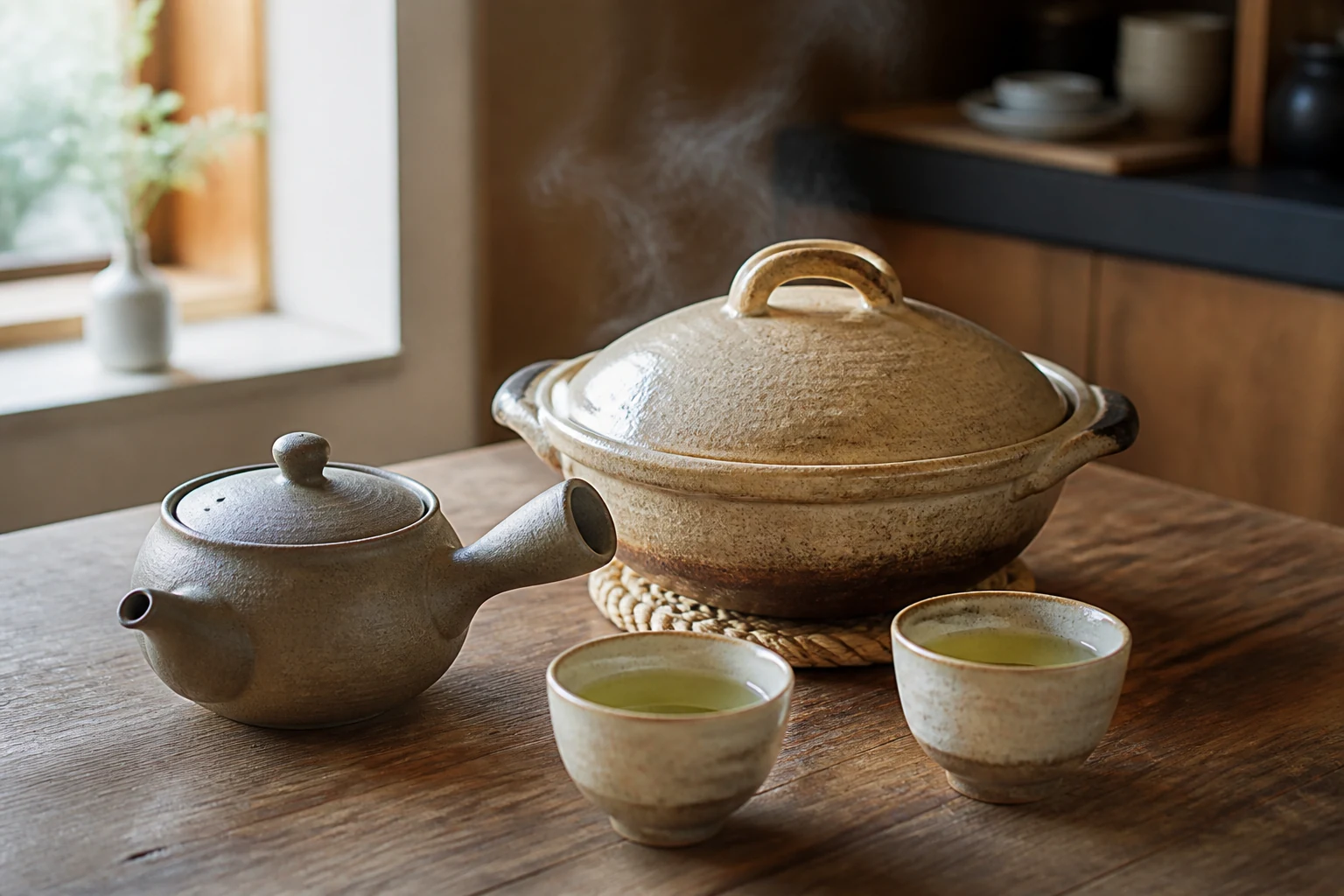
If you want to try the Japanese side of this comparison, both of these are currently in stock at Musubi Kiln and pass our own authenticity checklist (named region, named maker, explicit material spec):
IROIRO Cylindrical Teapot, 15.5 fl oz: Maker/Brand field states Jinsui / Tokoname Ware. Unglazed stoneware, 460 ml, built-in ceramic mesh strainer. ¥16,434 (roughly $103 at the exchange rate at the time of writing, 2026-08-25 stock check). Hand wash only. This is the unglazed-clay category, chosen for its effect on flavor over repeated brews.
White Japanese Teapot, Mino Ware: named region (Mino, Gifu Prefecture), glazed porcelain, 470 ml, attached stainless steel strainer. ¥8,316 (roughly $52, 2026-08-25 stock check). A more forgiving everyday piece than an unglazed kyusu; check dishwasher use against the individual listing rather than assuming it either way.
Musubi Kiln isn't yet a partner shop for this site, so these are plain links with no tracking or commission.
FAQ
Is a gaiwan harder to use than a kyusu? It takes more practice to pour cleanly without spilling leaves or burning your fingers, since there’s no handle and no built-in mesh. Most guides suggest a kyusu (or a simple mesh infuser) as the easier starting point, with a gaiwan as a skill worth building once you’re brewing Chinese teas regularly.
Can I brew Japanese green tea in a gaiwan, or Chinese oolong in a kyusu? Yes, neither is off-limits, but you’re working against the design either way. A gaiwan’s small size and open pour suit the frequent, adjustable infusions that oolong and pu-erh reward, while a kyusu’s larger pot and clean pour work well for green tea’s quicker single or double steep.
What’s the difference between a gaiwan and a Yixing teapot? Both are used for the same style of Chinese tea brewing, but a gaiwan is a handle-less lidded bowl, while a Yixing pot is a true teapot with a spout and handle, made from a specific porous clay (zisha) that’s meant to absorb flavor over years of use with the same tea.
Does an unglazed kyusu work the same way as a Yixing pot? They’re built on a similar principle: both are unglazed, porous clays that season with use and are usually dedicated to one type of tea. But they come from separate traditions (Tokoname/Banko clay in Japan vs. zisha clay in China) and aren’t interchangeable in shape or brewing style.
Final Thoughts
Neither pot is a better version of the other; they were built for different teas and different rituals. If you already know which tea you drink most, that answers the question for you: Japanese green teas call for a kyusu, and Chinese oolong or pu-erh call for a gaiwan (or a Yixing pot). If you’re not sure yet, a kyusu is the more forgiving place to start.
For more on telling a genuinely Japanese kyusu from a generic import, see our full authenticity checklist, or our broader buyer’s guide to spotting Japanese-style knockoffs across knives, ceramics, and lacquerware. If you’re comparing traditions elsewhere in the kitchen, our santoku vs. Western chef’s knife breakdown follows the same idea for knives.