Quick answer: for an everyday plate that’s still genuinely hand-decorated Kutani ware, get the Cat Shaped Dinner Plate ($50) — full dinner-plate size, dishwasher- and microwave-safe, and priced closer to nice everyday tableware than a collector’s piece. Full comparison below, from $50 to $562.
Comparison at a Glance
| Piece | Price | Style | Microwave | Dishwasher |
|---|---|---|---|---|
| Cat Shaped Dinner Plate | $50 | Gosai five-color, cat motif | Yes | Yes |
| Brilliant Colorful Flower Rice Bowl | $56 | Hand-brushed floral | Yes | Yes |
| Jidai Kutani Sauce Plate Set (5) | $129 | 5 traditional motifs | Yes | Yes |
| Hanazume Rice Bowl Pair | $115 | Taisho-era floral | No | No |
| Akae Kutani Plate Set (5) | $562 | Fine red linework + gold | Yes* | No |
*See the gold-decoration caveat below — we’d treat this one as hand-wash regardless of what the spec sheet says.
What Makes Something “Kutani Ware”
Kutani ware comes from the Kaga region of Ishikawa Prefecture, and it’s defined less by shape than by its gosai (five-color) overglaze palette — green, blue, yellow, purple, and red, typically covering most of the surface in bold nature or landscape motifs. One honest historical nuance worth knowing: modern scholarship suggests a meaningful share of the earliest “Ko-Kutani” (old Kutani) pieces were actually produced in Arita, not Kaga, and are sometimes reclassified under Arita/Imari categories today. It’s a real craft tradition, just not quite the unbroken single-region lineage some retailers imply.
For context, two other well-known Japanese ceramic traditions you’ll see referenced elsewhere: Arita/Imari ware (Kyushu, underglaze blue with red/gold/black overglaze outlining, historically a major European export) and Mino ware (Gifu Prefecture, four defining styles including Shino and Oribe, and — thanks to post-Meiji mass production — the source of roughly half of all pottery made in Japan today). Kutani, Arita, and Mino are genuinely different regions and styles, not interchangeable marketing terms.
1. Cat Shaped Dinner Plate — Best Overall
Real Kutani ware from the Harekutani kiln, in a full 26cm dinner-plate size — most of the pieces in this roundup are smaller specialty items, so this is the one that actually functions as an everyday main plate. It’s also dishwasher- and microwave-safe, which is genuinely useful rather than something to be suspicious of here, since the decoration is underglaze rather than applied metallic leaf.
Pros:
- Full dinner-plate size, not a novelty or side-dish piece
- Dishwasher- and microwave-safe for actual daily use
- Available in three colorways (Blue/Green/Red)
Cons:
- Only 3 units were in stock at the time of writing — check current availability
- A single plate, not a set, if you want a matching group for a table setting
Bottom line: the pick if you want one genuinely usable, genuinely Kutani plate for daily meals. See it at Musubi Kiln. It’s also one of the picks in our Japanese housewarming gift guide — just stick to the Blue or Green colorway for that occasion, not Red.
2. Brilliant Colorful Flower Rice Bowl — Best Everyday
A standard 11cm rice bowl size with hand-brushed floral decoration across five colorways, from Atelier Yu. Dishwasher- and microwave-safe, and priced close to the budget pick above — a sensible way to add real Kutani ware to daily use without committing to a full plate.
Pros:
- Standard rice-bowl size, genuinely useful day to day
- Five color options to match different table settings
Cons:
- A single bowl, not a matched set
- Less visually bold than the cat plate or the sauce plate set below
Bottom line: the easiest, lowest-commitment way to add real Kutani ware to a daily table setting. See it at Musubi Kiln.
3. Jidai Kutani Square Sauce Plate Set — Best Set
Five small square plates (7cm each) from Seikou Kiln, each with a different hand-painted traditional motif — this is the pick if you want a genuine matched set for condiments, appetizers, or a multi-dish meal, rather than a single piece.
Pros:
- Five different motifs in one set, not five copies of the same design
- Dishwasher- and microwave-safe
- Good stock levels (10+ units) at time of writing
Cons:
- Small format (condiment/appetizer size), not a substitute for dinner plates
- $129 for a set of small plates is a real price jump from the single-piece budget picks
Bottom line: the pick if you specifically want a matched Kutani set rather than one statement piece. See it at Musubi Kiln.
4. Hanazume Rice Bowl Pair — Best Gift
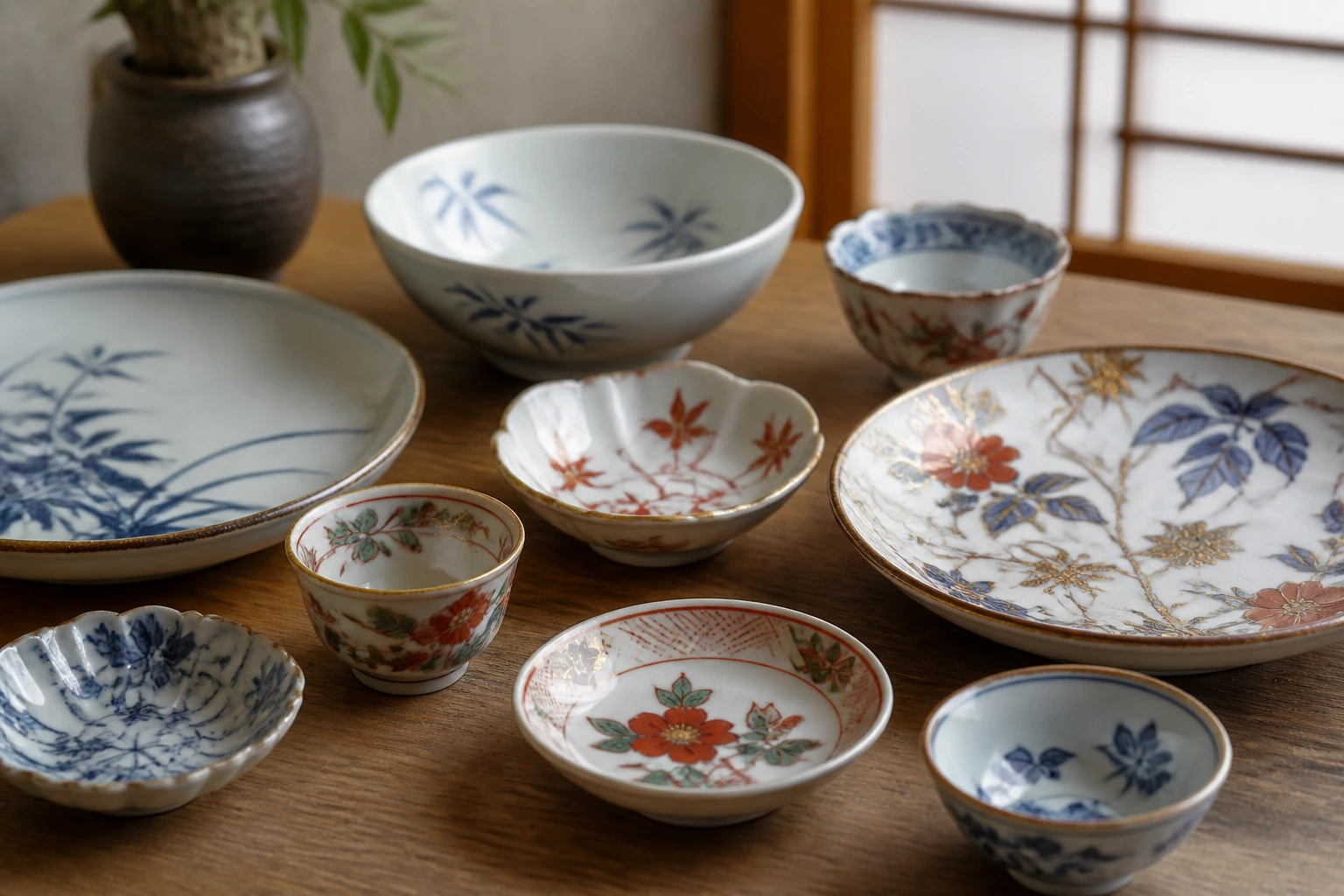
A pair of rice bowls (12cm and 11.5cm — the two are intentionally slightly different sizes) in the “Hanazume” (“filled with flowers”) design, based on a Taisho-era pattern. Worth noting clearly: unlike the three picks above, this one is not dishwasher- or microwave-safe, so it needs the same hand-wash care as more delicate lacquerware.
Pros:
- A genuine pair (not just two of the same bowl), suited to gifting for couples
- Historic Taisho-era design, not a generic floral pattern
Cons:
- Requires hand washing, no dishwasher or microwave use
- More care-intensive than the other everyday-use picks on this list
Bottom line: the one to buy as a wedding or anniversary gift, not for rough daily use. See it at Musubi Kiln. This kind of matched rice-bowl pair is actually a named Japanese tradition — see our guide to meoto jawan pairs for a 9th anniversary for the full story and two more options.
5. Akae Kutani Plate Set — Best Premium
Five small plates (15.5cm each) in the Akae tradition — fine red linework with gold accents, associated with the Iidaya style of Kutani decoration. At $562 for the set, this is by far the most expensive item here, and it comes with an honesty flag worth knowing before you buy.
A caveat we won’t skip: the product’s own spec sheet lists this set as microwave-safe despite the gold accents. That’s the retailer’s stated spec, not our assumption — but as a general rule, gold and silver overglaze decoration is usually treated as hand-wash/no-microwave, since metallic decoration can spark in some microwaves. We’d recommend treating this one as hand-wash-only regardless of what the spec sheet says, rather than testing it.
Pros:
- Fine, detailed Akae-style linework — a genuinely different decorative tradition from the bolder gosai pieces above
- A real matched set of five
Cons:
- $562 — by a wide margin the most expensive piece in this comparison
- Spec sheet says microwave-safe despite gold accents; we’d treat that claim with caution
- Only 4 units in stock at the time of writing
Bottom line: a collector’s set, not a practical daily-use upgrade — treat the gold decoration with the same care as fine china. See it at Musubi Kiln.
Want Something More Affordable and Everyday?
If hand-painted Kutani is more than you want to spend right now, MUJI’s Hasami Ware line is genuinely made in Japan too — mass-produced, single-color-glaze porcelain from £5.95, not a decorative collector’s tradition, but a legitimate everyday alternative.
A Good Example of Honest Disclosure
Worth mentioning: Musubi Kiln’s own “Kutani Art” sub-line is upfront that it uses transfer-printing to reproduce the hand-painted look rather than actually hand-painting each piece — the product copy says so directly. That’s the honest version of the ad-copy-versus-spec-sheet problem we flagged in our lacquerware chopsticks article: if you want genuinely hand-painted Kutani, the five picks above are hand-decorated; the Kutani Art line is a lower-cost, openly-reproduction alternative, not a hidden downgrade.
What We Found on Amazon
Genuine, named-ware Kutani products do exist on Amazon, but they skew toward small novelty pieces rather than full dinnerware:
- Nakamaru Kutani Ware Akae Phoenix Plate — a small 13.1cm plate, sold via Amazon Japan import. Genuinely Kutani, but a small appetizer-size plate, not a dinner plate, and stock on this listing runs low.

Nakamaru Kutani Ware Akae Phoenix Plate
13.1cm appetizer plate, genuinely Kutani, imported from Japan.
- Peanuts Snoopy Kutani Ware Bean Plate — genuinely Kutani ware (a licensed novelty piece), 8.5cm.

Peanuts Snoopy Kutani Ware Bean Plate
8.5cm, genuinely Kutani ware. 4.6★ (37 ratings).
What to watch for: a listing titled “MINO WARE JAPAN” turned up in our search, but its own product description only claims the plates have “a color scheme that resembles Mino ware” — it stops short of actually claiming Japanese manufacture or genuine Mino-yaki origin. A storefront brand name isn’t the same as an origin claim; read the actual product description, not just the seller name. It’s the same gap we track across every category on this site — see our buyer’s guide to spotting Japanese craft knockoffs for the full checklist.
Which One Should You Buy?
- If you want one genuinely usable Kutani plate, get the Cat Shaped Dinner Plate.
- If you want the lowest-commitment way to add real Kutani ware to daily meals, get the rice bowl.
- If you want a matched set for a full table setting, get the Jidai Sauce Plate Set.
- If you’re buying a gift, get the Hanazume Rice Bowl Pair.
- If you want a genuine collector’s set and don’t mind the price, get the Akae Kutani Plate Set — and hand-wash it regardless of the spec sheet.
FAQ
Is Kutani ware the same as Imari or Arita ware? No — they’re different regional traditions. Kutani (Ishikawa) is known for its bold five-color gosai palette; Arita/Imari (Kyushu) typically uses underglaze blue with overglaze outlining and was historically a major European export; Mino ware (Gifu) covers a different set of styles again and is Japan’s largest ceramics production region today.
Is gold-decorated Kutani ware actually microwave-safe? Treat it as hand-wash-only regardless of what a spec sheet says. Metallic overglaze decoration can spark in a microwave, and it’s not worth testing on a piece you paid for.
Why is there such a big price gap between these five picks? Format and technique. Full-size, everyday-safe pieces like the cat plate and rice bowl are priced closer to nice tableware; smaller, more finely hand-painted collector pieces like the Akae set command collector prices for the labor and precision involved, not the size of the piece.
Final Thoughts
If you’re buying Kutani ware to actually use, stick to the dishwasher- and microwave-safe picks — the Cat Plate and the rice bowl both hold up to daily life. Save the Hanazume pair and the Akae set for gifts or display pieces you’re prepared to hand-wash.