Some of the shops we link to are partners who may pay us when you buy through them. This doesn't change which pieces we recommend. How this works.
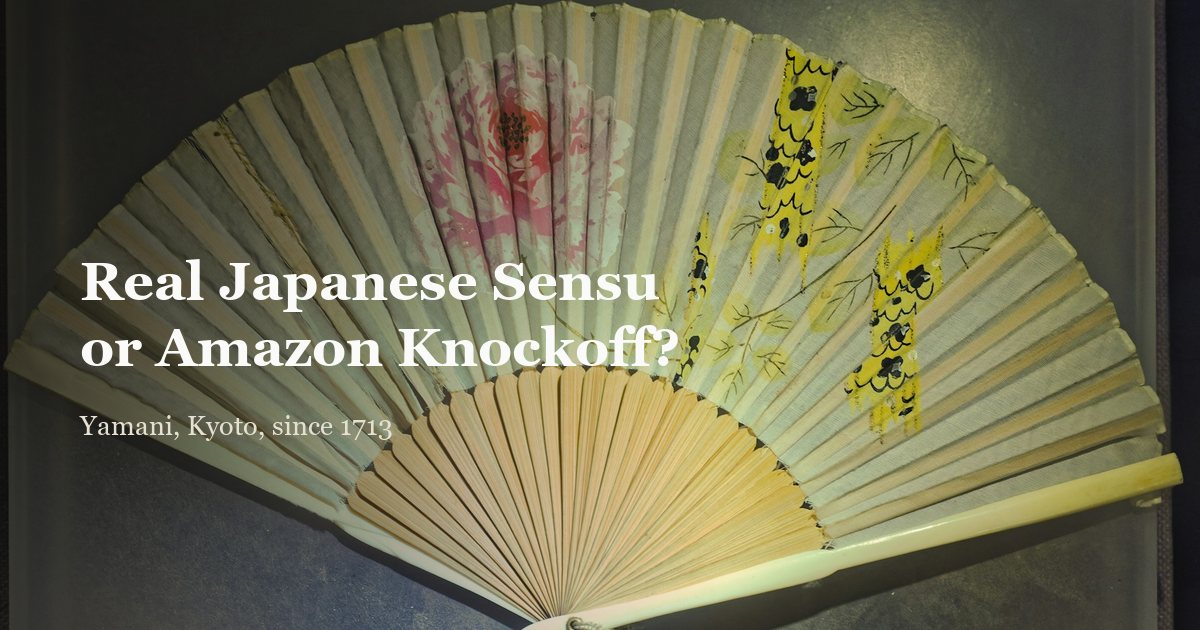
Yamani, a Kyoto fan wholesaler operating since 1713, sells Kyo-sensu folding fans through Japanese Taste with "Made in Japan" stated directly in the product details. Most of what shows up when you search "Japanese folding fan" on Amazon is a different thing: bamboo-and-silk fans sold under store-brand names like OMyTea, with no country-of-origin field, and several literally titled "Chinese Japanese" fan. That double label isn't a typo: it's a seller hedging between two markets, and it means the listing isn't telling you where the fan was made.
The Folding Fan Was Invented in Japan, Then Exported to China
This is one of the odder ironies we’ve run into researching this site. The folding fan, as a physical object, is a Japanese invention. According to Wikipedia’s history of the hand fan, it originated in Japan sometime between the 6th and 9th centuries, and in 988 AD a Japanese monk presented folding fans to the Chinese emperor as tribute during the Northern Song dynasty, the first recorded introduction of the folding fan to China. The fan Japan exported that day was already an established court accessory; the Heian court had passed sumptuary laws restricting how elaborately fans could be decorated, which only happens once something has become popular enough to need regulating.
The specific fan sold as sensu today (bamboo ribs covered in paper, as opposed to the earlier solid-wood hiogi) took shape toward the end of the Heian period. China later adapted the design; a paper-both-sides version came back to Japan during the Muromachi period. So “Chinese and Japanese fans are basically interchangeable” has some real history behind it as a design lineage, but that’s a different claim from “this specific $12 Amazon fan was made in either country,” which the listing usually doesn’t answer either way.

What Amazon’s Bestselling “Japanese” Fans Actually Say
Search “Japanese folding fan” on Amazon and the top results are dominated by a handful of house brands (OMyTea, Zolee, and similar) selling what their own titles describe as a “Foldable Chinese Japanese Vintage Bamboo Silk Fan.” We checked one of the bestsellers directly (OMyTea’s Gray Sakura fan, 4.6 stars, 1,121 ratings, Amazon’s Choice): the bullet copy describes “classic Chinese & Japanese style,” names the seller only as “OMyTea Co., Ltd.,” and states no country of origin anywhere in the structured product details. The fan itself may be a perfectly functional bamboo-and-silk fan. It just doesn’t say where it was made or by whom; it tells you what aesthetic it’s going for, which is a different thing.
That pattern matches what this site has already found in kitchen tools, garden tools, and half a dozen other categories: a generic company name standing in for a maker, and “Japanese” used as a style word rather than an origin claim. The dual “Chinese Japanese” labeling is just an unusually blunt version of the same thing. Most listings in other categories don’t admit to hedging quite this openly.
Yamani: A Kyoto Fan Wholesaler Since 1713
Yamani is a real, independently documented company. Kogei Japan, a directory of traditional Japanese craft makers, lists Yamani as founded in Kyoto in 1713 as a fan wholesaler, working in the same trade ever since. That makes it roughly 300 years older than most of the brand names on the Amazon results page above. Its fans are sold under the Kyo-sensu name, referring to the Kyoto folding-fan tradition specifically, and the listings we checked on Japanese Taste state “Made in Japan” directly in the product details rather than only in marketing copy.
Comparison at a Glance
| Yamani (Japanese Taste) | Typical Amazon “sensu” | |
|---|---|---|
| Maker named | Yamani, Kyoto, est. 1713 | Store brand only (e.g. “OMyTea Co., Ltd.”) |
| Country of origin field | Made in Japan | Not stated |
| Materials | Bamboo ribs, paper | Bamboo ribs, silk fabric (origin unspecified) |
| Price | $29.99–$59.99 | Roughly $10–$20 |
| How it’s marketed | Kyo-sensu, a named regional craft | “Chinese Japanese” style, decoration/costume use |
Checked against current Japanese Taste and Amazon.com listings on September 15, 2026. Prices vary by retailer and change often.
1. Yamani Kabuki Ukiyo-e Sensu, 22.5cm
This is a mid-size fan with a ukiyo-e-style kabuki print, bamboo frame, and paper face; Japanese Taste’s listing states the country of origin as Japan in the structured product details, not just the title, and shows it in stock at the time we checked. At $34.99 it’s roughly double what a typical unbranded Amazon fan costs, for a fan with a named 300-year-old maker behind it instead of a generic store brand.
Japanese Taste isn't yet an approved partner shop for this site, so this is a plain link with no tracking or commission.
See the Yamani Kabuki Ukiyo-e Sensu at Japanese Taste →
2. Yamani Seigaiha Wave Pattern Large Sensu, 25.5cm
A larger fan (25.5cm versus 22.5cm) in the Seigaiha “wave” pattern, one of the most recognizable traditional Japanese textile motifs. Japanese Taste lists it as “Made in Japan,” made of bamboo and paper, and marked as limited stock rather than a mainline item, so check availability before you commit if you want this specific pattern. At $59.99 it’s the more expensive of the two, reflecting the larger size rather than a different construction.
Japanese Taste isn't yet an approved partner shop for this site, so this is a plain link with no tracking or commission.
See the Yamani Seigaiha Wave Pattern Sensu at Japanese Taste →
A Note on Ordering From Japanese Taste
Japanese Taste ships from Japan rather than a US warehouse, so expect a longer delivery window than an Amazon Prime order, and factor in the possibility of customs charges on top of the sticker price. This site’s Trustpilot check on the retailer (2.3/5 as of our last review) turned up complaints about delivery delays and customs surprises specifically, so budget extra time and a little extra cost rather than assuming next-day delivery.
How to Check a Sensu Listing Yourself
- Look for a named maker or workshop, not just a store brand. “Yamani” or “Kyo-sensu” is a specific, checkable claim; “OMyTea Co., Ltd.” is a seller name that could be attached to anything.
- Check the structured country-of-origin field, not the title. A title can say “Japanese fan” while the actual spec sheet says nothing, or says “Chinese Japanese” as a style descriptor rather than a location.
- Treat “Chinese Japanese” labeling as a real signal, not a mistake. It usually means the seller is deliberately not distinguishing the two, which is different from a listing that names one country and means it.
This is the same logic behind our general buyer’s checklist for real Japanese craft: a named maker and an explicit origin field beat a style word in the title, in every category we’ve checked so far.
FAQ
Is a fan labeled “Chinese Japanese Fan” fake? Not necessarily fake. It just isn’t making a country-of-origin claim either way. “Chinese Japanese” in a title usually signals the seller is using both terms as style descriptors (a design lineage the two countries genuinely share, per the history above) rather than telling you where a specific unit was manufactured.
Does “sensu” always mean it’s Japanese-made? No. “Sensu” is the Japanese word for a folding fan, and sellers can use it descriptively regardless of where the fan was actually produced. Look for a named maker and an explicit country-of-origin field rather than taking the word itself as proof.
What’s the difference between a sensu and an uchiwa? A sensu folds flat; an uchiwa is a fixed, non-folding fan on a solid frame, traditionally round or paddle-shaped. They’re both Japanese fan types, but they’re different objects with different construction, so a listing using one term for the other design is worth a second look.
Why is Yamani’s fan so much more expensive than an Amazon fan? Partly size and materials, but mostly the fact that you’re paying for a named maker with three centuries of continuous operation in the same craft, rather than a generic bamboo-and-silk fan from a company that could be selling anything else next month. Whether that premium is worth it depends on whether the origin itself matters to you or you just want a functional fan.
Final Thoughts
The folding fan’s actual history (invented in Japan, exported to China over a thousand years ago, refined on both sides since) is why “Chinese Japanese” as a label isn’t pure nonsense. It’s also why it’s not a substitute for an origin claim on the specific product you’re about to buy. Yamani’s listings state Made in Japan directly and come from a company with a three-century paper trail; most of what else is on the Amazon results page doesn’t make that claim at all. If you’re putting together a summer yukata outfit, our geta sandals sizing guide covers what to check on the footwear side. Our full checklist for spotting real Japanese craft runs through the same maker-and-material logic for knives, ceramics, and lacquerware.