"Japanese kitchen tools" isn't one product category, it's a dozen of them — knives, whetstones, donabe pots, iron kettles, mandolines, scrub brushes — and each one has its own "Japanese-style but not Japanese-made" problem. This guide is a directory: the categories we've already verified in depth, linked below, plus three more tools (mandoline, mortar and pestle, scrub brush) we're verifying here for the first time.
Some of the guides linked here contain shops who are partners and may pay us when you buy through them. This doesn't change which pieces we recommend. How this works.
Why This Category Is Harder to Shop Than It Looks
A Japanese chef’s knife and a Japanese scrub brush have almost nothing in common, except one thing: both get sold on Amazon next to a “Japanese-style” version that was never near Japan. We’ve documented this pattern separately for knives, whetstones, donabe pots, and iron kettles on this site, and every time, the underlying issue is the same one we laid out in our buyer’s checklist for spotting knockoffs: the word “Japanese” is free to use, but a named maker, a named production city, and a filled-in country-of-origin field are not.
Kitchen tools make this worse than most categories because the individual items are often small and cheap. A $150 tetsubin kettle attracts more scrutiny than an $8 scrub brush, so sellers of small kitchen gadgets get away with vaguer claims more often. That doesn’t mean the checks stop mattering, just that fewer buyers bother to run them.
The Checklist, Applied to Kitchen Tools
The same six checks from our general knockoffs guide apply here, with a kitchen-specific version of each:
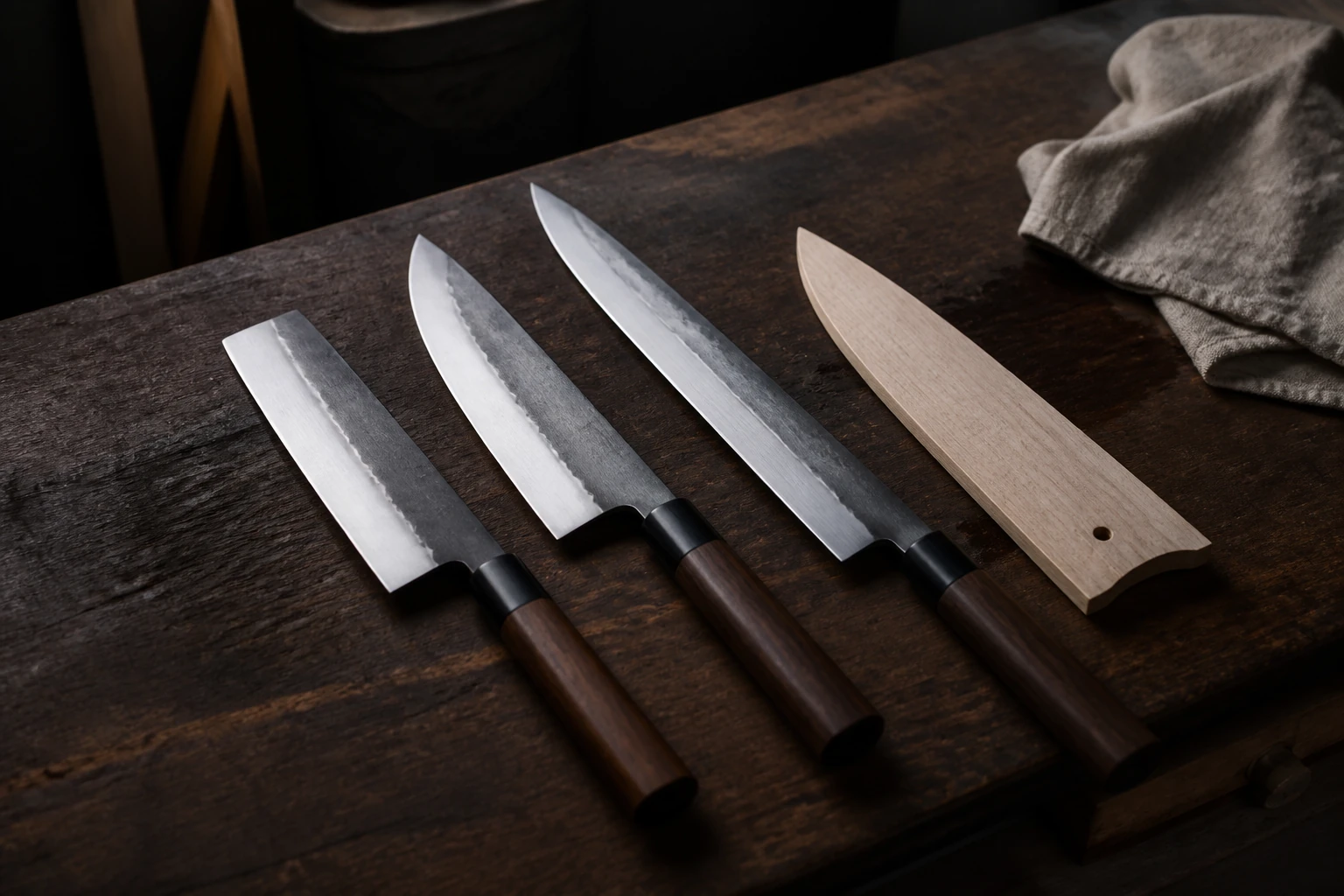
- A named production city. Real answers look like Seki, Tsubame-Sanjo, Yamaguchi, or Yangjiang. Wait, that last one is a trap: Yangjiang is in Guangdong, China, and it’s a genuine center of Chinese cutlery manufacturing that some sellers use interchangeably with Japanese city names in their marketing copy, counting on most shoppers not knowing the difference.
- A named maker, not a brand code. Benriner, Kai, Tojiro, Global, Kamenoko Tawashi are all real companies with real histories. A brand field that’s a random string of capital letters is the same white-label pattern we’ve flagged in every other category on this site.
- An explicit material or steel spec. “Japanese stainless steel” means little on its own; a named steel type or a named production process (hand-forged, single-piece construction) means more.
- Country of origin filled in on the listing itself, not just implied by the product title.
- A price that isn’t permanently discounted 50-70%.
- Sold by more than one retailer, not just a single dropship storefront.
Categories We’ve Already Verified
We’ve done the maker-and-origin legwork on eight kitchen and dining categories already. Here’s the directory:
| Category | Verified pick | Roughly | Full guide |
|---|---|---|---|
| Chef’s knives | Shun Classic Santoku / Fujitora Santoku | $100-150 | Verified Made-in-Japan picks |
| Kitchen shears | Kai Seki Magoroku DH3345 / Global GKS-210 | $30-120 | Kitchen shears guide |
| Whetstones | KING KW65 1000/6000 Combination | $30-40 | Whetstone guide |
| Donabe (clay pots) | TIKUSAN Donabe / COTONOHA Donabe | $56-130 | Donabe guide |
| Tetsubin (iron kettles) | Iwachu 11884 / ITCHU-DO HAKEME | $190-210 | Tetsubin kettle guide |
| Bento boxes | OSK / Zojirushi / Akita Cedar Magewappa | varies | Bento box guide |
| Kintsugi repair kits | Chimahaga Basic | $159 | Kintsugi kit guide |
| Hinoki cutting boards | Yoshihiro Anti-Twist Core / TIKUSAN Natural Cypress | $36-100 | Hinoki cutting board guide |
Prices vary by retailer and change often — treat this as a starting point, and check the linked guide for the current listing.
Three More Kitchen Tools, Verified
The three tools below were first run through the same checklist here. The Benriner has since gotten its own full review, linked below.
Benriner Mandoline Slicer
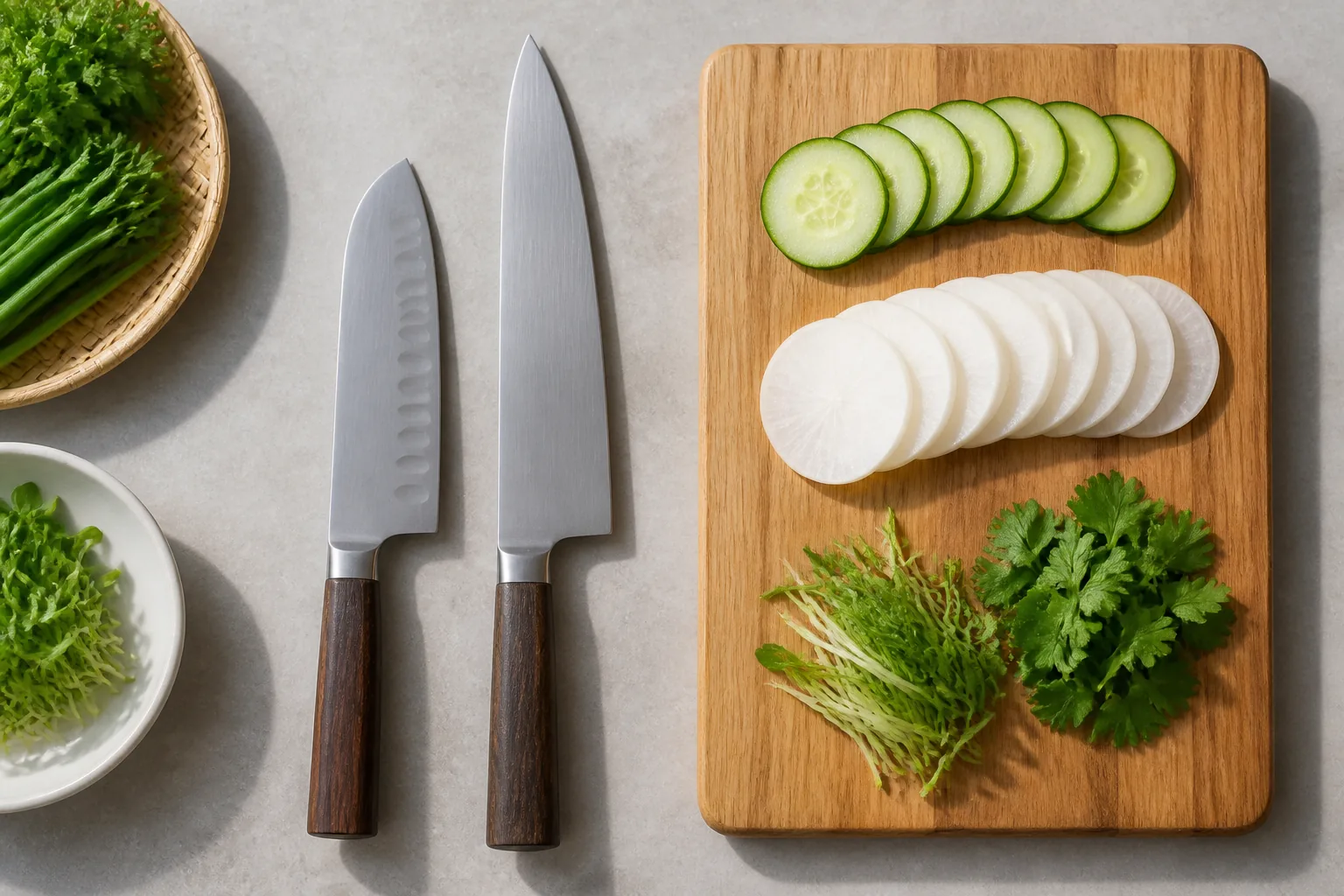
Benriner is the name that comes up constantly in professional-kitchen recommendations for vegetable slicers, and the company’s own product listings state the slicer is manufactured in Japan, a claim the brand has backed with the same design since the 1940s. The Benriner Mandoline Slicer with 4 Blades (Amazon’s Choice, 4.6 stars from over 2,300 ratings, roughly $32) is the standard version: a fixed blade plus three interchangeable coarse, medium, and fine blades, with a plastic body and Japanese stainless steel blades.

Benriner Mandoline Slicer with 4 Blades
Fixed blade plus 3 interchangeable blades, Japanese stainless steel. 4.6★ (2,313 ratings).
Worth knowing before buying one: mandolines are genuinely sharp enough to injure a hand badly, and Benriner ships a plastic safety guard with every unit. Use it. It’s not optional gear for beginners only. For how the standard, compact, and Super Slicer sizes compare, see our full Benriner mandoline review.
TIKUSAN Suribachi and Surikogi (Mortar and Pestle)
A suribachi is a ridged ceramic mortar, used with a wooden pestle (surikogi) to grind sesame seeds, garlic, and herbs into a texture a blender can’t replicate — the ridges are cut into the glaze specifically to grip and shred food rather than just crush it. The style traces to Mino ware (Mino-yaki), the Gifu prefecture ceramics tradition already covered in our Kutani ware history piece as a separate, older production region from Kutani itself.
The TIKUSAN Suribachi and Surikogi Set with Spout (4.7 stars from 88 ratings, roughly $51) names Mino ware directly in its listing and states the pestle is Japanese cypress. TIKUSAN also makes the donabe pots in our donabe guide, so this is a brand we’d already verified as a real Japanese houseware manufacturer before checking this specific product.

TIKUSAN Suribachi and Surikogi Set with Spout
Mino ware mortar, Japanese cypress pestle. 4.7★ (89 ratings).
Kamenoko Tawashi Palm-Fiber Scrub Brush
This is the oldest brand on this list by a wide margin. Kamenoko Tawashi has been made by the same Tokyo company, founded by Shozaemon Nishio, since 1907 — independent write-ups from Umami Mart and MADE IN JAPAN.JP both cover the brush’s origin story: a returned doormat, cut down and curved into a hand-sized scrubber by the founder’s wife, that ended up looking like a turtle floating in a bucket of water (kame is Japanese for turtle, hence the name).
The Kamenoko Tawashi Kiwame #1 (Small) (4.4 stars from 778 ratings, roughly $14) states it’s manufactured in Japan from natural palm fiber and stainless steel wire directly in the listing. It’s a genuinely small purchase, but it’s also a useful one to know about: these scrub without soap, work on cast iron without stripping seasoning, and hold up to scrubbing root vegetables without falling apart the way a sponge does.

Kamenoko Tawashi Kiwame #1 (Small)
Natural palm fiber and stainless steel wire, made in Japan. 4.4★ (778 ratings).
Where “Japanese-Style” Kitchen Tools Get Murky
Search any of these three product names on Amazon and you’ll also find generic alternatives sitting right next to the verified picks above — a “Handheld Mandoline, Japanese Style Slicer” with no maker name or country of origin in its spec sheet, or a bagged coconut-fiber scrubber marketed as a “tawashi” with no Japan claim anywhere except the word itself. None of that makes the generic version bad. A mandoline blade is a mandoline blade regardless of who forged it, and a scrub brush doesn’t need a hundred-year pedigree to clean a pot. But if the reason you’re shopping for a Japanese kitchen tool specifically is the country of origin, “tawashi” or “Japanese style” in the title isn’t proof of anything on its own — run it through the checklist above the same way you would a knife or a whetstone.
FAQ
Is a tool automatically worse if it isn’t made in Japan? No. Plenty of well-made kitchen tools come from elsewhere, and a mandoline blade or a scrub brush doesn’t need a Japanese pedigree to work well. The checklist in this guide is for the specific case where country of origin is the reason you’re buying, not a general quality filter.
Why do so many kitchen tool listings skip the country-of-origin field? Some sellers genuinely don’t fill it in, and some skip it because filling it in accurately would undercut the marketing. Either way, an empty field isn’t proof of anything by itself — it’s one signal among the six in the checklist above, and it’s worth combining with the others rather than reading alone.
Which of these categories has the clearest Japan-vs-not-Japan split? Knives and whetstones, mainly because both categories have a well-documented cluster of brands (see our fake knife brands guide) that disclose non-Japanese manufacturing locations in their own marketing, once you know to look. Mandolines and scrub brushes have less documentation simply because fewer people have written about them, not because the underlying pattern is different.
Will you add more tools to this guide? Yes — this is meant to be a living directory. Tamagoyaki pans turned out to be a big enough category to get their own dedicated guide; see our best Japanese tamagoyaki pan made in Japan guide for that one. As we verify more categories (otoshibuta drop lids and others are on the list), we’ll add them here too.
Final Thoughts
Eight categories verified in full elsewhere on this site, three more checked here for the first time, and the same six-point checklist behind all eleven. If you’re shopping for a Japanese kitchen tool this guide hasn’t covered yet, the general knockoffs checklist has the underlying method: a named place, a named maker, a named material, and a country-of-origin field that isn’t left blank.