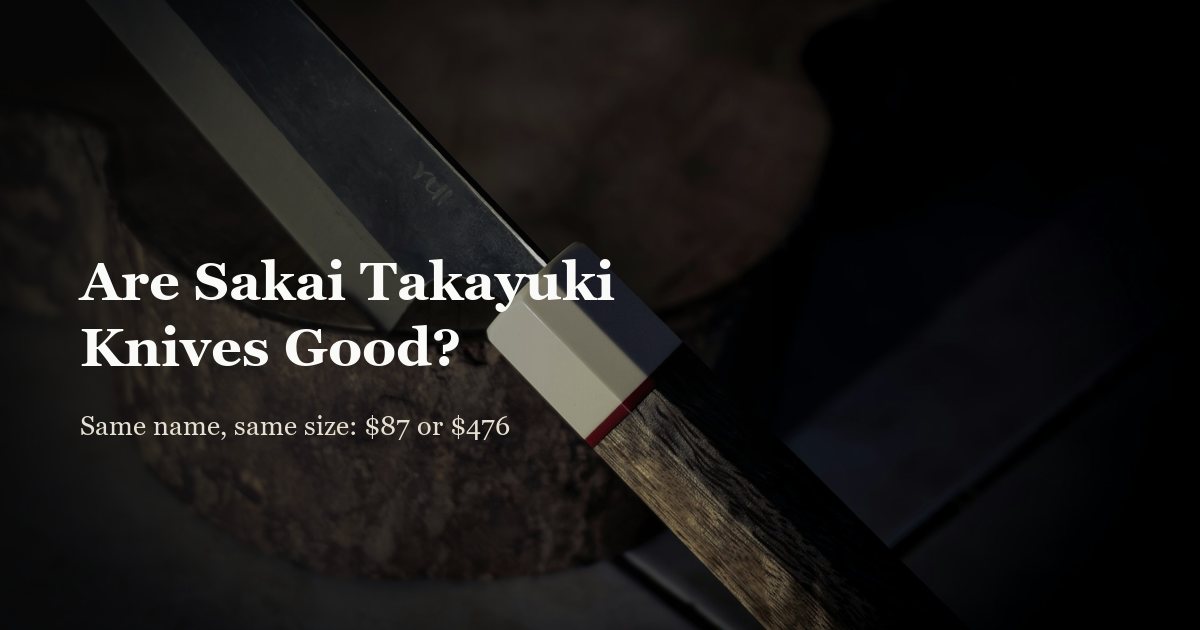
Yes, Sakai Takayuki is a real Japanese brand, and the knives we looked at are made in Japan, but "Sakai Takayuki" tells you who sells the knife, not how it was made. The name belongs to Aoki Hamono, a knife wholesaler in Sakai, Osaka. Under it you'll find an $86.99 stainless TUS gyuto and a $475.99 Homura gyuto forged by a named blacksmith, in the same 210mm size. For a first Japanese knife, the TUS is the one to buy. Pay for a higher line only when you know what the extra money gets you: a harder steel, a different shape, or a specific smith's work.
Some of the shops we link to are partners who may pay us when you buy through them. This doesn't change which pieces we recommend. How this works.
We haven’t used these knives ourselves. This page is based on Aoki Hamono’s own company listing, Sakai City’s register of certified knife craftsmen, and the spec sheets on Hocho Knife, a Japanese retailer that carries most of the range. Prices and stock are from Hocho Knife on November 14, 2026.
Who Actually Makes Sakai Takayuki Knives
Sakai Takayuki (堺孝行) is a brand of Aoki Hamono Seisakusho, a company in Sakai, a city south of Osaka known for its knives. In its company listing on iPROS, a Japanese business directory, Aoki Hamono describes itself as a wholesaler. It sells under three brand names, Sakai Takayuki, TAKAYUKI, and Sakai Kikutaka, to kitchenware shops, department stores, and trading companies in Japan, and to knife retailers abroad. Every spec sheet we checked lists “Manufacturer: Aoki Hamono Co., Ltd.” and “Made in JAPAN.”
That wholesale role is normal in Sakai. Traditional Sakai knives are made in stages by separate workshops: a blacksmith forges and hardens the blade, a sharpener grinds and puts the edge on it, and a wholesaler fits handles, adds its name, and sells it. You can see the split in Sakai City’s list of certified traditional craftsmen for Sakai knives (Sakai uchihamono), which files each person under a department, forging (鍛冶) or sharpening (刃付), at their own named workshop. Aoki Hamono isn’t on that list, which fits a company whose job is to commission and sell knives.
So the useful question isn’t whether Sakai Takayuki is good. It’s which Sakai Takayuki you’re looking at. Hocho Knife lists hundreds of Sakai Takayuki items. Its gyutos alone ran from $80.99 to $1,093.99 when we checked, and the range covers both stainless knives with no smith named and blades credited to a named blacksmith.
The Lines, Compared at 210mm
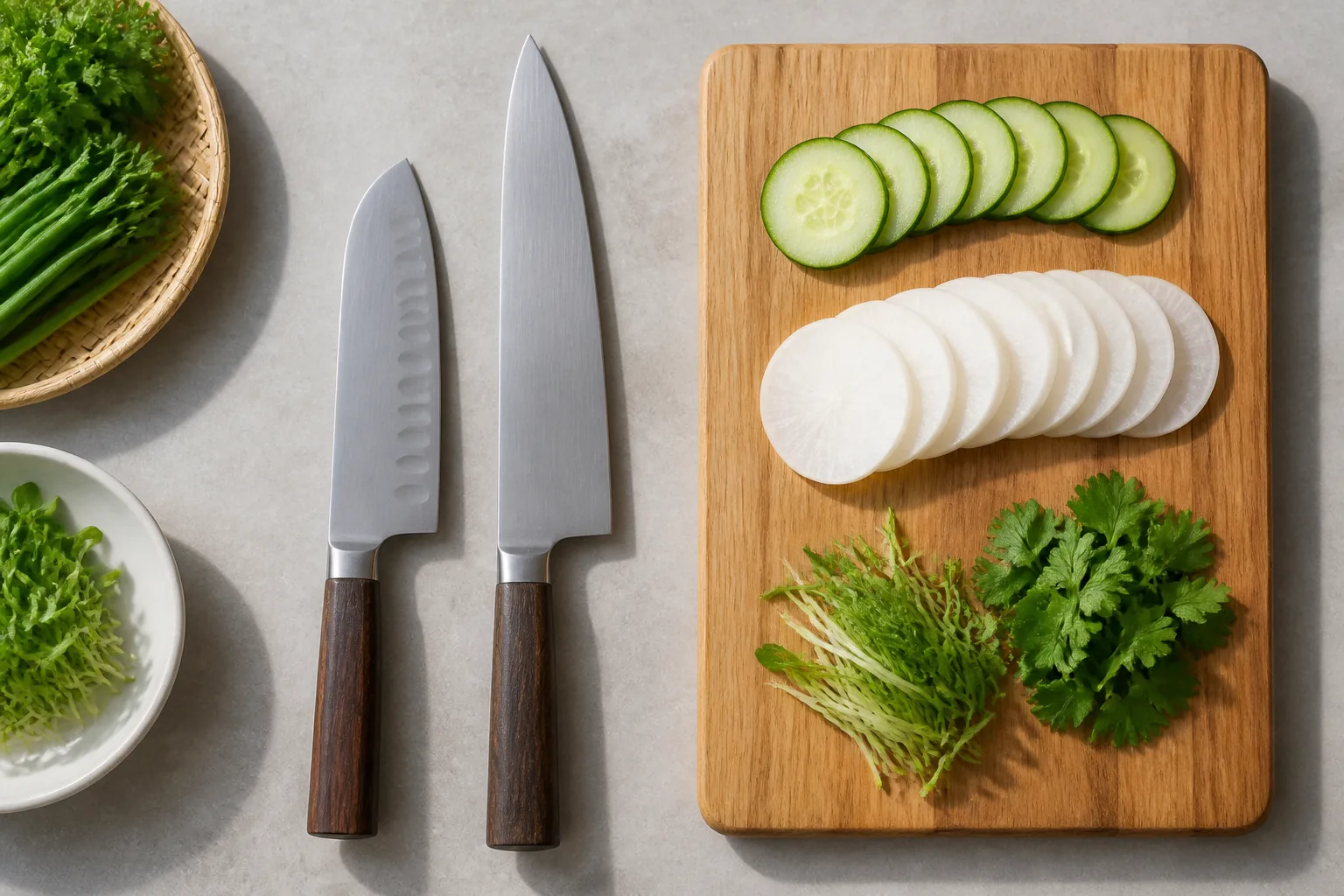
To compare like with like, here’s the 210mm gyuto (Japanese chef’s knife) from each main line, using Hocho Knife’s spec sheets.
| Line | Blade steel | Edge | Weight | Price | Stock |
|---|---|---|---|---|---|
| TUS | TUS high-carbon stainless | Double | 180g | $86.99 | In stock |
| Grand Chef | Böhler-Uddeholm high-carbon stainless, HRC 61-62 | Double | 180g | $151.99 | In stock |
| 33-Layer VG10 Damascus Hammered | VG10 core, 33-layer stainless cladding, HRC 60 ±1 | Double | 186g | $171.99 | In stock |
| Aoniko | Blue #2 (Aogami 2) carbon steel, single steel | Double, 60/40 | 153g | $203.99 | In stock |
| Aogami Super Kurouchi Hammered | Aogami Super core, stainless clad, about HRC 65 | Double | 150g | $350.99 | Out of stock |
| Tokujyo Kengata Gyuto | White #2 (Shirogami 2) carbon steel | Single, right-handed only | 165g | $403.99 | In stock |
| Homura Taxus | Blue #2 carbon steel, forged by Itsuo Doi | Double | 160g | $475.99 | In stock |
From Hocho Knife’s product pages, checked November 14, 2026. Hocho Knife shows both a regular price and a sale price; the prices above are what the product pages charged that day.
Of the pages we checked, only the Homura line named the person who forged the blade. Hocho Knife says the Homura knives are made by blacksmith Itsuo Doi, son of the smith Keijiro Doi, and that the Doi family emblem is stamped near the logo. The other lines carry the Sakai Takayuki name with no smith credited.
TUS: The One Most People Should Buy
Sakai Takayuki TUS Gyuto 210mm, $86.99. TUS is a high-carbon stainless steel. The blade is about 1.7mm thick at the spine, and the handle is plywood.
Pros:
- The cheapest way into the brand, and still made in Japan per the spec sheet
- Stainless, so a wet blade left by the sink won’t rust the way carbon steel does
- A thin, light blade (180g) compared with a typical German chef’s knife
Cons:
- No hardness rating listed, so you can’t compare edge retention against the VG10 or carbon lines on paper
- Plain plywood handle, and the product page credits no smith or hand-forging
Bottom line: the right first Japanese knife. It’s the same knife our gyuto size guide uses to compare lengths, and it costs $86.99 at 210mm.
33-Layer VG10 Damascus: The Gift-Looking Upgrade
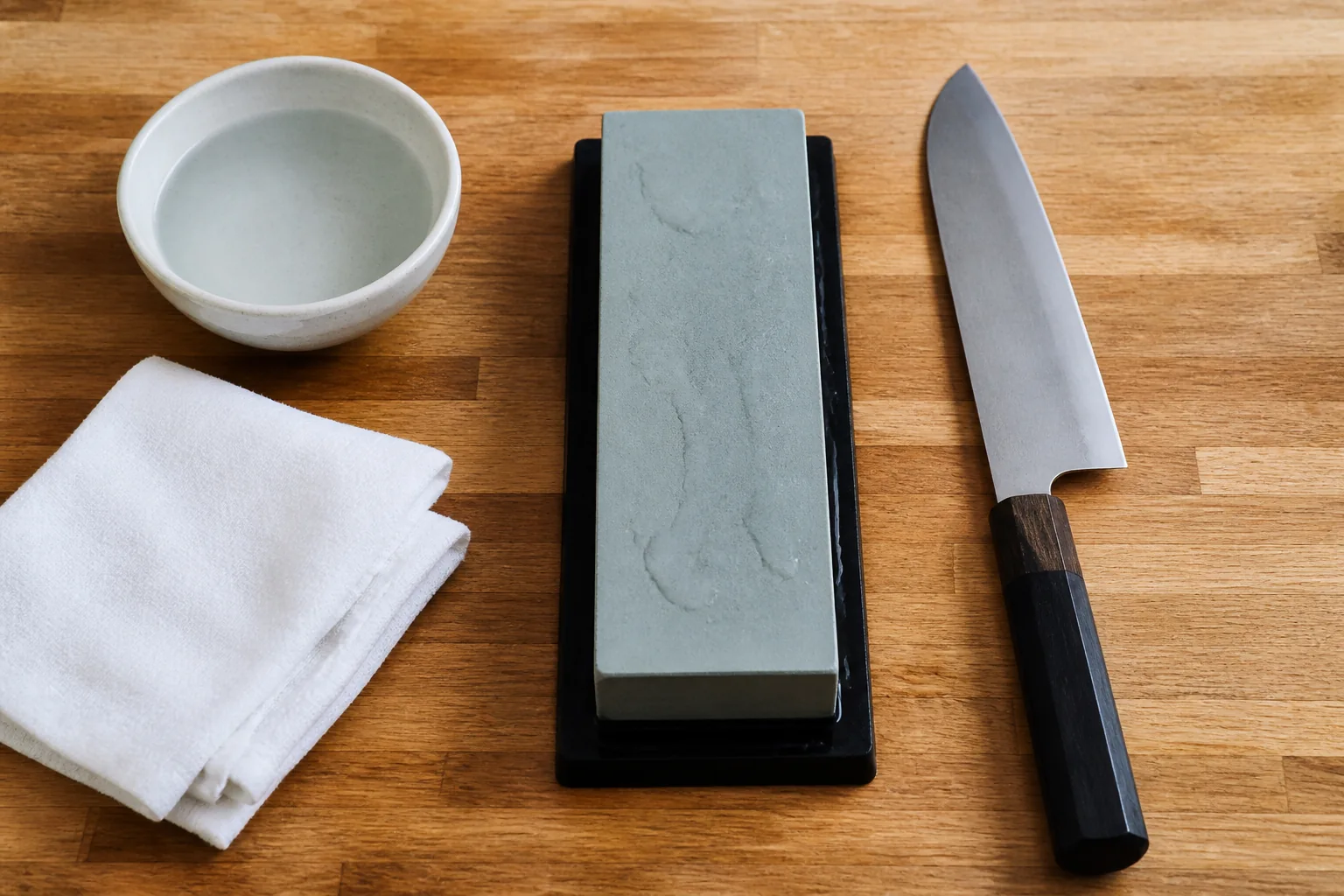
Sakai Takayuki 33-Layer VG10 Damascus Hammered Gyuto 210mm, $171.99. A VG10 stainless core rated HRC 60 ±1, wrapped in 33 layers of stainless steel with a hammered finish.
Pros:
- A listed hardness, and VG10 is a well-known Japanese stainless knife steel
- Still stainless, so care is close to the TUS
- The layered, hammered look is what many people expect a Japanese knife to look like, which matters if it’s a present
Cons:
- Almost twice the TUS price. The layers are cladding on the outside of the blade; the cutting edge is the VG10 core
- Hocho Knife notes the handle material may change from mahogany pakka to Japanese pakkawood without notice
Bottom line: a good step up if you want a harder stainless edge, or if the knife is a gift and appearance counts. Don’t pay for it because of the Damascus pattern alone. Our guide to checking a Japanese knife explains why the pattern says nothing about the steel inside.
Aoniko Blue #2: Carbon Steel at a Mid Price
Sakai Takayuki Aoniko Blue #2 Gyuto 210mm, $203.99. The whole blade is Blue #2 (Aogami 2) carbon steel, with a mahogany handle.
Pros:
- Carbon steel at about half the Homura’s price
- The lightest knife here except the Aogami Super (153g)
Cons:
- The whole blade is carbon steel, so it will rust and discolor unless you dry it straight after use
- The edge is ground 60/40, which Hocho Knife says suits right-handed users a little better than left-handed ones
Bottom line: for cooks who already know they want carbon steel and will look after it. If you’ve never owned a knife that needs drying after every use, start with a stainless line.
Homura: When You’re Paying for the Smith
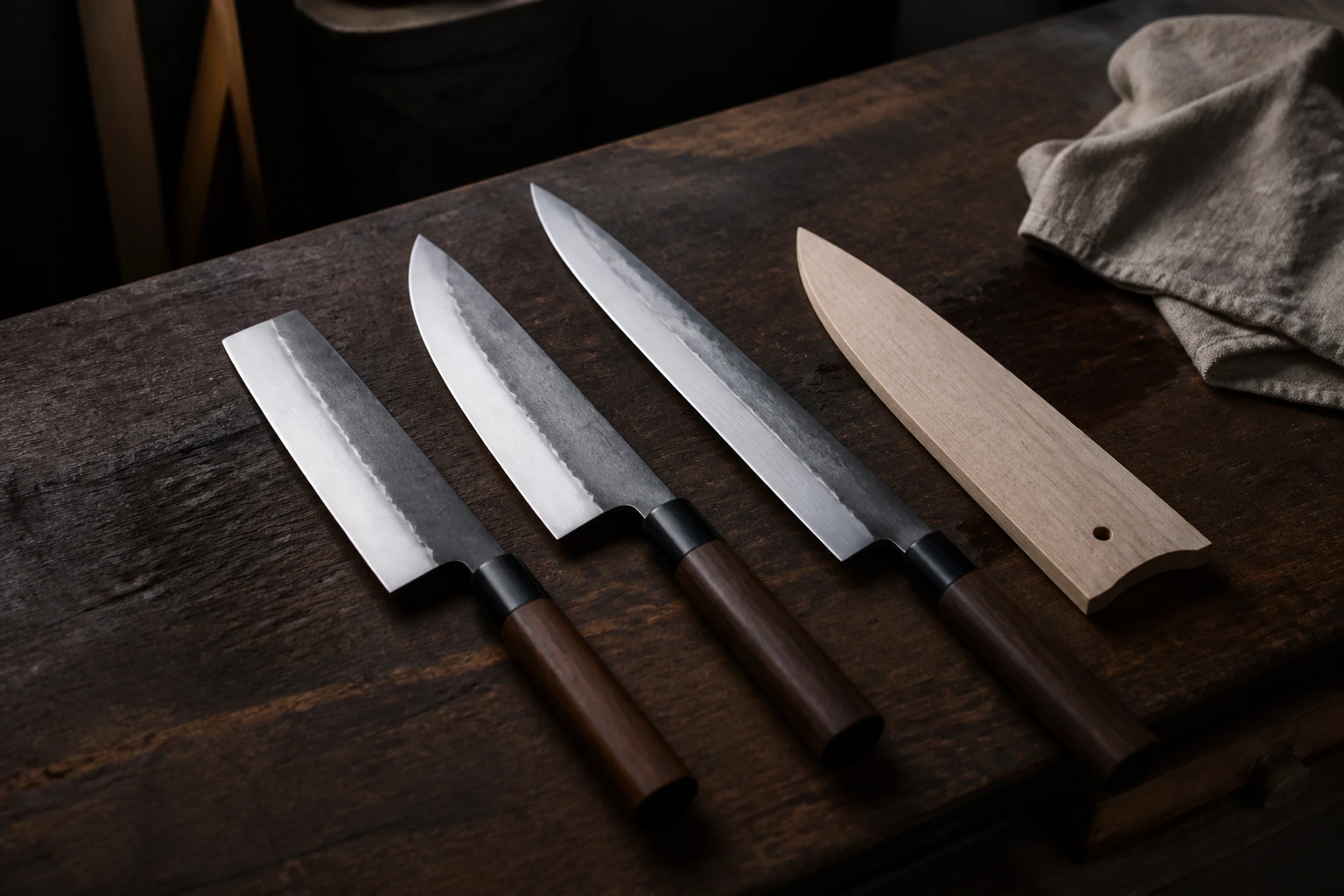
Sakai Takayuki Homura Taxus Blue #2 Gyuto 210mm, $475.99. Blue #2 carbon steel forged by Itsuo Doi, with a Japanese yew or zelkova handle, a buffalo horn ring, and a saya (wooden sheath).
Pros:
- The only line here where a named blacksmith is credited, with his family’s mark on the blade
- Comes with a saya
Cons:
- More than five times the TUS price for the same blade length
- Carbon steel, with the same rust care as the Aoniko
Bottom line: this is the line where the Sakai craft story people read about applies. Buy it if you want a particular smith’s work and will care for carbon steel. As a first gyuto it’s a lot of money for something you’ll have to learn to look after.
Three Things to Check Before You Buy Any Line
- The edge. Most Sakai Takayuki gyutos are double-edged and work for either hand, but not all. The Tokujyo Kengata Gyuto in the table is single-edged and listed for right-handed users only. Left-handed cooks should read the “Blade Edge” line on every spec sheet.
- Where the steel comes from. “Made in Japan” is about where the knife was made, not where the steel came from. The Grand Chef line uses steel that Hocho Knife credits to Böhler-Uddeholm, a European steelmaker. That’s a fine steel, but it isn’t a Japanese one.
- Retailer stories. Some shop pages for this brand mention a 600-year Sakai tradition or say every knife is handmade. Sakai’s knife history is real, but those lines are sales copy. We couldn’t find a statement from Aoki Hamono that the stainless lines are hand-forged, and only the Homura page named a smith.
Who Shouldn’t Buy Sakai Takayuki
If you put knives in the dishwasher or want something heavy enough to split squash and chop through chicken bones, a Japanese gyuto is the wrong tool whatever the brand. None of the gyutos above weighs more than 186g. A heavier German-style chef’s knife is the better choice there, and our santoku vs Western chef’s knife comparison covers the trade-offs.
And if you mainly want the cheapest real Japanese knife, Sakai Takayuki isn’t the only option. Tojiro also makes knives in Japan, and our guide to fake Japanese knife brands lists the ones we’ve checked.
Which One Should You Buy?
- First Japanese knife, or not sure: TUS Gyuto 210mm, $86.99.
- A gift, or a harder stainless edge: 33-Layer VG10 Damascus Gyuto 210mm, $171.99.
- You want carbon steel and will dry it every time: Aoniko Blue #2 Gyuto 210mm, $203.99.
- You want a named smith’s work: Homura Taxus Gyuto 210mm, $475.99.
- Still choosing between knife shapes: start with our santoku vs gyuto comparison.
FAQ
Is Sakai Takayuki a good knife brand? It’s a genuine brand from Sakai, Japan, sold by the knife wholesaler Aoki Hamono. Quality depends on the line: the range runs from an $86.99 stainless TUS gyuto to a $475.99 Homura gyuto forged by a named blacksmith, so compare the steel and edge on the spec sheet rather than the brand name.
Where are Sakai Takayuki knives made? In Japan. Every Hocho Knife spec sheet we checked lists Aoki Hamono Co., Ltd., a company in Sakai, Osaka, as the manufacturer and says “Made in JAPAN.” Some lines use imported steel, such as the Grand Chef’s Böhler-Uddeholm stainless.
Are Sakai Takayuki knives handmade? It depends on the line. Of the product pages we checked, only the Homura line named the blacksmith who forged it (Itsuo Doi). We found no statement from the maker that the stainless lines such as TUS are hand-forged.
Who is Aoki Hamono? A knife company in Sakai that sells its knives wholesale under the Sakai Takayuki, TAKAYUKI, and Sakai Kikutaka names to shops and trading companies in Japan and abroad, according to its own company listing.
Is the Sakai Takayuki TUS a good first knife? Yes, for most home cooks. It’s stainless, made in Japan, and $86.99 for the 210mm gyuto at Hocho Knife when we checked on November 14, 2026.
Final Thoughts
Sakai Takayuki is a real Japanese brand, but the name covers knives that are made in very different ways. Start with the TUS unless you have a reason not to. Move up the range for a specific thing you can name: a harder edge, carbon steel, or a smith’s signature on the blade.