Quick answer: look for a named regional tradition (Wakasa-nuri, Wajima-nuri, Aizu-nuri, Kishu-nuri — not just “Japanese lacquerware”), a named maker or workshop rather than a generic brand code, and an explicit material spec on the listing’s structured spec sheet that actually says “urushi,” not just “lacquer.” Then apply the single fastest test: if it’s advertised as dishwasher- or microwave-safe, it almost certainly isn’t genuine urushi. Full checklist below.
Some of the reviews linked here contain shops who are partners and may pay us when you buy through them. This doesn't change which pieces we recommend. How this works.
Why Lacquerware Is the Hardest Category on This Site to Verify
With knives and teapots, the gap is usually between the marketing copy and reality — a brand claims “Japanese steel” while quietly disclosing a different country of origin elsewhere on the page. Lacquerware has a version of that same gap, but it’s stranger: the ad copy and the retailer’s own spec sheet can contradict each other on the same product page. When we researched our lacquerware chopsticks comparison, we found listings where the description called a product “high-durability urushi lacquer” while the structured material field a few lines down listed the actual coating as urethane resin. That’s not us reading too much into vague language — it’s two parts of the same page disagreeing with each other.
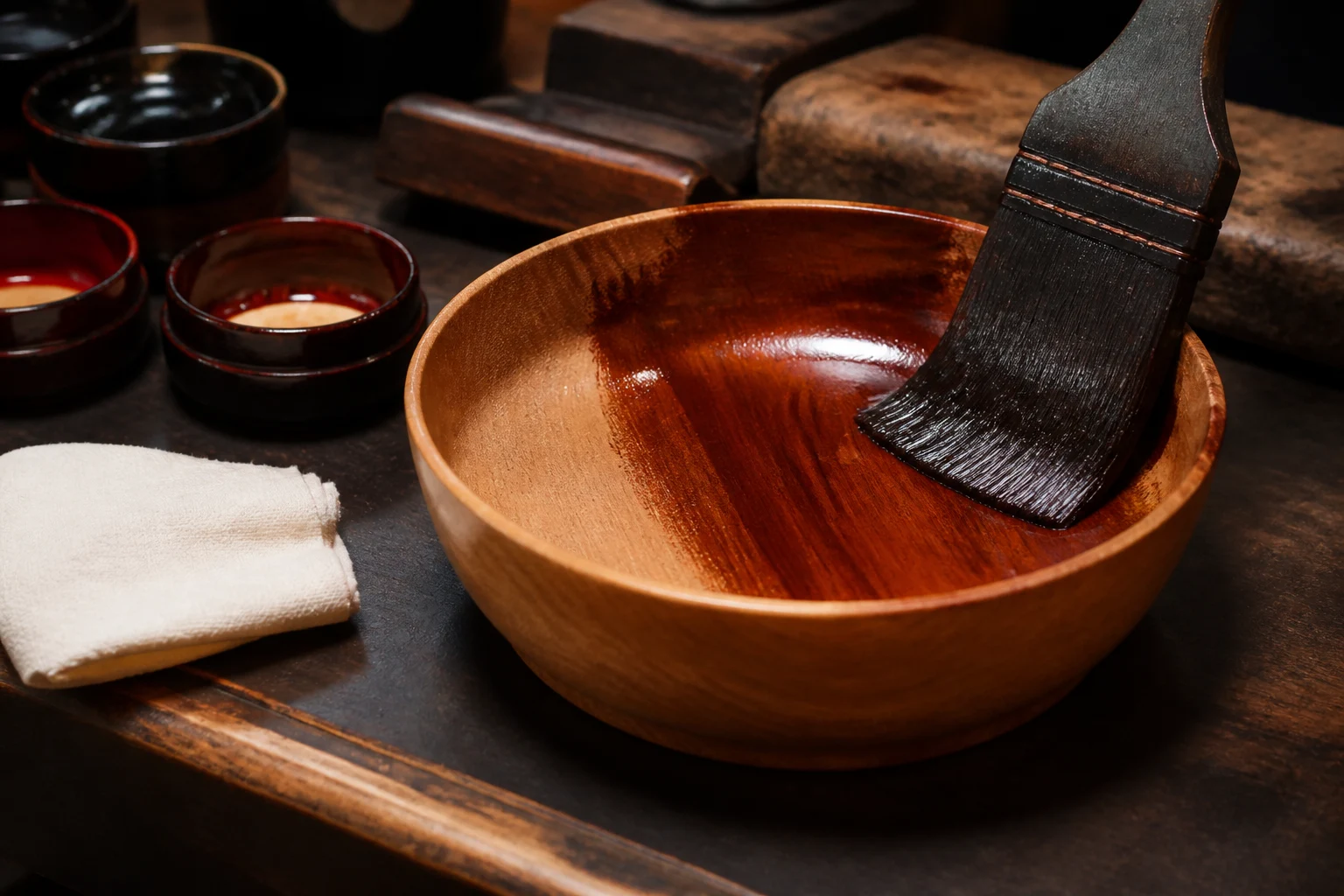
Part of why this happens: genuine urushi is lacquer tapped from the sap of Toxicodendron vernicifluum (a relative of poison ivy — the sap contains the allergenic compound urushiol). It’s applied in many hand-polished coats, cures slowly in a humid environment, and can’t tolerate a dishwasher cycle, a microwave, or harsh detergent. Urethane and polyester coatings — and cashew lacquer, a related but distinct synthetic — mimic the glossy look for a fraction of the labor, cure normally, and are what actually make a “lacquerware” product dishwasher-safe. Nothing about a urethane-coated product is fake or dishonest on its own; it’s a legitimate, lower-maintenance alternative. The problem is only when it’s sold using language (“urushi,” “traditional lacquer”) that the product’s own spec sheet doesn’t back up.
The Checklist
1. A Named Regional Tradition
Genuine lacquerware points to an actual place: Wakasa-nuri (Obama, Fukui Prefecture), Wajima-nuri (Ishikawa), Aizu-nuri (Fukushima), or Kishu-nuri (Wakayama) are the major named schools. “Japanese lacquerware” or “Asian-style lacquer” with no regional tradition named is the same soft red flag we’ve found in every other category on this site — a real craft has a place attached to it, a generic import usually doesn’t.
2. A Named Maker or Workshop, Not a Generic Brand Code
Check the “Maker/Brand” field in the listing specs, not just the title. A real workshop uses an actual name and, often, a documented lineage — our review of the Winter Plum Flower chopsticks names fourth-generation artisan Furukawa Katsuhiko of Furukawa Wakasa Lacquerware Store, a real business independently profiled by an Obama tourism blog. A brand field that’s a random string of letters is the same white-label pattern we flagged in our teapot and knife checklists.
3. An Explicit Material Spec on the Spec Sheet — Not the Ad Copy
This is the check that’s specific to lacquerware, and the one most worth slowing down for. Read the structured material or “Details” field, not the product description. There are three honest answers a listing can give:
- “Urushi” stated explicitly — the strongest claim a spec sheet can make
- “Lacquer” with no type specified — genuinely ambiguous. Don’t treat this as a red flag on its own; some listings are just vague rather than misleading. Treat it as unconfirmed.
- “Urethane,” “polyester,” or “cashew lacquer” named directly — this is a synthetic coating, full stop, regardless of what the ad copy above it says
When we checked five Wakasa-nuri chopstick listings from the same retailer for our comparison guide, four of the five had a spec sheet that said urethane or unspecified “lacquer” even when nearby ad copy used the word “urushi.” Only one — the most expensive item in that lineup — had a spec sheet with no urethane or polyester listed anywhere.
4. The Dishwasher- or Microwave-Safe Test
This is the fastest, single most reliable check, and it doesn’t require reading a spec sheet at all: genuine urushi cannot survive a dishwasher cycle or microwave use. The heat, water pressure, and detergent will crack, cloud, or dull it over time, and the wood core underneath can shrink or warp. So if a listing advertises itself as dishwasher-safe, that claim is, by itself, strong evidence the coating is urethane, polyester, or cashew lacquer — no matter what the word “urushi” appears elsewhere on the same page. The one documented exception: a small number of long-established Echizen lacquerware workshops have developed natural urushi formulations tough enough to be marketed as dishwasher-safe, per independent lifestyle site Savvy Tokyo — so this test is a very strong default, not an absolute rule, if a listing specifically names Echizen and still claims genuine urushi.
5. Country of Origin Filled In on the Listing Itself
The same rule that applies to knives and teapots on this site applies here: a seller can put “Made in Japan” in a headline for anything. A filled-in, structured Country of Origin field in the product details is a smaller, more mundane thing to fake convincingly, which is exactly what makes it worth checking.
6. Price Sanity Check
Hand-applied urushi work — especially anything using togidashi (grind-and-reveal inlay), raden (shell inlay), or rankaku (eggshell inlay) — is genuinely labor-intensive, and the price reflects that. A “genuine urushi, hand-inlaid” claim on a $10–15 pair of chopsticks doesn’t line up with the actual labor those techniques require. That doesn’t mean every affordable lacquerware product is dishonest — plenty of honestly-priced urethane pieces exist — it means an unusually low price paired with an “urushi” or “hand-inlaid” claim specifically is worth a second look.
7. Care Instructions Match the Material
If a listing claims genuine urushi, it should also tell you to hand-wash only, avoid direct sunlight, and keep it away from sustained heat — because that’s what real urushi actually requires. A listing that claims “genuine urushi” and dishwasher-safe in the same breath is contradicting itself, not describing a special product.
If You Can Handle the Piece in Person
Everything above works from a listing alone, which matters most before you buy. If you’re holding a piece — at a shop, or after it arrives — a few tactile cues are worth knowing, though we’d treat these as supporting evidence rather than a standalone test, since they’re harder to verify with certainty than a spec sheet: genuine urushi tends to feel closer to room temperature and warms to the touch faster than a synthetic coating, which stays noticeably cooler; the surface often shows very slight natural undulation under strong light rather than the perfectly flat, mirror-even finish typical of a factory-sprayed coating; and it carries a faint, sweet scent from the tree sap rather than a chemical or plastic smell. None of these require special expertise, but none of them are as clear-cut as the dishwasher-safe test above — use them to add confidence to a listing that already passed most of the checklist, not to override one that failed it.
One Worth Knowing: Even Antiques Get This Wrong
This isn’t only a new-production problem. Savvy Tokyo’s guide to the craft notes that Negoro-nuri — the red-over-black style where decades of use are meant to wear through the top layer and reveal the black underneath — is specifically one of the most commonly faked styles in the antique and auction market, precisely because that worn, two-tone look is easy to imitate artificially. If you’re shopping for an older or vintage piece rather than a new one, that’s a different, harder authentication problem than anything on this list, and worth researching separately before paying an antique premium.
A Verified Example
We’ve already reviewed one piece on this site that passes essentially the entire checklist above: the Winter Plum Flower Chopsticks from Furukawa Wakasa Lacquerware Store. Named region (Wakasa-nuri, Obama, Fukui), named and independently-verified artisan (Furukawa Katsuhiko), documented techniques (togidashi, raden, rankaku), a spec sheet listing simply “Lacquer” with no urethane or polyester anywhere, and — consistent with all of that — it is explicitly not dishwasher- or microwave-safe. It’s also, unsurprisingly given all of that, the most expensive item in our entire chopsticks lineup. Read the full review for the price and current availability, or see all five of the products we checked side by side in our lacquerware chopsticks comparison.
Musubi Kiln isn't yet a partner shop for this site, so any Musubi Kiln links in our linked reviews are plain links with no tracking or commission.
FAQ
Is urethane-coated “lacquerware” fake? No — it’s a legitimate, functional product, just not traditional urushi. The only dishonest version is when it’s marketed using “urushi” language its own spec sheet doesn’t support.
My lacquerware listing just says “lacquer” with no type specified. Is that a red flag? Not on its own. Treat an unspecified “lacquer” material field as unconfirmed rather than as evidence of anything — it’s the combination of vague copy, a missing named maker, and a dishwasher-safe claim that adds up to a real signal, not any one of them alone.
Does genuine urushi actually get better with age? Yes — this is one of its most distinctive traits. The lacquer keeps slowly curing for years after it’s applied, and pieces are widely described as gaining character with use. We cover this, along with actual care instructions, in our lacquerware care guide.
How is this different from checking a Japanese knife or teapot listing? The underlying logic is the same — named region, named maker, explicit material spec, filled-in country of origin — which we cover as one shared framework in our cross-category buyer’s guide. Lacquerware’s specific twist is that the ad copy and the retailer’s own spec sheet can disagree on the very same page, which is why the dishwasher-safe test matters more here than anywhere else we cover.
Final Thoughts
The reassuring part of all this: you don’t need to be able to identify urushi by touch or smell to shop for it responsibly. Read the structured spec sheet instead of the ad copy, and treat a dishwasher-safe claim as your fastest signal either way. Four of the five products in our own lacquerware chopsticks research turned out to be honestly urethane or unspecified “lacquer” once we checked — which isn’t a scandal, just a reason to check before you pay a premium for a word the listing itself doesn’t back up.