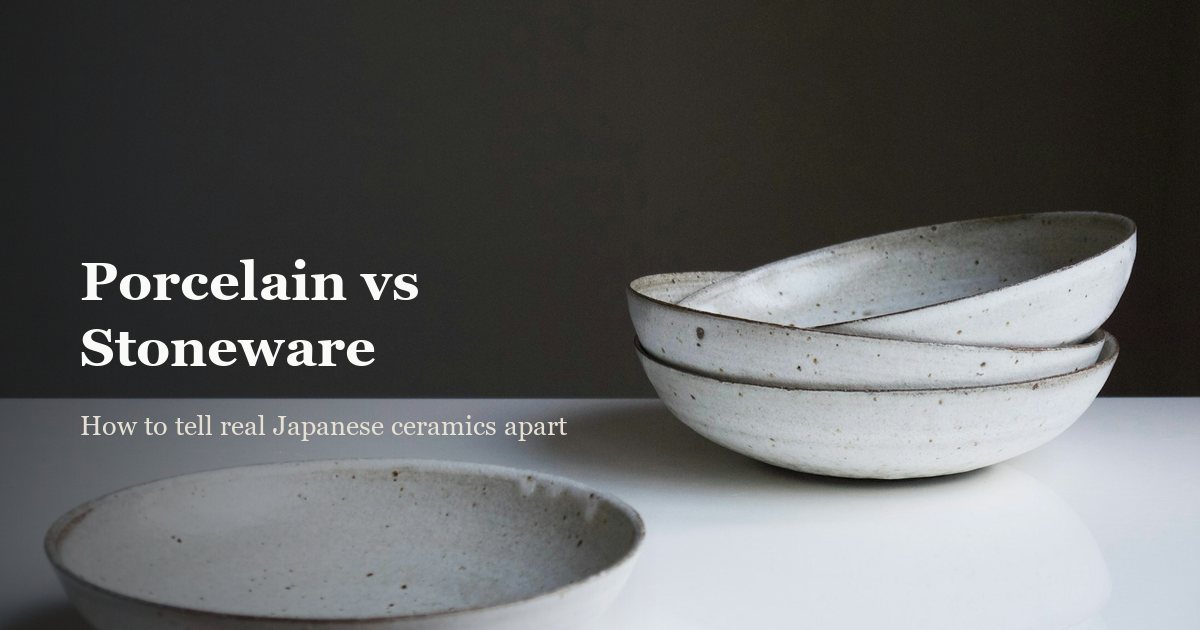
Japanese pottery listings throw around “porcelain,” “stoneware,” and “pottery” fairly loosely, and even specialty retailers occasionally contradict themselves on their own product pages. Neither material is better than the other — they’re suited to different jobs, and several of the regional ware traditions covered elsewhere on this site fall cleanly into one category or the other. This is a guide to telling them apart before you buy, using checks that don’t require a lab.
The Core Difference, in One Paragraph
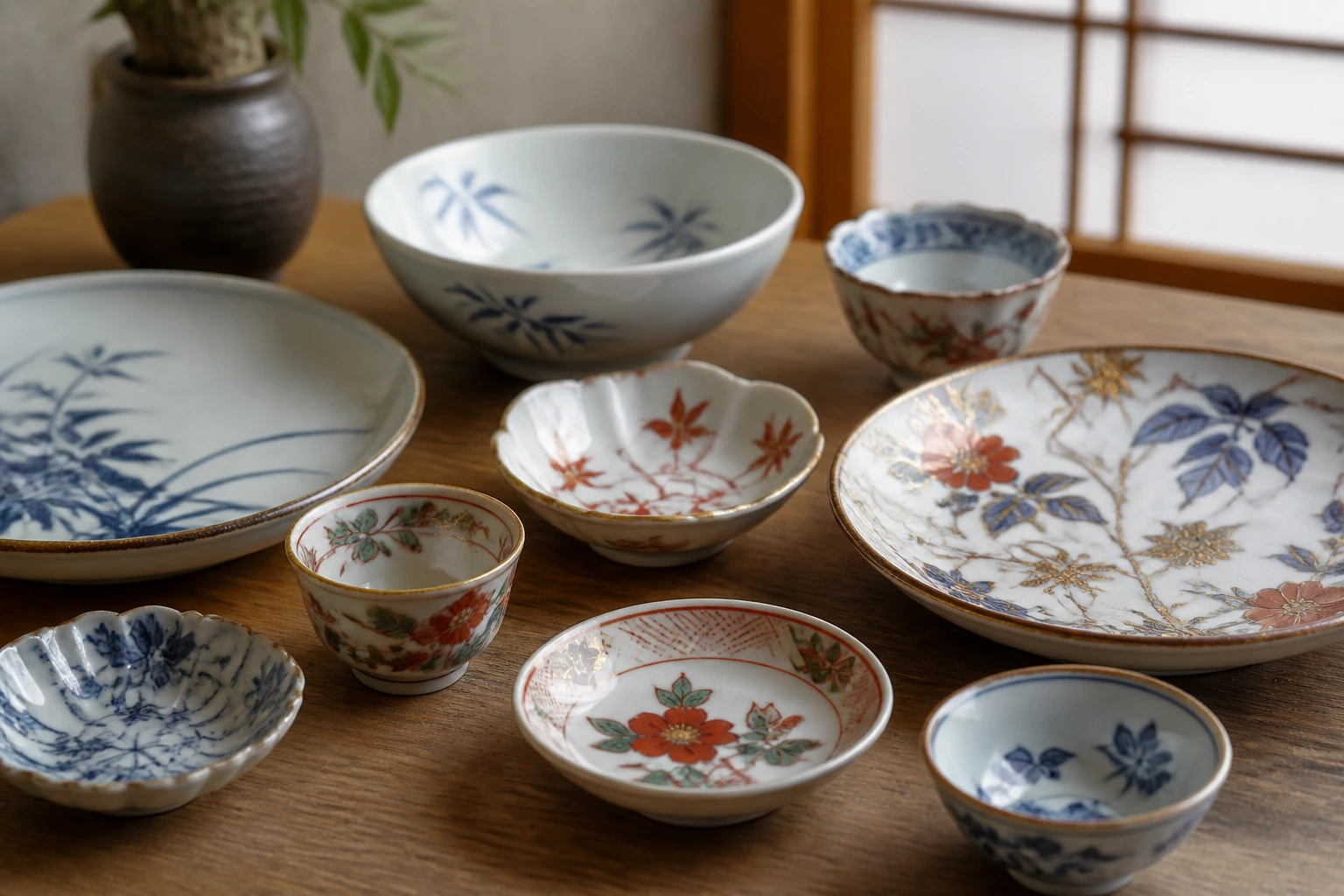
Porcelain is made from a purer, whiter clay body (kaolin-rich, sometimes blended with feldspar and silica in the Japanese “porcelain stone” tradition) and fired at roughly 1,300°C or higher. Stoneware and earthenware use an iron-richer, less refined clay and fire at a lower range, roughly 1,200–1,300°C. That temperature and clay difference is what produces almost every other difference you can see, hear, or feel: porcelain comes out white, dense, thin, and often slightly translucent when held to light; stoneware comes out heavier, opaque, earth-toned, and more porous. Neither is a “better” material — porcelain suits precise, glossy, refined pieces, while stoneware suits the rustic, textured, wabi-sabi aesthetic that a lot of Japanese tea and sake ware is specifically going for.
The specific numbers above (firing temperatures, clay composition) come from Japanese pottery retailers’ own educational content rather than an independent ceramics-science source, so treat them as a well-established retail account rather than a laboratory specification — see the FAQ below for more on that distinction.
Four Checks You Can Do From a Listing or in Person
1. The Light Test
Hold the piece up to a light source, or check a listing’s photos for a backlit shot. Porcelain is thin and dense enough that light passes through it at least faintly at the rim or thin sections — a soft glow rather than a hard shadow. Stoneware and earthenware stay fully opaque no matter how bright the light behind them is, because the clay body is thicker and less vitrified.
2. The Tap Sound
Tap the piece lightly with a fingernail or a utensil. Porcelain rings with a clear, almost bell-like tone, because the clay has vitrified (turned glass-like) at its higher firing temperature. Stoneware gives a duller, shorter thud. This is one of the fastest checks if you’re holding the piece in person, though it’s obviously not something you can do from a product photo.
3. Weight and Rim Thickness
For a similar-sized bowl or cup, porcelain is usually noticeably lighter and thinner-walled, with a finer, smoother rim edge. Stoneware tends to be thicker-walled and heavier for the same size, with a more substantial-feeling rim. This is a comparative check — it’s most useful when you can compare two pieces side by side, less useful as an absolute rule for a single item.
4. Water Absorption (for unglazed or secondhand pieces)
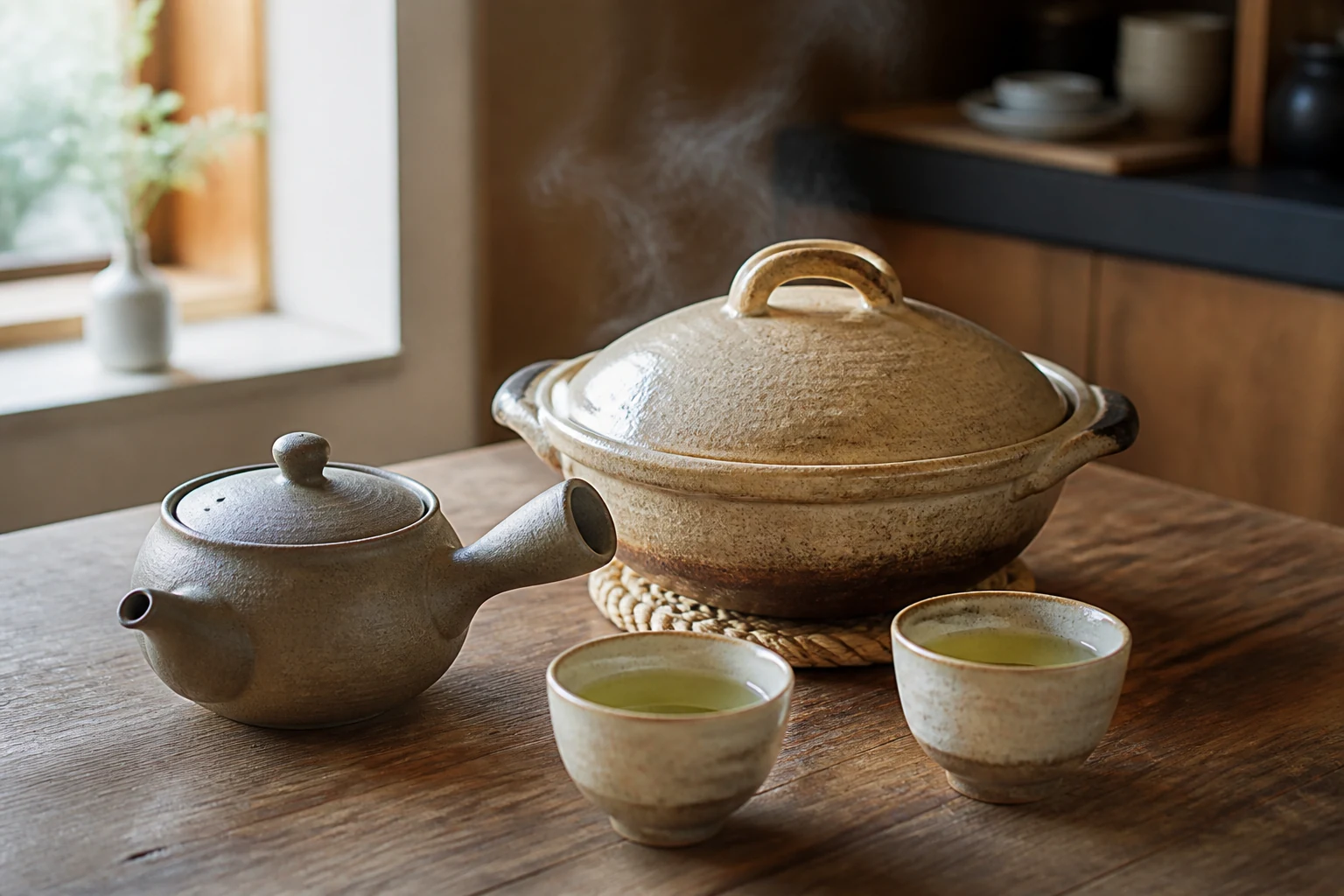
Porcelain’s vitrified body absorbs essentially no water, which is part of why it doesn’t need a glaze to become watertight. Unglazed stoneware and earthenware are genuinely porous — this is a feature, not a defect, in traditions like Bizen ware sake vessels or Tokoname and Banko unglazed teapots, where retailers and enthusiasts credit the porosity with mellowing the flavor of what’s poured into it. If you’re evaluating a secondhand or unglazed piece, an unglazed foot ring or base that darkens or feels slightly damp after contact with liquid is consistent with stoneware or earthenware, not porcelain.
Where This Site’s Existing Picks Fall
Several regional traditions we’ve already covered sort cleanly into one category, which is useful as a reference point:
Porcelain traditions:
- Kutani ware (Ishikawa Prefecture) — see our Kutani ware history and Kutani dinnerware guide
- Arita ware (Saga Prefecture) — Japan’s earliest porcelain tradition, featured in our sake sets guide
- Hasami ware (Nagasaki Prefecture) — covered in our MUJI Hasami ware review
- Mino ware (Gifu Prefecture) — mixed regionally, but the pieces we’ve verified so far, including in our sake sets guide, have been porcelain
Stoneware and unglazed earthenware traditions:
- Bizen ware (Okayama Prefecture) — unglazed stoneware, fired against straw wrapping; see the Hidasuki pick in our sake sets guide
- Tokoname ware and Banko ware (Aichi and Mie Prefectures) — unglazed clay specifically prized for teapots, covered in our kyusu teapot guide
- Iga ware and Banko-yaki donabe — unglazed clay cookware, covered in our donabe pot guide
If a listing names one of these regions specifically, you can generally infer the material category even before checking the spec sheet — though as the next section shows, “generally” is doing some work in that sentence.
Even Specialty Retailers Get This Wrong on Their Own Pages
Here’s the reason this is worth its own guide rather than a single line in our general knockoffs checklist: the contradiction isn’t limited to cheap Amazon listings. Musubi Kiln, a specialty Japanese tableware retailer whose products we’ve featured across multiple guides on this site, has at least two product pages where the copy contradicts itself on this exact point.
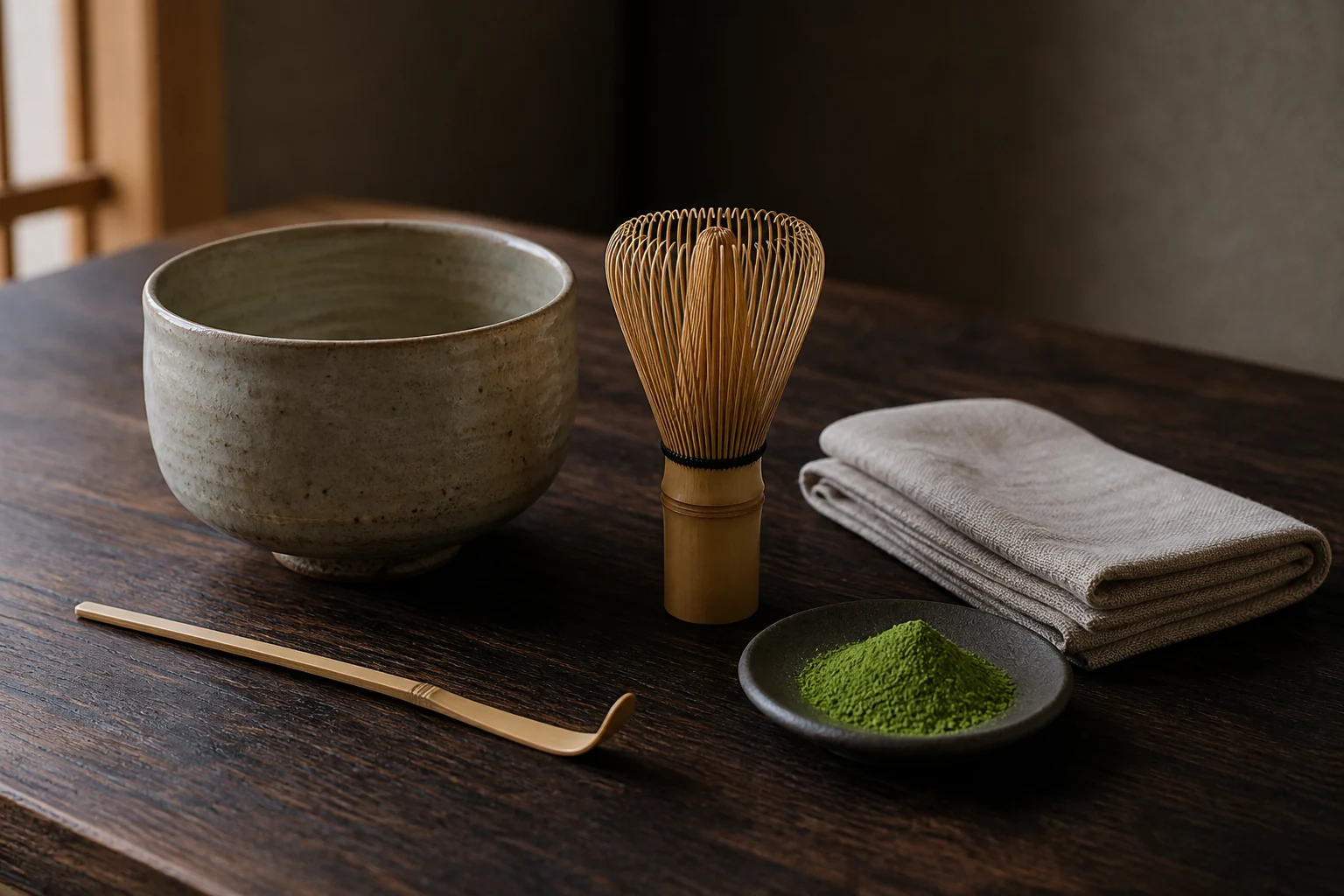
Their “Rabbits in Sunny Spot” matcha bowl, featured in our matcha bowl guide, has a spec sheet that lists both “porcelain” and “stoneware” for the same piece. And while researching this guide, we found a second example: the Bizan Kiln Sakura and Bird Kutani Sake Set (featured in our sake sets guide) is titled and categorized as Kutani ware porcelain throughout the listing, but one line of the product description reads “the smooth texture of stoneware feels relaxing and soft to your mouth” — describing the exact same object.
Neither of these looks like an attempt to mislead. Kutani ware genuinely is porcelain, and it’s a reasonable guess that this is a template or copy-paste error in Musubi Kiln’s product description generator rather than a material substitution. But it’s a useful, concrete reminder that even a retailer we otherwise treat as a credible, specialty source can have a spec sheet that disagrees with itself. When that happens, we default to the named regional ware tradition (which is documented, historical, and checkable independently) over a single adjective in the ad copy, and we say so explicitly rather than picking one silently.
What “Japanese-Style” Listings Tend to Leave Out
The same pattern that shows up across every category on this site applies here too: a listing that shows a rustic, speckled glaze and calls itself “traditional Japanese pottery” or “Japanese-style stoneware,” without naming an actual region (Bizen, Shigaraki, Tokoname, Mino) or a maker, isn’t making a checkable claim about being a specific ware tradition — only about resembling one. That’s not automatically a problem; a lot of genuinely nice stoneware is made outside Japan and sold honestly as “Japanese-style.” It just means the material category (porcelain vs. stoneware) and the origin claim are two separate things, and a listing can be accurate about one while saying nothing at all about the other.
FAQ
Is porcelain “better” than stoneware? No — they’re suited to different purposes. Porcelain is prized for precision, whiteness, and detailed overglaze decoration (like Kutani ware’s gosai palette). Stoneware is prized for texture, rustic character, and, in unglazed forms, functional porosity that some traditions credit with affecting flavor. Price and craftsmanship vary independently of which material a piece uses.
Where do the firing-temperature numbers in this guide come from? From Japanese pottery retailers’ own educational blog content (Tsukushi, Takumi Japan, and similar specialty sellers), which broadly agree on the roughly 1,200°C stoneware / 1,300°C+ porcelain ranges. We’re treating this as a well-established retail account rather than an independently verified ceramics-science figure, since we didn’t find a peer-reviewed or government source stating the exact cutoff.
Can a single piece be part porcelain and part stoneware? Not in the sense of one clay body being both — a fired ceramic piece is one material throughout. What can happen, as this guide covers, is a retailer’s own listing using both words inconsistently for the same single-material piece, which is a copywriting error rather than a real hybrid material.
Does the tap-sound test work through a listing’s video, or only in person? Only in person, realistically — a video’s audio compression and your speaker or headphones will color the sound too much to trust it. Treat the light test and weight/rim checks as the ones you can meaningfully apply to a listing’s photos, and save the tap test for when the piece is actually in your hands.
If Bizen ware is unglazed stoneware, is it dishwasher-safe? Generally no — the same porosity that’s prized for affecting flavor also means detergent and high heat aren’t a good match for it. Hand wash and dry thoroughly, similar to the unglazed-teapot care guidance in our kyusu guide.
Final Thoughts
The four checks above (light, tap sound, weight, water absorption) work whether you’re standing in front of a shelf or scrolling a listing’s photos, and none of them require special equipment. But the more important habit is the one this guide keeps coming back to: read the specific regional ware name, not just the material adjective, and don’t assume a retailer’s own copy is internally consistent — even a specialty seller can contradict itself on the very same product page. For the broader six-point framework this site uses across knives, lacquerware, and teapots as well as ceramics, see our buyer’s checklist for real vs. knockoff Japanese craft.